This meme showed up on my Facebook news feed and I really like it! So I thought I’d share the prayer with readers.
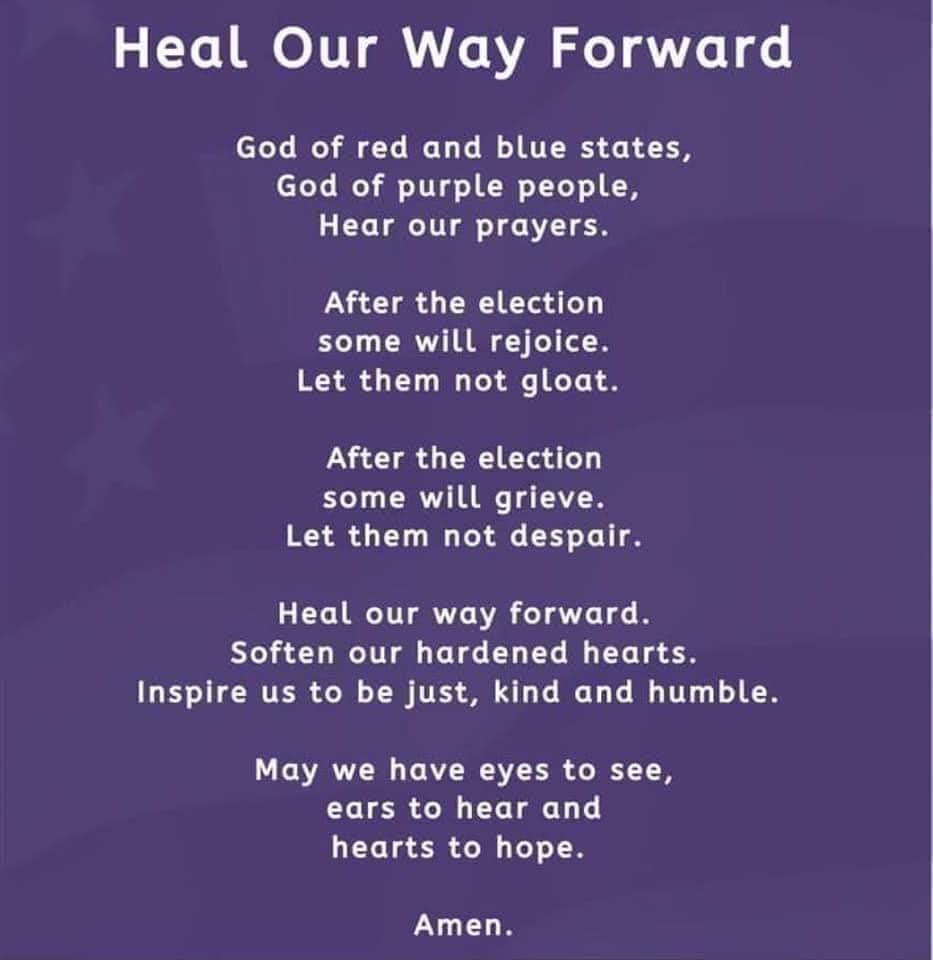

This meme showed up on my Facebook news feed and I really like it! So I thought I’d share the prayer with readers.
In a year of losses, I’m now facing another one. My spiritual director for the past three years died this month following a valiant fight with multiple sclerosis and cancer.
Prior to beginning my journey with Sister M, I had found myself at a spiritual crossroads. My husband and I attended church almost weekly, and I had read the Bible from cover to cover, along with shelves full of books on religion and spirituality. Yet I still found myself asking the “big” or “ultimate” questions. What do I actually believe about God and why? What is God’s purpose for my life? What are my values, or what should they be? How do I live my life in a way that is consistent with my beliefs and values?
Several factors had led to this renewed questioning. The transition in focus and priorities prompted by my retirement. The “time is limited” epiphany that comes with being 60-something, losing loved ones and developing chronic health problems myself. Questions about faith and a church’s true purpose raised by reading the Bible and serving on my congregation’s evangelism committee. The internal tug-of-war over my own values brought on by the increasing divisiveness and polarization in our society.
I made a commitment: Develop a better understanding of God, so I can fulfill God’s purpose for my life, discern what my values should be, and live accordingly. Toward this end, I engaged Sister M to help me sort through my bushel basket full of questions. It’s important for me to point out here that seeing Sister M did not replace going to church. Spiritual direction is a one-on-one partnership in which one Christian helps another grow in a personal relationship with God. It’s a supplement to — rather than a substitute for — church.
Sister M and I met monthly for one-hour sessions. She offered a variety of suggestions for homework assignments, allowing me to choose which ones I might find most helpful. Sometimes she would have me write my thoughts about a topic. Other times she might have me create an image, or take my camera and go for a walk, or read a book.
I had already developed a morning meditation ritual — sitting in my recliner in front of the fireplace with a cat in my lap and a cup of coffee by my side while I journaled about my priorities for the coming day. I began using this time to write out my thoughts and insights generated by the homework assignments.
I must admit the idea of working with a spiritual director made me a bit nervous at first. While I hoped this person would ask the hard questions, I didn’t want someone who would merely push me to adopt their own belief system. I needed this person to be nonjudgmental and open to the idea that I was questioning all kinds of dogma, from the spiritual and religious to the political and ideological.
Sister M, thankfully, was patient as I grappled with questions some would say I shouldn’t even be asking. Her demeanor was very pleasant, and we immediately discovered one thing in common — we both grew up on farms.
One of her first assignments: Come up with an image that best symbolizes my present spiritual condition. I created a Photoshop image of myself buried under a mountain of clutter. A pair of arms juggled several balls in the air — family, friends, volunteer work, the house. More balls had been dropped and were nestled on the ground at the bottom of the heap — my writing, self-care, God.

I listed those areas of my life that felt not-so-well-ordered. My relationships. A messy house. My frantic, overloaded schedule. Health issues. My writing, which seemed to languish. My emotional life, which often left me feeling like a walking bundle of anxieties. The suspicion I entertained from time to time that my life had been reduced to crossing items off endless to-do lists. My spiritual life, with all those questions and doubts.
Sister M listened to my litany without negative judgment — at least none that I could detect. I half expected her to supply some relevant Bible verses about the Godliness of cleanliness and self-discipline. Instead, she suggested I spend an hour each day tackling the clutter — just one hour — and leave the rest for the next day. Baby steps.
One of the first questions Sister M asked me was, “Have you ever questioned the existence of God?” She didn’t flinch when I said, “Oh yeah. More than once.” For most of my life, I had leaned toward the idea that there probably is a God. Yet, nagging doubts continued to creep in from time to time. I didn’t voice them to anyone, though. If the Christians around me ever doubted God’s existence, they certainly weren’t letting on.
As I began taming my schedule and tackling the endless clutter — one hour and one day at a time — a flash of insight occurred to me. A little epiphany, one might say. Could the question of God’s existence be what I was distracting myself from with all the to-do lists, the frantic scheduling, the endless cleaning and the mindless Internet surfing that cluttered my life and unquieted my mind? My spiritual director agreed that I might be on to something.
I confessed that what I really wanted was the “blinding light” experience the Apostle Paul had on the road to Damascus, or the burning bush Moses encountered. I wanted to be like those people who saw the blinding light or the burning bush, just knew what they knew about God, and had their mission in life spelled out for them.
She recommended I use part of my morning meditation time to be completely quiet. “Listen for God’s voice,” she said. Well, the blinding light hasn’t happened for me — at least not yet. But what has happened is nearly as amazing.
I walked outside. Dismissing the existence of a God is tempting when so many people who claim to speak in God’s name spew hatred for their fellow and sister human beings while committing assorted hypocrisies and evil deeds. Denying God’s existence gets even easier when watching one terrible event after another unfold on the news. But I’ve found it’s almost impossible to deny the existence of a Creator when I’m outdoors with evidence of God all around me.
Sister M helped me explore various kinds of “spiritual clutter” that was crowding attention to God out of my life — and I eliminated a major distractor by walking away from an incredibly abusive volunteer work situation. As much as leaving the organization saddened me, I immediately felt so much “lighter” — like I put down the 100-pound bag of stress I had carried around for five years.
When my spiritual director asked me point-blank if I ever doubted the existence of God, her question gave me permission to “go there.” For the next leg of my spiritual journey, I wanted to keep being honest about the questions I had. And I had LOTS of them.
Who, or what, exactly, is this Entity I choose to call God? What is my authority for what I believe? The Bible? Church tradition? Why go to church, when by my own admission, I feel the presence of God most while immersed in nature? What is prayer and how should we pray? Can writing, singing and gardening be forms of prayer? Is it okay to ask God for things? What does salvation mean, actually? How do I relate the 10 Commandments to 21st Century issues? In a world where many “sins” have been reframed as “diseases” or “dysfunctional behavior,” is sin still a legitimate concept? How would liberal Christians define sin versus how conservative Christians define it? Considering that no creed exists anywhere in the Bible and a number of Christian churches don’t have one, do we need a creed? If so, what should be in it? Is there a common core of beliefs shared by most Christians, regardless of sect or denomination? Do all of these denominations offer equally legitimate paths to God? Is there a way to heal the divisions between believers and relate respectfully to people whose viewpoints differ from ours?
That was just for starters. When I shared this list of questions with Sister M, as usual, there were no lectures. She just smiled and asked, “Where do you want to start?”
We explored a variety of prayer techniques. Among them: morning meditation, nature prayer, prayers of petition and intercession, prayers of thanksgiving, writing and journaling as a form of prayer, and practicing better mindfulness in church. While I had used some of these prayer techniques off and on for years, I committed to doing them on a more regular, disciplined basis.
When it came to my dreams, one goal on my bucket list remained elusive. From age 10 onward, I’d dreamed of writing a book. More than 50 years later, that goal was … still on my bucket list. So, with encouragement from Sister M, I decided it was time. My book — with the working title We Need to Talk — will examine the polarization ripping apart our society and share my personal search for an appropriate Christian response.
My spiritual progress may seem agonizingly slow to some who are reading this. But for me, finding a way to effectively address my occasional doubts about God’s existence was HUGE. Summoning the self-respect and courage to walk away from an abusive situation was an enormous step in the right direction. My creativity has soared. I’ve now written several book excerpts, I recently posted my 100th blog entry, and I’ve discovered a new hobby – nature photography. And while I haven’t yet tamed all the clutter in my house, I’ve gotten much more comfortable with incremental progress. Baby steps, as Sister M would say.
The graphic I produced for her at the beginning of our work together would now look more like this.

As they say around the tables at 12-Step meetings, we aim for spiritual progress rather than spiritual perfection. One thing I do know for sure: I’m grateful God gave me the opportunity to make a portion of this journey with Sister M.
Rest in peace, dear sister in Christ. In your honor, I’m going to keep asking those pesky questions.
Does anyone have a recipe for this using cauliflower?


One of my absolute favorite comfort foods is peanut butter. So, a real treat for me was the Chocolate Peanut Butter Cup pie at Baker’s Square Restaurant and Bakery, a local Midwestern chain restaurant known for its amazing pies. (Alas, the restaurant has sadly closed.)
The dessert, of course, was meant to resemble an actual Reese’s peanut butter cup (my all-time favorite candy), with its chocolate graham cracker crust, peanut butter cheesecake filling and chocolate ganache topping liberally sprinkled with chopped peanut butter cups. Ah-h-h-h!
The bad news: Each slice contained a whopping 830 calories. Even more scary was the delectable dessert’s heavy fat and sugar content – 56 grams of fat and 63 grams of sugar. The online recipes that came closest to duplicating the restaurant version – with their heavy cream and astronomical sugar content – flunked the nutritional test nearly as badly.
The good news: With just a few ingredient tweaks, I’ve been able to improve the dessert’s nutritional content considerably. So, I get to have my pie and eat it too, so to speak. Better yet, this no-bake recipe is fairly simple to make. The pie also freezes well for up to three months, so it can be enjoyed a slice at a time over a period of several weeks.
Replacing regular cream cheese with the fat-free variety cuts nearly 12 grams of fat and 140 calories from each serving. I further reduce the calories, fat and sugar content by using sugar-free Cool Whip, sugar-free vanilla pudding made with fat-free milk, sugar-free chocolate frosting and even sugar-free peanut butter cups.
Bottom line: Sorry, this still is not a totally low-calorie treat – but I’ve managed to cut out about half the calories, half the fat and nearly all of the sugar. And I swear there is NO sacrifice in taste. Plus, this version actually has some nutritional value – about the same protein content as a 3-ounce hamburger patty, in fact.
Of course, one way to further cut the calorie content as well as fat and sugar consumption is to control portion size. Cutting the pie into 12 servings rather than the standard 8 still allows for a somewhat generous slice (in fact, a slightly bigger slice than I got when splitting the restaurant dessert with a friend, which I sometimes did). Below, I’ve provided nutrition information for a smaller slice (12 servings per pie) and a larger slice (8 servings per pie).
Note: I’ve included brand names for some of the ingredients I use because of the marked differences in taste and quality between the various fat-free and sugar-free products. These are the brands that have worked best for me in terms of flavor, and which don’t just replace fat content by increasing sugar content. I always have to watch for this when using reduced-fat products.
Ingredients
Directions
Prepare pudding according to package instructions but using only one cup of milk. Add whipped topping and stir until blended.
Add cream cheese and peanut butter. Blend thoroughly in a food processor or blend using a food processor stick. (You may wish to add the cream cheese a small chunk at a time or soften it in the microwave oven about 30 seconds to one minute to make the blending process easier.)
Spoon mixture evenly into pie crust and refrigerate at least four hours until pie filling is firm. Or place in the freezer for about a half hour.
Soften frosting by placing in the microwave oven for up to 30 seconds and then stirring. Spread the frosting evenly over the cheesecake.
Chop the peanut butter cups and sprinkle over the top.
Nutrition information
Servings: 12 | Calories: 335 | Carbohydrates: 44 g | Protein: 8 g | Fat: 20 g | Saturated fat: 2 g | Cholesterol: 4 mg | Sodium: 400 mg | Potassium: 143 mg | Fiber: 4 g | Sugar: 7 g | Vitamin A: 1% | Vitamin C: 0% | Calcium: 2% | Iron: .5%
Servings: 8 | Calories: 502 | Carbohydrates: 66 g | Protein: 12 g | Fat: 30 g | Saturated fat: 4 g | Cholesterol: 6 mg | Sodium: 600 mg | Potassium: 215 mg | Fiber: 6 g | Sugar: 11 g | Vitamin A: 2% | Vitamin C: 0% | Calcium: 3% | Iron: 1%
One of my priorities — which I reaffirm every New Year’s Day … and the beginning of every Lenten season … and every birthday — is to start adhering to a healthy eating plan.
Alas, since I prefer chocolate-covered peanut butter cookie bars to celery, it is even more challenging for me to adhere to a healthy eating plan than it was for me to quit smoking nearly 20 years ago.
So I appreciate the abundance of memes that express empathy for my struggle.
I’ve pretty much stopped drinking soda, but I have to admit, I did this for years.

This is my story and I’m sticking to it.
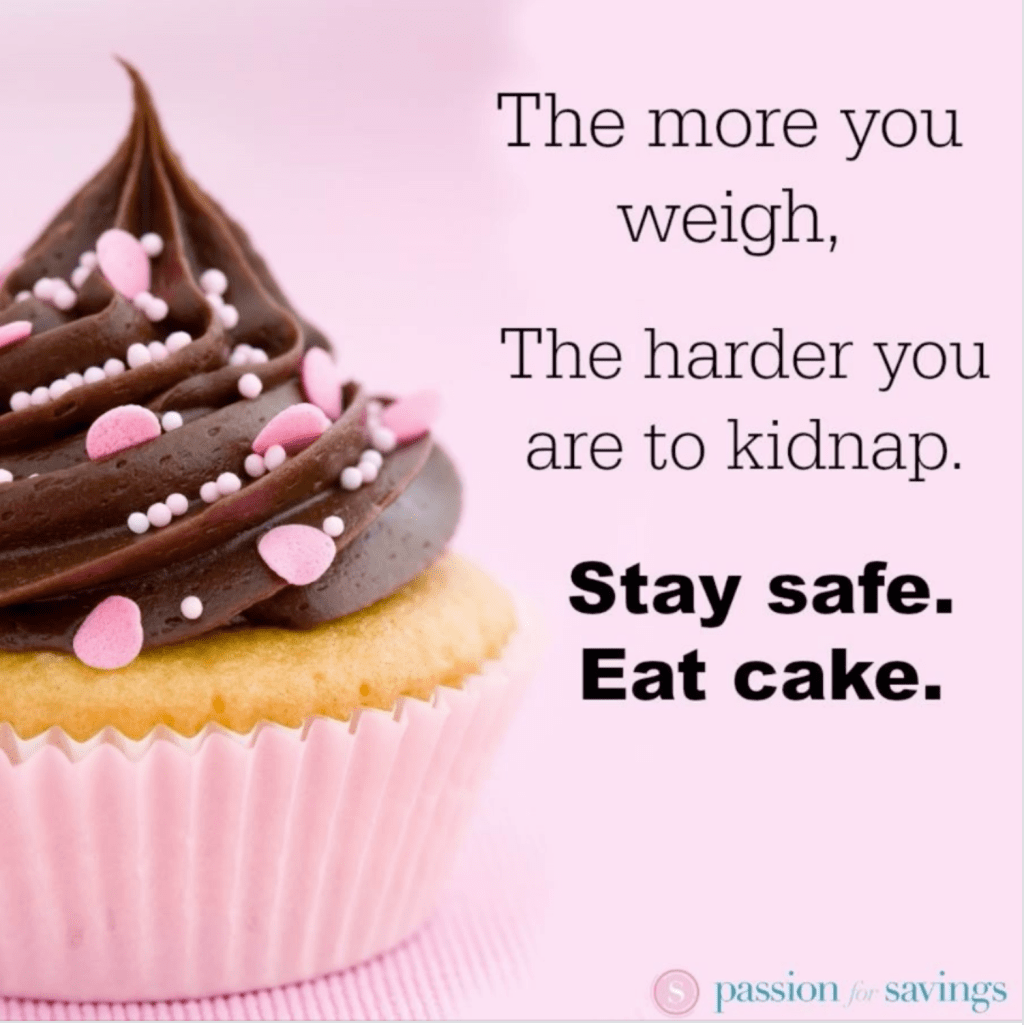
Story of my life.

Note to my sweetie: Don’t even think about it.

Works for me.

They’re right … I’ve never seen this.

What if they figure out a way to make the fries out of cauliflower?
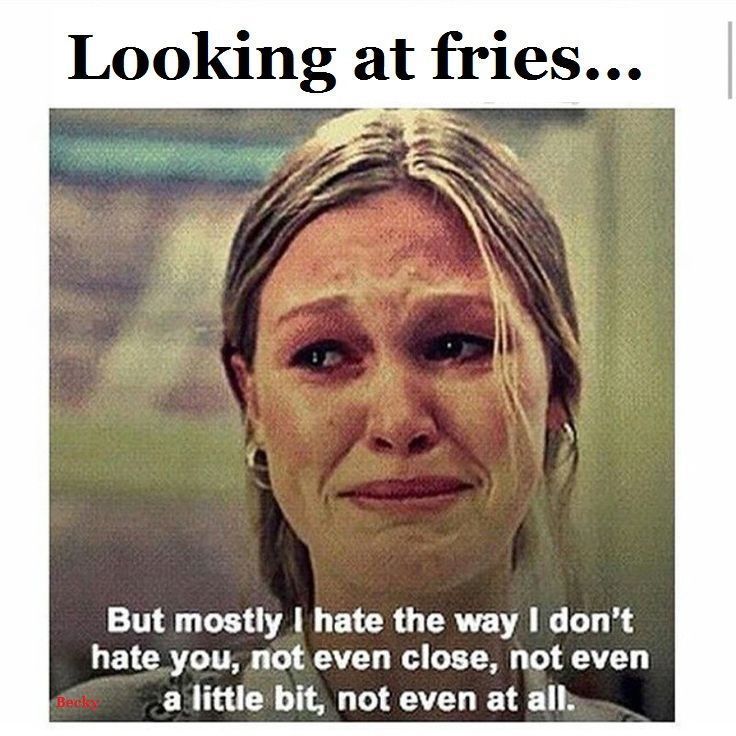
So chocolate is good for you and lettuce will kill you? I’ve been waiting for this moment all my life!
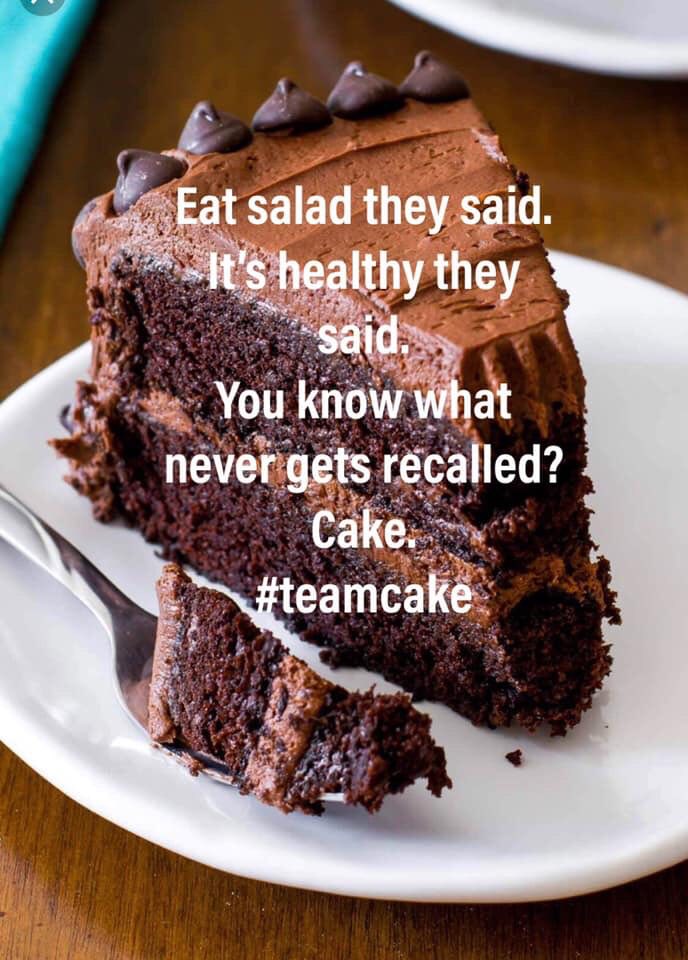
Believe me, I’m tempted. All. The. Time.

If anyone figures out how to do this, they’ll be rich enough to retire within a week.

Note: This is an excerpt from We Need to Talk, my book in progress, which examines the polarization ripping apart our society and shares my personal search for an appropriate Christian response. For an overview of the book and to read my previous excerpts, link HERE.
Implore people to stop the name-calling, gratuitous insults, demonizing of opponents and overall nastiness dividing our society, and culture warriors of all stripes rush to silence us.
“This political correctness is getting out of hand,” conservatives complain.
“Enough with the tone policing,” progressives lecture.
“Censorship!” everyone cries.
I understand political correctness, tone policing and censorship exist. But both progressives and conservatives have hopelessly twisted these concepts.
Left-of-center activists first used the term politically correct to satirize their own tendency to adopt uniform opinions and causes, thus poking gentle fun at a rigid insistence on ideological purity. Alas, in recent years, some conservatives have hijacked this term and hurl it indiscriminately at anyone who dares to suggest that common decency and respect for others are still virtues worth cultivating.
I’ve been told I overdosed on political correctness when I forgot to laugh at a patently offensive joke or sought to debunk a stereotype. The accusations go something like this:
Excu-u-u-u-se me if someone thought that joke was racist. I guess nobody could accuse me of being politically correct.
Well excu-u-u-u-se me, but racism isn’t politically incorrect. It’s immoral.
Or this:
We can’t open our mouths anymore without some member of the politically correct thought police yelling, “Racist! Sexist! Homophobic!” People are so oversensitive these days.
Hmmm. If it walks like a duck and quacks like a duck, guess what it is? I’m not saying oversensitive people don’t exist. However, most people I know would prefer that ethnic slurs not become socially acceptable.
Progressives can be equally guilty of hijacking a legitimate concept and distorting its original meaning.
Wikipedia defines tone policing as an attempt to detract from the validity of a statement by attacking the way it’s presented rather than the message itself. One example is to tell people they’re being “divisive” for merely raising an issue that others may be reluctant to talk about, such as discrimination in the workplace.
But lately, the term gets thrown at us like a hand grenade by some progressives who feel oppressed if we fail to listen while they call us names or scream profanities at us. A Facebook post circulating among several progressive groups illustrates this trend:
Hearing ‘I hate men’ shouldn’t make men stop being feminist. Hearing ‘f*** white people’ shouldn’t make white people stop opposing racism. Your opposition to oppression should be moral and immovable. Your belief that all humans should be treated with equal respect shouldn’t be conditional based on whether or not individual people are nice to you.
Okay, let’s unpack this. I wholeheartedly agree that we should treat all human beings with equal respect, whether or not every single individual in a particular group acts like a nice person. And I’m not going to stop opposing racism because one person of color says something hateful about white people. But if someone drops the F bomb on me, I reserve the right tell them I find this behavior abusive, regardless of their race/gender or mine.
Here’s another example, making the rounds on Facebook:
If you use that “background color” shit, STOP! It blocks EVERYONE who relies on screen readers and/or text-to-speech programs from accessing your posts! These programs, for some reason, CANNOT read the text in those backgrounds and thus your blind/low-vision friends CANNOT find out what you have to say! This is an official “yelling at your friends to not be assholes” post.
Whoa! If someone out there really does lie awake nights thinking up ways to exclude and oppress blind people, I seriously don’t want to know them. But I’m pretty sure most people who use the background color feature on Facebook don’t even know this poses a problem, and there are far less abrasive ways to spread the news.
Regarding censorship, some people – conservatives and progressives alike – simply do not tolerate disagreement well, even honest disagreement, and will consider any expression of opposing views to be a violation of their free-speech rights. I’ve heard variations of the following more times than I can count:
It’s my First Amendment right to state my honest opinion of [Dumbocrats, Rethuglicans, fill in the blank]. My freedom of speech trumps your hurt feelings.
These people seem to forget the same First Amendment protects our own right to say, “I don’t agree with you” or “I find that joke offensive.” While the U.S. Constitution does indeed guarantee one’s right to say pretty much whatever one pleases, it doesn’t force the rest of us to listen. And dissent in and of itself does not constitute censorship.
Calling a woman a fat broad is not “politically incorrect.” It is just plain rude. Refusing to listen while someone calls us names or engages in other abusive behavior toward us is not “tone-policing.” It is setting a healthy boundary. Deleting rants full of ad hominem attacks from the comments section after our Facebook or blog posts is not censorship. It is exercising our right to set standards for our own publications or social media accounts.
To anyone who thinks their passionate beliefs entitle them to spew hostility, here’s the deal: If you want me to listen to you, please remove your middle finger from under my nose. Then state your concern minus the name-calling, insults and profanity. My attention span will improve dramatically.
Questions for readers: How has our society’s polarization impacted you personally? (If you live outside the U.S., is there similar polarization going on your country?) How do we become part of the solution rather than part of the problem? I’d love to hear your responses to these questions, as well as your comments on this article. Just hit “Leave a Reply” below. When responding, please keep in mind the guidelines I’ve outlined on my Rules of Engagement page (link HERE).
Can photography be a form of prayer? Howard Zehr, author of The Little Book of Contemplative Photography, thinks so.
Photography can serve as a medium for reflection and meditation, and encourages mindfulness, he says. “By slowing down to reflect and meditate, by heightening our visual awareness and our imaginations, by cultivating receptivity and a more holistic way of knowing, we can renew ourselves while gaining new insights into ourselves, the creation, and the Creator.”
Some photographic subjects present themselves in an obvious way. An amazing sunrise practically screams, “Quick! Grab your camera.”

As do the brilliant fall colors in this park scene.

However, mindfulness is also about “being aware of and appreciating the ordinary, of being open to beauty and insights in the commonplace,” Zehr says.
For example, who knew that chives going to seed could be so pretty?

“We often overlook things that we experience as ordinary or everyday,” Zehr says. “We tend to make preconceived judgments about what is worth looking at or photographing, valuing the ‘picturesque’ or ‘spectacular’ and failing to recognize many of the visual possibilities around us.”
How about a coneflower blossom?

Throughout his little book, Zehr gives us exercises designed to increase our awareness of the visual richness of ordinary objects and scenes. One exercise: Set out to photograph without a specific subject in mind, remaining open to whatever seems to present itself.
Like a leaf that has floated to the ground.

A pair of acorns.

Or a single perfect rose.

“To me, photography is an art of observation. It’s about finding something interesting in an ordinary place,” Zehr says. “I’ve found it has little to do with the things you see and everything to do with the way you see them.”
Like bright red berries against a deep blue sky.

Or a starkly bare tree with a cloudy sky shortly before sunset serving as a backdrop.

“Ordinary things, when really seen, make extraordinary photos,” Zehr says. “Such photos seem to make themselves. They seem like presents that were given.”
I snapped this photo of icicles dripping from a twig on a bush next to my porch.

These fall leaves still flashed their brilliant colors as they peeked out from under a very early snowfall.

“One must always take photographs with the greatest respect for the subject and for oneself,” Zehr says.
Of course, one can’t help but respect this goose walking straight toward me in the park, who just begged to be noticed … and photographed.

“A contemplative approach to photography is an expression of wonder grounded in respect and humility,” he says. “As such, it calls us to live in right relationship with our Creator, the creation, and our fellow human beings.”
An attitude of wonder “requires that we look anew at the familiar, that we stop taking the world around us for granted,” he adds. “An attitude of wonder is essential if we are truly to experience the creation and the Creator.”

Pozole is a traditional Mexican soup made with hominy, meat (usually pork or chicken) and lots of delicious seasonings.
As anyone who regularly follows my blog knows, I’m always looking for ways to sneak more wholesome stuff like vegetables and fiber into my diet while ditching the bad stuff like added salt and sugar.
So I’ve created a variation on this favorite that reduces both calories and carbs, features extra veggies and eliminates added salt without sacrificing a bit of the flavor. It’s also gluten-free (be sure to check the label on the hominy). If you omit the chicken and substitute low-sodium vegetable broth for the chicken broth, it can even be made vegetarian.
This recipe makes about 10-12 cups of soup and is perfect for batch cooking. The soup can be frozen for up to three months.
Ingredients
Directions
Stir together the oregano, cumin, basil and black pepper in a small bowl.
Add the chicken, blended spices, lime juice, bay leaves, garlic and cloves to the broth and bring to a boil. Reduce heat and allow to simmer.
While the soup is simmering, chop/slice the squash, celery, carrots, onion and pepper and add to the mixture.
Add 4-5 cups of water, or until the soup is of desired thickness.
Continue to simmer for about a half hour, or until vegetables reach desired softness (slightly al dente) and chicken is completely cooked.
Add the hominy when the vegetables are nearly cooked through.
Nutrition information
Serving size: 1 cup | Calories: 75 | Carbohydrates: 8 g | Protein: 9 g | Fat: 1 g | Saturated Fat: 0 g | Cholesterol: 25 mg | Sodium: 130 mg | Potassium: 372 mg | Fiber: 2 g | Sugar: 3 g | Vitamin A: 85% | Vitamin C: 30% | Calcium: 2% | Iron: 3%
Note: This is an excerpt from We Need to Talk, my book in progress, which examines the polarization ripping apart our society and shares my personal search for an appropriate Christian response. For an overview of the book and to read my previous excerpts, link HERE.
As I’ve studied the polarization problem and its negative impact on both ourselves and our society, I’ve begun asking myself these questions:
I’ve decided one of the first small steps I can personally take is to examine my relationship with social media. As I’ve begun doing so, I’ve come to an inescapable conclusion: I need to pay much more conscientious attention to what I post, share and “like” on sites like Facebook and Twitter.
If there’s one thing many conservatives and progressives agree on, it’s that social media have played a huge role in keeping the culture wars going. In a recent survey by the Pew Research Center (link HERE), 55 percent of adult social media users said they felt “worn out” by how many combative political posts and discussions they see on these platforms.
Seven in 10 respondents also said they found it “stressful and frustrating” to communicate on social media with people they disagree with about politics. The sense of exhaustion and frustration held true across political parties, according to the report.
Several culprits contribute to social media’s role in dividing us. Algorithms that create “echo chamber” bubbles of one-sided information and opinions. Viral spread of false or misleading information in “fake news” stories with click-bait headlines. Political “discussions” that amount to little more than judgmental blaming and shaming, name-calling, insults, character assassination and demonization of opponents. Endless memes promoting hateful and inflammatory messages.
The worst part? I have to admit I’ve been part of the problem from time to time. Too often in recent years, I’ve found myself getting sucked into social media fights – even with people I ordinarily like – over politics and contentious “hot-button” ideological issues.
Whenever a Facebook skirmish erupts – whether the trigger is a Supreme Court decision, a political candidate’s suitability for office, or a crisis playing out on the news – my first instinct is to try and stay out of the fray.
Alas, I tend to have strong opinions about a lot of issues (imagine that!) and sooner or later, someone will post a meme that I just can’t seem to resist sharing against my better judgment. Okay, I know it’s a bit snarky. Maybe a bit judgmental or even mean. But it’s SO clever. Then, of course, someone on “the other side” will beg to differ with my assessment of the meme’s cleverness, and before I know it, I’m bogged down in another argument.
One evening, I realized I had just spent the better part of a whole day arguing with total strangers on a Christian Facebook page over this question: “Is it racist to make jokes about lutefisk, lefse and jello at Lutheran potlucks?” (No, I’m afraid I’m not making this up.) I further realized it wasn’t the first time something like this had happened.
So what can I start doing differently?
I’m not ready to go “off the grid” when it comes to social media. With family and friends scattered over two continents, I would not be able to stay connected so well without Facebook. This has been especially true during the current pandemic.
However, I can take some constructive steps to avoid getting lured into flame wars and to be part of the solution rather than part of the problem when it comes to divisive social media behavior.
Finally, I can use Facebook for its original purpose – to help me keep up with family and friends. How are all my nieces and nephews and dozens of cousins doing? Who’s getting married? Who just had a baby? Which friend got a promotion at work or went on a fabulous vacation? Who just went to the emergency room and needs prayers?
Or I can share cute photos of my adorable pets. I’m happy to report I have never had anyone threaten to block or “snooze” me because I posted too many photos of these little guys.

Fortunately, my Facebook friends love Olaf DaVinci and Champaign Le Chat as much as my camera and I do.
Questions for readers: How has our society’s polarization impacted you personally? (If you live outside the U.S., is there similar polarization going on your country?) How do we become part of the solution rather than part of the problem? I’d love to hear your responses to these questions, as well as your comments on this article. Just hit “Leave a Reply” below. When responding, please keep in mind the guidelines I’ve outlined on my Rules of Engagement page (link HERE).
When I review my priorities each year on my birthday, one lofty goal remains the same: Maintain our home as a sanctuary for ourselves, our family and our friends.
On each birthday, I promise this will be the year I finally sort through all the accumulated STUFF in our house, recycle or give away anything we don’t need, and find a place for whatever we decide to keep. And get some more pictures up on the walls.
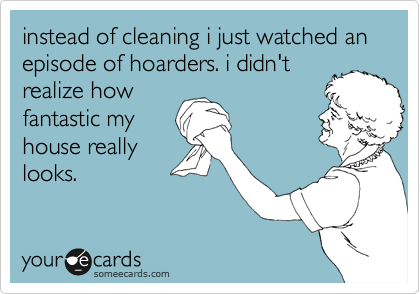
Alas! The goal of a spotlessly clean house with a place for everything and everything in its place, even in the garage and basement, continues to elude me. So I especially love the abundance of housekeeping memes that remind me I’m not alone in my never-ending struggle.
I mean, this seems like a perfectly reasonable question:
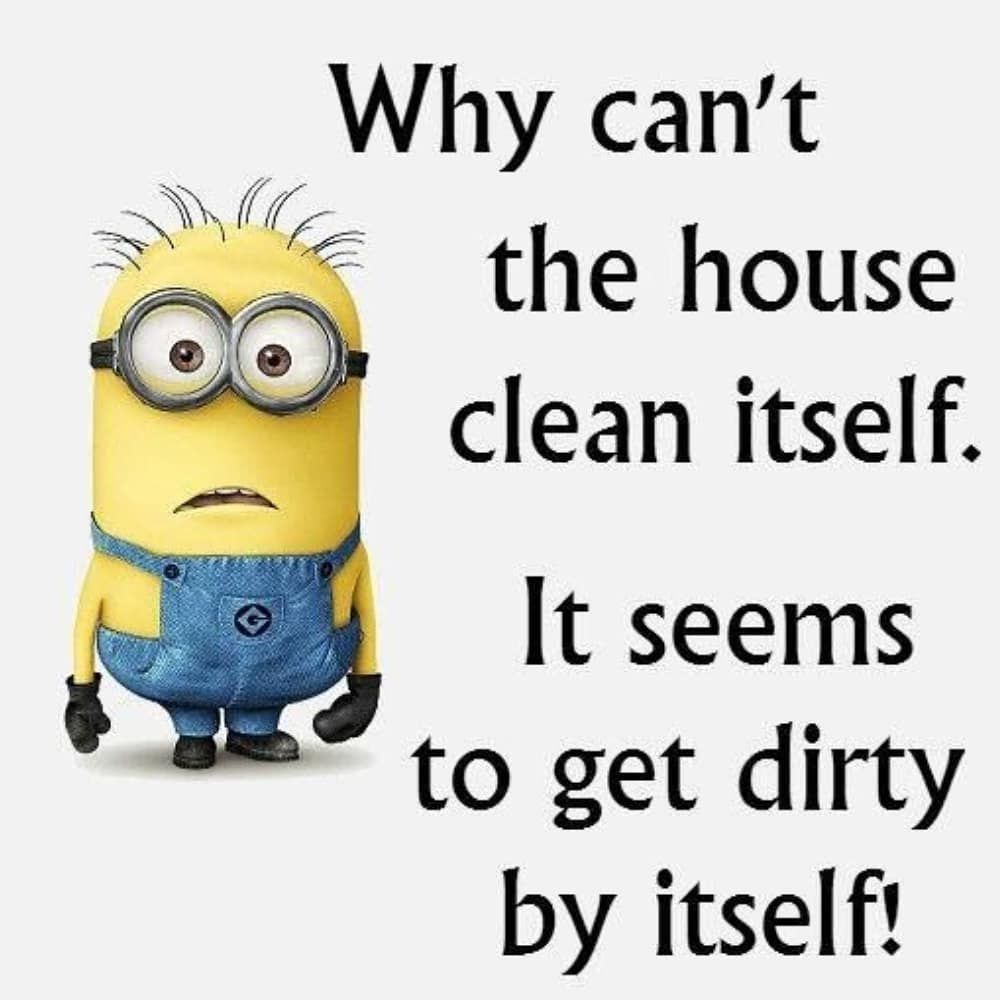
This is my story and I’m sticking to it.
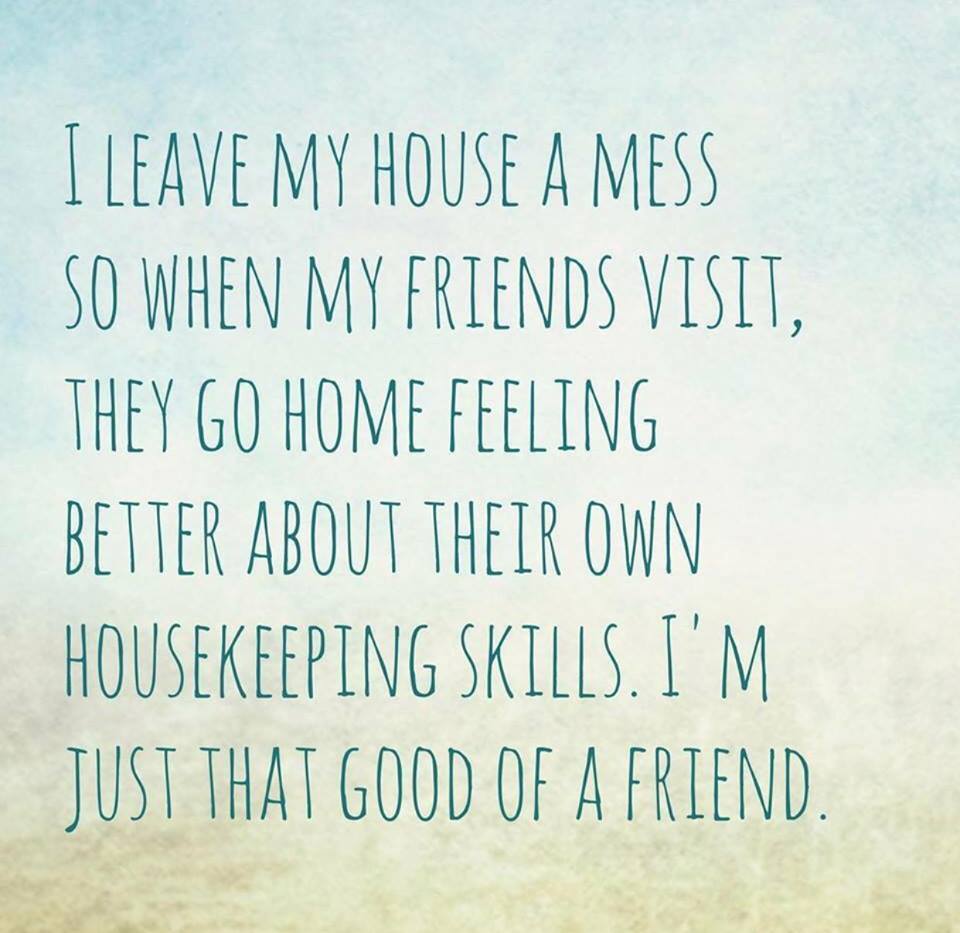
Love our cleaning ladies! Can’t wait to get them back once this crazy pandemic is over.

Ah yes! I’ll plead guilty and Pete likes to tease me about it.
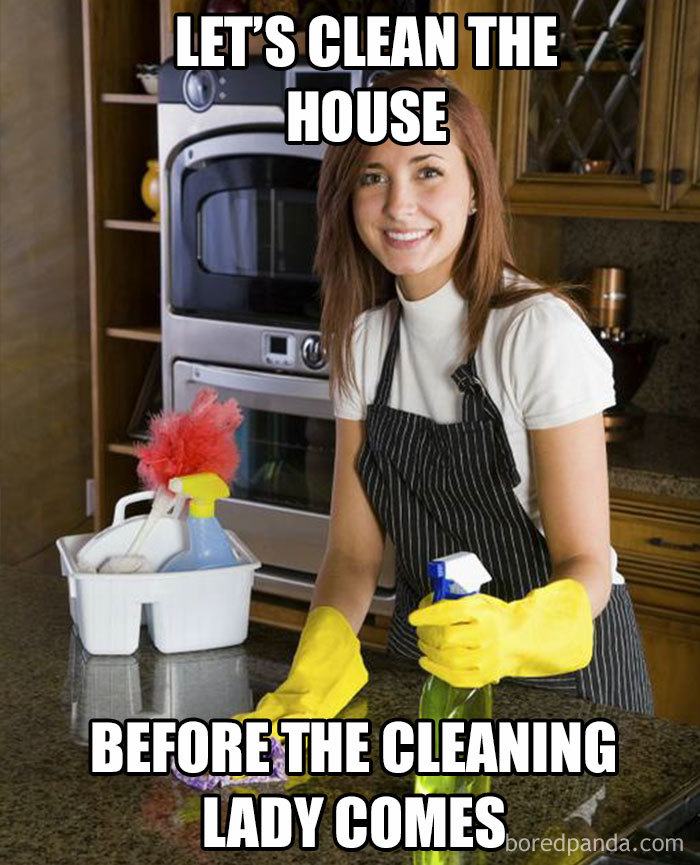
I do have to make sure my sweetie Petey sees this one.
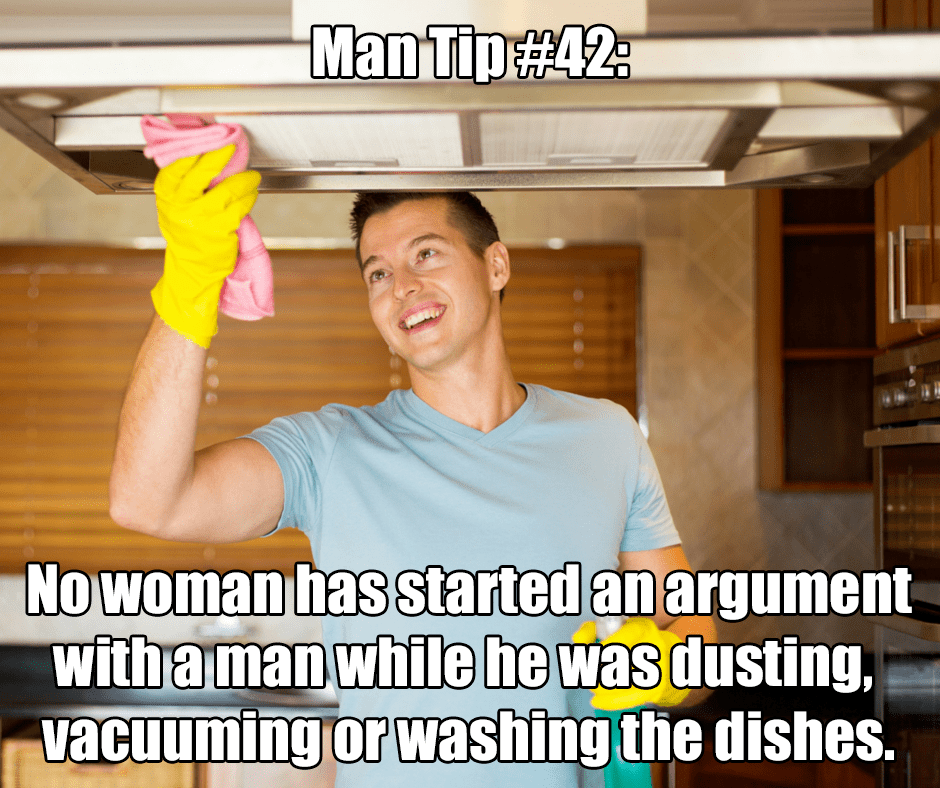
Happens to Pete and I every time …
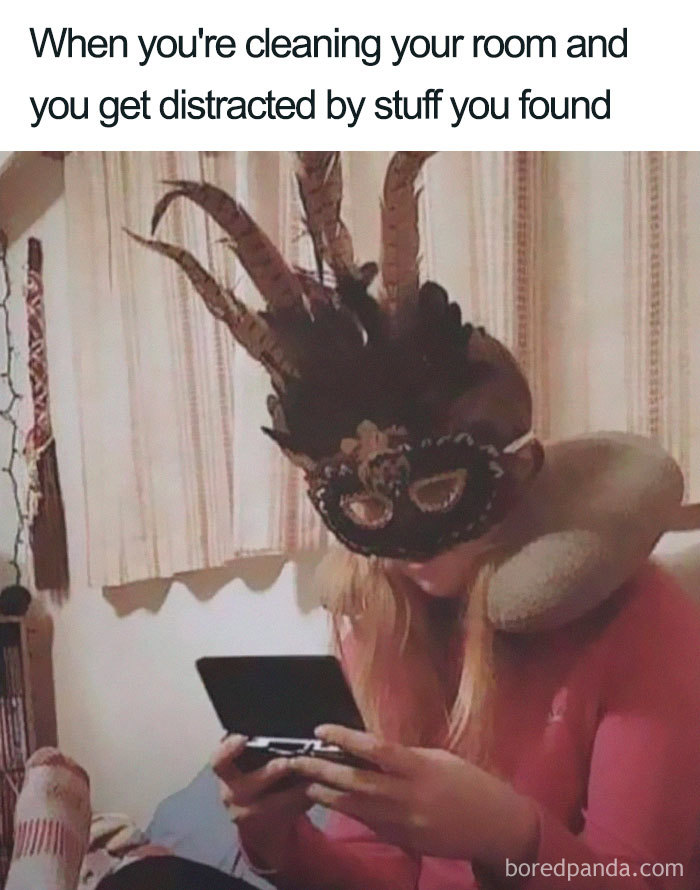
Before I retired, a clean house was also a sign I had a looming project deadline that triggered my procrastination tendencies even worse than housework.
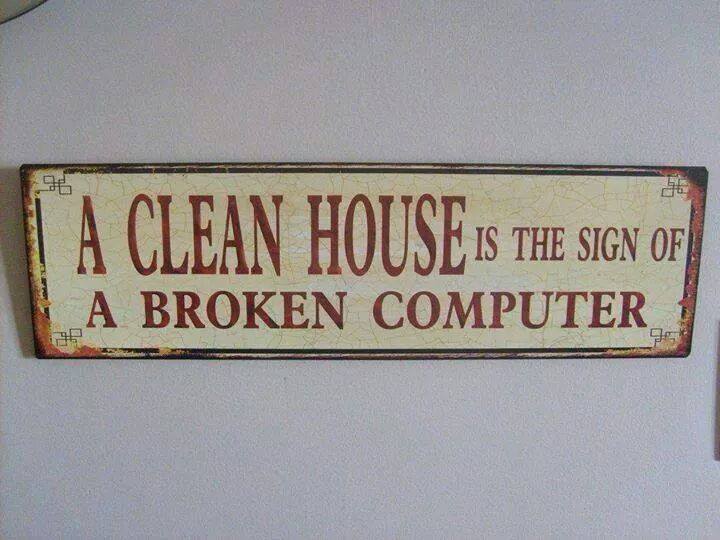
No truer words ever spoken.
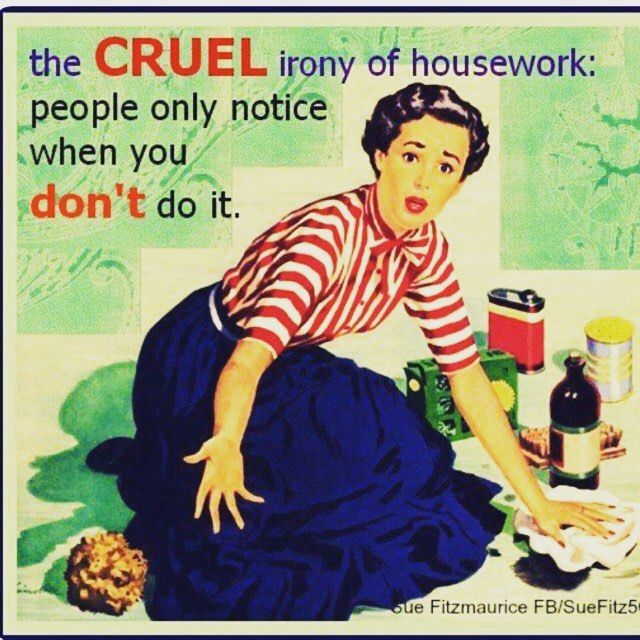
I yearn for the magic dustpan that actually does its job.

But, of course, what we really need is some perspective!