Book excerpt: Little epiphanies

Note: This is an excerpt fromΒ We Need to Talk,Β my book in progress, which examines the polarization ripping apart our society and shares my personal search for an appropriate Christian response. For an overview of the book and to read my other excerpts, clickΒ HERE.

Insight doesn’t usually come to me in bigΒ EUREKA! moments, but tends to creep into my awareness through a series of little epiphanies. And so it was with the realization that our society’s culture wars were wreaking real damage, both in our communities and in my personal life. Even worse, I began to discern – albeit more slowly – that my own attitudes and behavior might be contributing to the problem.

The first of these little epiphanies came during my 20-year career in human services. Between my paid employment and my volunteer commitments, it was hard to avoid the fallout from our larger society’s political battles because the never-ending conflict so often affected my ability to simply do my job. Government funding to the social service agencies where I worked would be cut or delayed on a regular basis because elected officials liked to hold state and federal budgets hostage until they got their way on ideological priorities. This often resulted in staffing shortages and a reduction in the level of services we were able to provide for people in need.

β€œPhilosophical differences” within the social service system itself sometimes kept helping professionals from working together for the benefit of people who sought assistance for problems ranging from drug addiction and homelessness to domestic violence and mental health issues. Conservative colleagues said poor choices and lack of personal responsibility were to blame for these individuals’ problems, while progressive colleagues insisted bad luck and social oppression were the culprits. My own experience told me the cause of most client problems was a complex combination of poor choices, bad luck and social oppression, but I often felt pressured by colleagues on both the left and the right to deny the reality in front of me when certain details of a person’s situation were not β€œideologically correct.” 

Outside of work, I frequently found myself sucked into arguments with friends, relatives and even strangers over contentious β€œhot-button” issues such as abortion, gun violence, climate change and racial unrest. Sometimes online squabbles would get sufficiently nasty for me to block or β€œsnooze” Facebook friends – both progressive and conservative – who refused to stop insulting my other Facebook friends. This situation got more pronounced after the 2016 election, with some friends actually pressuring me to stop associating with people on the β€œwrong” side of the ideological divide.Β 

However, I have to admit I wasn’t always the innocent victim or bystander in these skirmishes. For years, I had been repelled by the culture wars and yet attracted like the proverbial moth to a flame.

One sign that I might be a bit too invested in the culture wars came when I realized I had just wasted an entire afternoon arguing with total strangers about jello. Yes, jello. Progressives and conservatives on one Christian denomination’s Facebook page had been wrangling for days over this question: β€œIs it racist to make jokes about jello at church potlucks?” I further realized it wasn’t the first time this had happened. Conservative and progressive Christians frequently mauled and skewered each other on Web sites such asΒ Patheos, gleefully calling each other names and dropping F-bombs on people left and right. While I didn’t resort to insults or profanity myself, I confess to participating in too many of these β€œdiscussions” for longer than I should have.Β 

Another β€œAha!” moment came during election season when I realized I hadn’t done my morning meditation in several days. Morning meditation was one of my favorite prayer rituals. I settled in my recliner in front of the fireplace with a cup of coffee by my side and a cat in my lap and asked for God’s protection and guidance as I journaled about my priorities for the coming day.Β Sometimes my husband serenaded Oley Cat and me with sacred songs on his dulcimer.Β So why was I missing out? Not because of early doctor appointments or work commitments. Before I even had my morning coffee, I would rush to my computer and click into Real Clear Politics or FiveThirtyEight.com to see who was ahead in the polls. Housework and my writing also languished while I aimlessly surfed the web, looking for that news story or editorial that would magically reassure me the right side was winning.

One beautiful October day, I was taking a twilight walk when I suddenly stopped short. Mother Nature’s handiwork prompted me to gasp. Fall leaves flashed yellow-orange-crimson. Light from the setting sun bounced off the tops of trees in even more vivid colors. The sky competed with the trees for sheer outrageousness – the sun painting the clouds red, orange, yellow, pink, purple. A still-warm breeze blew gently across my face. Then I stopped short again. I realized I had been walking for several minutes before I noticed what was in front of me. While God was putting on this living fireworks display, I had been gazing at the sidewalk, my mind flitting from one surly thought to another: I wish our elected officials would stop acting like children. … What kind of people would vote for a monster like that? … What on earth is wrong with people?! … How can they think that way?  

The final straw that convinced me I’d had enough of the culture wars came with the COVID-19 pandemic. Here we were, facing a virus that was killing hundreds of thousands of people, and our elected officials would not stop brawling long enough to develop a coherent plan for addressing this urgent public health issue. One would think the general public might urge lawmakers to put aside their political differences and collaborate on ways to get personal protective equipment to our frontline workers, ensure ICU beds were available for everyone who needed one, and help families and small businesses affected by our shutdown orders. Instead, all we could seem to do was bicker about face masks and shame each other with Facebook memes while we retreated further into our ideological camps and dug in our heels.

So what could one person do to stop the lunacy? I was pretty sure the answer wasΒ not to retreat from the political arena, look the other way in the face of injustice or stop working to resolve problems such as poverty and hunger. On the other hand, something clearly wasn’t working – either in our society or in my responses to the endless strife. At the very least, my own responses needed to change.Β 

Unfortunately, the church community – where one might hope to find some guidance – seemed only to provoke more confusion and discord. Many Christian denominations were drawing progressive-versus-conservative battle lines that matched those of secular society. As people on either end of the political/ideological divide pressured me to take sides, I often found myself performing mental gymnastics to make my religious beliefs about an issue fit a particular political party’s platform. And I came to realize how much my own beliefs were being shaped by my desire to fit in with the people around me rather than by an objective search for truth.Β 

This internal tug-of-war brought on by the increasing divisiveness in our society prompted me toΒ ask myself several questions:Β WhatΒ were my own beliefs about the hot-button issues that consumed our nation’s culture warriors?Β Should I continue holding onto these beliefs and values, or should some of them be changed or discarded?Β How could I avoid the continual pressure to β€œchoose sides” and do more of my own thinking? What was my role as a Christian in fighting or mitigating society’s political battles? How should I engage people who disagreed with me, while keeping in mind God’s commandment to love our neighbors as ourselves? And perhaps most importantly, how did I avoid becoming part of the problem as our society grew ever more partisan and angry? How could I be part of the solution?

To help me sort through these questions, I engaged a spiritual director shortly after the 2016 election. With her encouragement, I began questioning many things I thought I knew. I questioned values other people wanted me to hold – whether they be conservative or progressive. I began asking myself how much I really believed everything I claimed to believe concerning church dogma and secular political ideologies. Was it possible I was merely paying lip service to certain ideas to please my peer group? I decided for the time being to ignore what academic β€œexperts” thought. I did not want a value system that simply let me fit in chameleon-like with my surroundings.Β Ultimately, I wanted a personal faith that would stand up to reason, scrutiny and pressure from the various culture warriors in my life.Β 

In 1 Thessalonians 5:21, the Apostle Paul said, β€œTest all things; hold fast to that which is good.” 

I certainly haven’t figured out all the answers. But I do think one key to finding an appropriate Christian response to our society’s polarization problem is to avoid knee-jerk ideological responses to heated controversies, hear people out on all sides and keep asking those pesky questions.

Questions for readers: How has our society’s polarization impacted you personally? How do we become part of the solution rather than part of the problem?Β I’d love to hear your responses to these questions, as well as your comments on this article. Just hit β€œLeave a Reply” below. When responding, please keep in mind the guidelines I’ve outlined on myΒ Rules of Engagement page (linkΒ HERE).

God’s other book: Kitties being adorable

Since May is National Pet Month, I couldn’t possibly pass up this excuse to share photos of my fur babies.

Besides, Olaf Da Vinci and Champaign Le Chat do “cute” so well, and my camera loves them almost as much as I do.

These two will have us know that a cat bed is defined as “anywhere the cat wishes to sleep.”

Nothing quite like being ignored by a cat …

Hmmmm. Does Oley need to go in the wash?

That little Champer! He has a whole king-size bed he could stretch out on, but no. He has to curl up on Pete’s clothes while the hubby is in the shower.

To practice one’s musical instrument, one must have appropriate supervision.

An office table probably should have a centerpiece, but shouldn’t it be placed in the middle of the table?

The expression on this guy’s furry little face is so priceless.

Just chillin’ …

Recipe: Garbanzo beef

For those seeking ways to cut back on pasta consumption, this recipe offers a variation on the ever-popular beefy mac. Add a green salad for a deliciously filling meal.

I’ve substituted garbanzo beans for the noodles to cut down on processed carbs and add fiber. To increase the vegetable-to-meat proportions, I’ve also doubled the amounts of mushrooms, garbanzos and tomatoes and used an extra-large pepper and onion. 

If you’re looking to cut the amount of red meat in your diet, and the saturated fat and cholesterol that come with it, feel free to use ground turkey instead of ground beef. Or, if you want to go vegan, use your favorite plant-based β€œbeef” crumbles. I’ve used the Boca veggie crumbles and found they work very well.

As usual, I use reduced-sodium versions of products whenever available, and do not add salt to this recipe, but include enough spices that I really don’t miss the salt.

Garbanzo beef freezes well, and so lends itself to batch cooking.

This recipe makes approximately 8 servings.

Ingredients

  • 1 tablespoon olive oil
  • 1 pound lean ground beef, ground turkey or plant-based β€œbeef” crumbles
  • 1 large onion, chopped
  • 1 large green pepper, chopped
  • 2 10-ounce jars sliced mushrooms
  • 1 28-ounce can reduced-sodium diced tomatoes
  • 2 16-ounce cans reduced-sodium garbanzo beans
  • Β½ teaspoon black pepper
  • 1 tablespoon Italian seasoning
  • 1 teaspoon garlic powder
  • 1 tablespoon low sodium Worcestershire sauce

Directions

SautΓ© the onion, green pepper and mushrooms in olive oil until tender and caramelized. Set aside.

Brown the ground beef or turkey and drain excess fat. Or, if using veggie crumbles, brown according to package directions.  

Combine the ground meat/veggie crumbles and spices with the onion, green pepper and mushroom mixture, stirring until well blended.

Add the tomatoes (with their juice) and drained garbanzo beans and simmer on medium heat for about 15 minutes or until the liquid is gone.

Nutrition information

Made with ground beef

Serving size: 1ΒΌ cups | Calories: 260 | Carbohydrates: 10 g | Protein: 11 g | Fat: 19 g | Saturated Fat: 9 g | Cholesterol: 83 mg | Sodium: 184 mg | Potassium: 284 mg | Fiber: 3 g | Sugar: 2.5 g | Vitamin A: 1% | Vitamin C: 21% | Calcium: 5% | Iron: 6% 

Made with ground turkey

Serving size: 1ΒΌ cups | Calories: 152 | Carbohydrates: 10 g | Protein: 13 g | Fat: 7 g | Saturated Fat: 1.5 g | Cholesterol: 40 mg | Sodium: 175 mg | Potassium: 284 mg | Fiber: 3 g | Sugar: 2.5 g | Vitamin A: 1.5% | Vitamin C: 21% | Calcium: 5% | Iron: 4% 

Made with veggie crumbles

Serving size: 1ΒΌ cups | Calories: 120 | Carbohydrates: 14 g | Protein: 11 g | Fat: 2 g | Saturated Fat: .5 g | Cholesterol: 0 mg | Sodium: 287 mg | Potassium: 355 mg | Fiber: 6 g | Sugar: 2.5 g | Vitamin A: 0% | Vitamin C: 21% | Calcium: 7% | Iron: 6% 

More cute animals

I shared my “Top 10” favorite cute animal memes about a year ago, but there are WAY more where those came from — a good thing, too, since the really irritating political ones just keep clogging my newsfeed on Facebook.

When I feel like I’m going to scream if I see one more snarky political meme, along comes a cute animal meme to the rescue.

So here is another batch of “Top 10” favorites.

Book excerpt: How did we get so polarized?

Note: This is an excerpt fromΒ We Need to Talk,Β my book in progress, which examines the polarization ripping apart our society and shares my personal search for an appropriate Christian response. For an overview of the book and to read my previous excerpts, linkΒ HERE.

Some blame the news media. Some blame our political leaders. Many blame folks on the other side of the culture wars. But my research shows that a variety of interrelated factors contribute to the extreme polarization in our society, including some influences that creep in beneath our conscious awareness:

  • Social media. If there’s one thing most people actually agree on, it is that social media can exacerbate polarization. Platforms such as Facebook and Twitter provide the ideal forum for the moral grandstanding and flame-throwing that fuel our culture wars. Some folks love a good fight and make a hobby of keeping everyone stirred up through deliberate trolling. For more of us, the relative anonymity of a screen allows us to share sentiments we’d never dream of expressing out loud to someone in a face-to-face conversation.Β 
  • Ideological bubbles and echo chambers. In his bookΒ The Big Sort, journalist Bill Bishop describes a demographic trend in which Americans have segregated themselves into homogenous communities, choosing everything from cable news networks to civic organizations and church denominations compatible with their lifestyles and beliefs. We have even separated geographically from those who differ from us ideologically. The result, Bishop says, is β€œa country that has become so polarized, so ideologically inbred, the people don’t know and can’t understand those who live a few miles away.” Meanwhile, on the Internet, sophisticated algorithms create β€œecho chambers” that ensure we are exposed mostly to people and sites promoting our own worldview and shielded from conflicting ideas or viewpoints.
  • Manipulation. We are relentlessly manipulated, often without realizing it, by folks who profit handsomely from keeping us polarized. Social media advertisers know the most salacious headlines get the most clicks – and generate the most ad revenue. Politicians whip us into an us-versus-them frenzy to secure our votes. Cable news networks boost their ratings by keeping people angry and divided. Online businesses appeal to our partisan divisions with in-your-face merchandise – aΒ Deplorable University coffee mug orΒ Safe Spaces Are for Snowflakes bumper sticker for conservatives, aΒ Jesus was Progressive car magnet orΒ Democrats Cleaning Up Republican Messes Since 1933 dog sweater for progressives (or their pets).Β 
  • Groupthink and our need for belonging. Kids begin forming in-groups as early as kindergarten and our cliquish behavior unfortunately doesn’t end when we leave high school. β€œThe human mind is exquisitely tuned to group affiliation and group difference,” says political analyst Ezra Klein in his bookΒ Why We’re Polarized. β€œIt takes almost nothing for us to form a group identity, and once that happens, we naturally assume ourselves in competition with other groups.” The more we identify with a group, the more we feel pressured to agree with its dogma – a party line that seems to include 650 boxes which must all be checked or we risk rejection by our chosen peers. The deeper our commitment to an identity group, the more vulnerable we are to the effects of β€œgroup polarization” – the tendency for the group as a whole to adopt attitudes or actions that are more extreme than the initial inclination of its individual members.
  • Projection and scapegoating. We humans have a distressing tendency to project our own less-than-admirable thoughts, behaviors and forbidden impulses onto others. Christians and non-Christians alike β€œare at times behaving horribly in the ways they engage in our political discourse,” says the Rev. Eugene Cho in his bookΒ Thou Shalt Not Be a Jerk. β€œWe want to preach to others, but we don’t preach to ourselves. We love to flip tables, but not our own. We love to expose the privilege in others, while rarely considering our own.” The concept of scapegoating first appears in Leviticus 16:8-10 – a goat would literally be cast into the desert to carry away the community’s sins – and the word β€œscapegoat” has since developed to indicate a person or group of people blamed and punished for the sins of others. Once we’ve blamed someone for all of society’s problems, it’s a short step toward demonizing and dehumanizing them.
  • Our soundbite culture. One problem that keeps us from discussing and resolving issues appropriately is our modern emphasis on brevity, which is often designed to accommodate our increasingly short attention spans. According to the Rev. Cho, our failure to engage issues more intelligently prevents us from fully understanding the β€œwhy” behind our convictions. (β€œDon’t just be a headline reader,” he urges us.) It is nearly impossible to give an issue the depth it deserves when we limit our communication to bumper stickers, 15-second sound bites and 280-character tweets.
  • Our inability to tolerate ambiguity or acknowledge moral complexity. Moral and ethical questions don’t always lend themselves to simplistic answers, and honest people can honestly disagree about the best way to resolve complex issues. A current example of this dilemma is our struggle over the best way to handle the COVID-19 pandemic. How do we protect people who are more vulnerable to severe illness or death without destroying the jobs that allow other people to feed their families, keep a roof over their heads and afford basic health care? When we don’t have enough of a life-saving vaccine to go around, who gets priority? Adding to the dilemma, scientists’ changing understanding of the virus has made it difficult for public health experts to offer consistent advice on safety measures. But rather than remain open to new research, too many of us prefer to dig in our heels and stick with whatever our identity group decrees to be β€œthe truth.”
  • Our oppositional mindset.Β We often hear how it’s easier to unite AmericansΒ against something than to unite themΒ for something. InΒ The Argument Culture, linguistics professor Deborah Tannen describes β€œa pervasive warlike atmosphere that makes us approach public dialogue, and just about anything we need to accomplish, as if it were a fight.” She explains that our society constantly urges us to engage the world in an adversarial frame of mind: β€œThe best way to discuss an idea is to set up a debate; the best way to cover news is to find spokespeople who express the most extreme, polarized views and present them as β€˜both sides’; the best way to settle disputes is litigation that pits one party against the other; the best way to begin an essay is to attack someone; and the best way to show you’re really thinking is to criticize.” Our use of language reflects this mindset, she adds: β€œThe war on drugs, the war on cancer … war metaphors pervade our talk and shape our thinking.” 
  • Relentless pressure to take sides. Our determination to pursue truth by setting up a fight between two sides leads us to believe every issue has two sides – no more and no less, Tannen says. But opposition β€œdoes not lead to truth when an issue is not composed of two opposing sides but is a crystal of many sides. Often the truth is in the complex middle, not the oversimplified extremes.” In other words, an issue may not actually have two sides, but rather, three or four or seventeen sides. Pressure to choose between the two sides presented to us keeps us from recognizing and remaining open to other options.
  • Negative partisanship and defining-by-opposition. Partisan behavior is often driven not by positive feelings toward the political party we support but by negative feelings toward the party we oppose, according to Klein. You might be guilty of negative partisanship, he says, β€œif you’ve ever voted in an election feeling a bit bleh about the candidate you backed, but fearful of the troglodyte or socialist running against her.” Charles C. Camosy describes β€œthe politics of defining-by-opposition” in his bookΒ Resisting Throwaway Culture. β€œWe almost always view the ideological communities to which we belong through the lens of a narrow progressive/conservative binary – a binary into which all issues, regardless of their complexity, are shoved and made to fit,” he explains. β€œWe define ourselves by our opposition to β€˜the other side’ well before we even engage their ideas and arguments.”
  • Logical fallacies. The dualistic, oppositional, either/or mindset outlined above is an example of a logical fallacy – a thinking error that distorts our perceptions and leads to inaccurate conclusions. Other logical fallacies that contribute to polarization include zero-sum thinking (we insist that one side’s gain must be the other side’s loss); fundamental attribution error (when bad things happen to other people, we believe they are personally at fault, but when bad things happen to us, we blame the situation and circumstances beyond our control); confirmation bias (we embrace information that supports our viewpoints, while ignoring information that doesn’t); and all-or-nothing thinking (if we change our mind about one issue, it will mean everything we’ve ever believed in is wrong, so we’ll be forced to change our entire worldview). 
  • Addiction to outrage and contempt. There certainly are plenty of issues to be legitimately angry about in our society right now. But face it, outrage and contempt can help us feelΒ so superior to others that many of us are hopelessly addicted. We live in a culture of contempt, says Arthur C. Brooks in his bookΒ Love Your Enemies. Brooks variously defines contempt as β€œanger mixed with disgust,” β€œan enduring attitude of complete disdain,” and β€œthe unsullied conviction of the worthlessness of another.” While most of us hate what unbridled outrage and contempt are doing to our society, he says many of us β€œcompulsively consume the ideological equivalent of meth from elected officials, academics, entertainers and some of the news media.” 
  • Our sinful nature. Many Christians believe sin can ultimately be defined asΒ separation. And what word would describe extreme polarization better than separation? Several β€œsins of separation” contribute to the polarization tearing our society apart. We commit idolatry when we turn the conservative/progressive movements into quasi-religions and place our loyalty to a political ideology or party ahead of our loyalty to God. We take God’s name in vain when we use it to promote hatred toward people or groups we oppose. We bear false witness against our neighbors when we deliberately twist their words and distort their positions on various issues so we can portray them as terrible people. We ignore the plank in our own eye while focusing obsessively on the speck in our perceived opponent’s eye. Most of all, we fail to love our neighbors as ourselves, especially if they voted for the wrong candidate in the last election.

Unfortunately, polarization can be self-reinforcing, creating an endless feedback loop, according to Klein. To appeal to a polarized public, political institutions, cable news networks and other public entities behave in more polarized ways. As the political institutions and other actors behave in more polarized ways, they further polarize the public. To appeal to a further polarized public, institutions must polarize even more. The cycle becomes a downward spiral.

If we want to stop this depressing cycle, a good first step might be paying attention to the ways we are pressured and manipulated to take sides in situations where taking sides may not be the best idea, as well as recognizing the logical fallacies that encourage polarized thinking and behavior. I’m also thinking those of us who identify as Christians may need to renew our commitment to follow the Lamb rather than the elephant or the donkey.

Questions for readers: What factors do you see leading to the extreme polarization in our society? What would help alleviate this? I’d love to hear your responses to these questions, as well as your comments on this article. Just hit β€œLeave a Reply” below. When responding, please keep in mind the guidelines I’ve outlined on my Rules of EngagementΒ page (linkΒ HERE).

Book excerpt: Is this criticism constructive or abusive?

Note: This is an excerpt fromΒ We Need to Talk,Β my book in progress, which examines the polarization ripping apart our society and shares my personal search for an appropriate Christian response. For an overview of the book and to read my previous excerpts, linkΒ HERE.

Most of us would agree that a hallmark of maturity is the ability to give and take constructive criticism without getting defensive or provoking defensiveness in others. Proverbs 9:8 and 17:10 commend people wise enough to profit from correction. If we must criticize others, Ephesians 4:15 reminds us to speak the truth in love.

Unfortunately, what some people call β€œconstructive criticism” isn’t really all that constructive. Sometimes criticism can be a form of abuse. Perhaps nowhere is this more true than with the β€œcritiquing” so characteristic of the culture wars in recent years. 

In a previous excerpt, I shared my theory that the extreme polarization in our society – along with the constant vitriol – has rendered many of us more defensive than we used to be. I don’t think this is entirely a matter of fragile egos. How many times can we hear words like β€œmoron” and β€œNazi” directed toward ourselves before the most thick-skinned among us shuts down?

When we react defensively to criticism, are we being overly sensitive, or is our reaction a signal that we’re being abused? When we deliver the criticism, are we speaking the truth in love or are we abusing others? 

Here are some of the guidelines I was taught by parents, teachers and various mentors about giving and receiving constructive criticism. I invite readers to compare and contrast these examples with the β€œcriticism” so often dished out by our society’s culture warriors on both the right and the left.

Constructive criticism stems from a genuine desire to help the recipient. The motive might be to help the recipient resolve a problem, be more successful at work, gain a different perspective on an issue or improve relationships with others.

Abusive criticism stems from less than honorable motives. The moral grandstanding so prevalent among culture warriors offers a prime example of criticism designed to help participants look good at other people’s expense in order to gain approval from their identity group or tribe.

Constructive criticism attacks the problem, not the person. Criticism focuses on the recipient’s actions or ideas, rather than on the recipient as a human being – for example, β€œI feel like I must challenge what you just said” vs. β€œanyone who thinks the way you do is a moron.”

Abusive criticism attacks the recipient personally. Examples of personal (ad hominem) attacks include the name-calling, ridicule and demonization of opponents so characteristic of our culture wars. People don’t just have wrong or misguided ideas. They are stupid, crazy or downright evil.

Constructive criticism respects the recipient’s dignity. The critic may take the recipient aside or raise concerns in a private message, thus allowing the recipient to avoid embarrassment.

Abusive criticism disregards the recipient’s feelings. The critic β€œcalls out” the recipient in a public forum such as Facebook or Twitter, and may get others to join in and pile on. For culture warriors on both sides, public humiliation is often the whole point. Some folks actually make loud pronouncements like, β€œI don’t care about your hurt feelings.”

Constructive criticism is even-handed. The critic notices strengths as well as weaknesses, and offers praise for things the recipient does right.

Abusive criticism is unbalanced. In our polarized society, we’re discouraged from acknowledging that someone perceived as an opponent might have any redeeming qualities whatsoever.

Constructive criticism happens only occasionally. The criticism might take place in the context of a workplace performance review or a private discussion in which the recipient has asked for feedback.

Abusive criticism happens too frequently. The critic finds something wrong no matter what the recipient does, and the criticism is relentless. On a societal level, the β€œcriticism” sounds more like a steady drumbeat of bashing than an honest critique. β€œGotcha” games abound.

Constructive criticism is fair. The critic targets things the recipient can realistically change, such as a faulty idea or an inconsiderate action, rather than things beyond the recipient’s personal control such as race, gender or someone else’s behavior.

Abusive criticism is unfair. Culture warriors on both the right and the left often resort to stereotyping and scapegoating entire groups of people, blaming individuals who belong to these groups for all of society’s ills. 

Constructive criticism is stated calmly and respectfully. The critic speaks in a normal tone of voice and treats the recipient like a reasonably intelligent person.

Abusive criticism often feels condescending or threatening. The critic yells, constantly interrupts, stands over the recipient, makes threats, or talks down to the recipient in a patronizing manner. These behaviors have been on frequent display by members of both parties during political debates in recent years.

Constructive criticism is specific and relevant to the situation at hand. Criticism focuses on current issues or concerns, and the critic offers concrete suggestions or solutions for any problems raised.

Abusive criticism resembles a fishing expedition. Culture warriors may dredge up everything an β€œopponent” has done in the past 30 or 40 years, including mistakes the individual has long since atoned for. The goal is not so much to resolve a problem, but rather to demonize, discount or destroy a perceived enemy.

Constructive criticism is a two-way street. The critic understands there are at least two sides to most issues and is able to look for their own part – or their own side’s part – in any problems being addressed.

Abusive criticism is all one-way. The critic can dish it out but can’t take it. Culture warriors often dodge a gentle invitation to look in the mirror by offering up accusations of β€œfalse equivalence” or β€œwhataboutism.” 

β€œTherefore encourage one another and build each other up,” 1 Thessalonians 5:11 reminds us. 

I truly believe the heat generated by our society’s intense polarization could be turned down several notches if people on all sides of our culture wars could learn how to distinguish constructive criticism, which builds up, from the abusive variety, which tears down. We could all profit from more building up and less tearing down.

Questions for readers: What are some examples of abusive criticism you’ve encountered? What would make the criticism more constructive? I’d love to hear your responses to these questions, as well as your comments on this article. Just hit β€œLeave a Reply” below. When responding, please keep in mind the guidelines I’ve outlined on my Rules of Engagement page (link HERE).

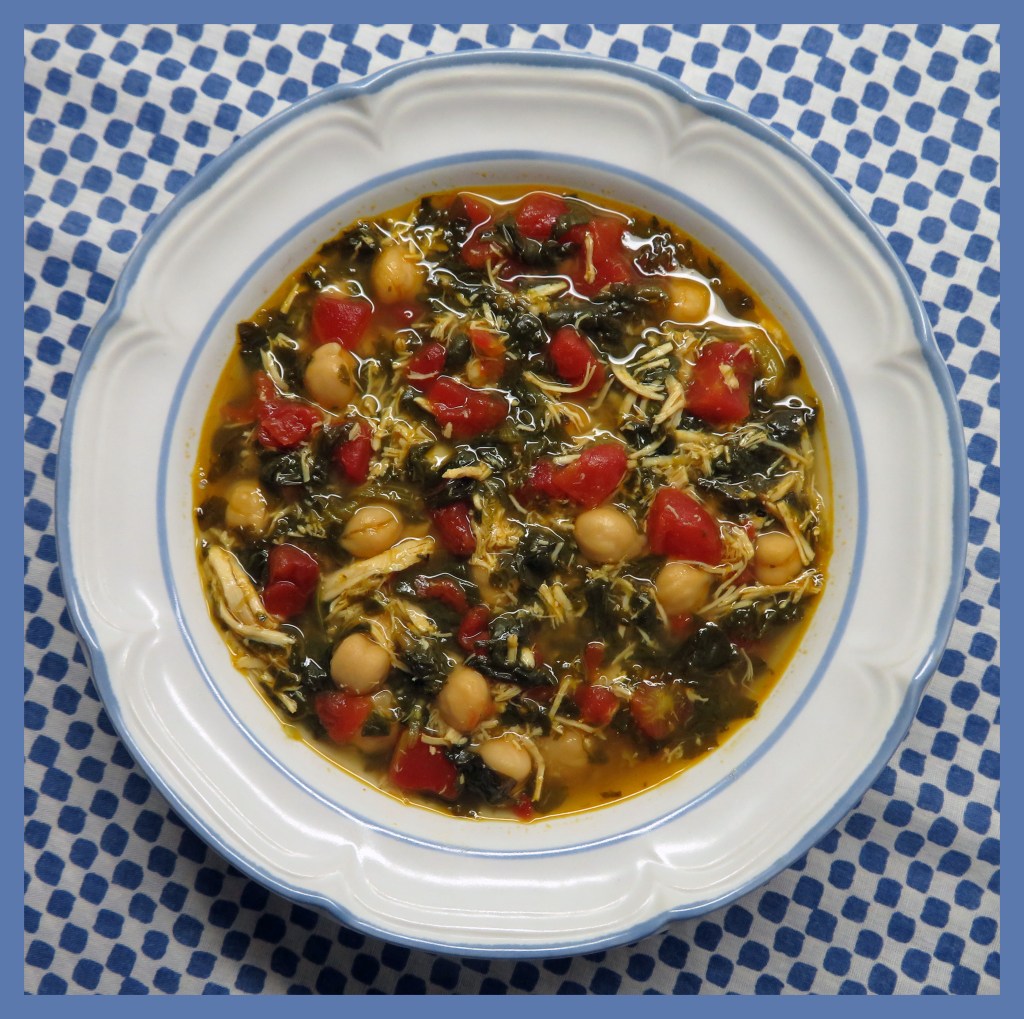
Recipe: Pete’s chicken and spinach soup

My husband came up with this recipe and it’s definitely a keeper.

There’s so much healthy stuff (like protein, veggies and fiber) and so little of the bad stuff (like added salt) that if he weren’t making it himself, I’d probably have to hide the ingredient list to get him to try it.

Plus, it’s easy-peasy to make. Pete says he has the recipe perfectly timed to prepare during the nightly PBS News Hour. 

And it’s delicious! What’s not to love?

This recipe makes approximately 6 one-cup servings.

Ingredients

  • 2 large boneless, skinless chicken breasts
  • 16-ounce can reduced-sodium garbanzo beans
  • 14.5-ounce can reduced-sodium diced tomatoes
  • 9-ounce package frozen chopped spinach
  • 32-ounce container low-sodium chicken broth
  • 2-3 bay leaves
  • 1 teaspoon powdered garlic
  • 1 teaspoon paprika 
  • 1/2 teaspoon cumin
  • 1/2 teaspoon dried cilantro leaves
  • Aleppo pepper flakes to taste (may be added at the table)

Instructions

Add chicken breasts and bay leaves to the broth in a large soup kettle and bring to a boil. Reduce heat and simmer until the chicken is cooked all the way through.

Shred or dice the chicken and return to the broth. 

Thaw the spinach in the microwave oven and add to the mixture.

Add the remaining ingredients and simmer an additional 20-30 minutes. 

Nutrition information

Serving size: 1 cup | Calories: 100 | Carbohydrates: 6 g | Protein: 14 g | Fat: 2 g | Saturated Fat: 0 g | Cholesterol: 30 mg | Sodium: 230 mg | Potassium: 320 mg | Fiber: 2 g | Sugar: 1 g | Vitamin A: 23% | Vitamin C: 22% | Calcium: 4% | Iron: 8% 

God’s other book: The sun shows off

Last month I shared some of my own sunrise/sunset photos.

Whenever the sun puts on a display, though, my Facebook friends love snapping photos as much as I do. This means I get treated to a steady parade of gorgeous scenes on my news feed.

So I couldn’t resist sharing a few of them as well. Here are some of my favorites.

Cousin Steve sends early morning greetings from Chicago.

Friend Barb regularly treats me to sunset photos snapped from her backyard in central Illinois.

Fellow congregation member Sandy shared this amazing beach shot.

My friend Collette snapped another.

Cousin Lise, who lives in Denmark, shared this stunner.

My niece Amanda captured an other-worldly sunrise on the farm where I grew up in western Illinois, and where she now lives.

Friend Will shared this panorama.

And Pastor Mary caught this spectacular sunset outside our church.

Thanks to all my friends and relatives for giving me something to feast my eyes on after a long day! And reminding me to peel myself away from my computer and look outside my own window from time to time.