Courting my Muse

I picked up a copy of The Artist’s Way: A Spiritual Path to Higher Creativity because I could relate all too well to author Julia Cameron’s description of writer’s block: “Creative, yes, but in spurts, like blood from a severed carotid artery. A decade of writing and all I knew was how to make these headlong dashes and hurl myself, against all odds, at the wall of whatever I was writing.” 

My own Muse had been on strike for several months, and attempts at negotiation had utterly failed to coax her out of hiding. A prolonged siege of work-related stress had left me feeling emotionally exhausted, with no creative energy whatsoever. I was ready to try almost anything.

Cameron calls The Artist’s Way a blueprint for “creative recovery” – in fact, 12-Step recovery movement lingo is sprinkled liberally throughout the book. She encourages us to nurture and protect our inner artist and to build healthy artist habits one day at a time. While we may relapse into unhealthy patterns from time to time, we seek progress, not perfection. If we faithfully use the tools she outlines in the book, we will experience a creative awakening. 

Why the 12-Step model? “On a societal level, blocked creative energy manifests itself as self-destructive behavior,” Cameron says. “Many people who are engaged in self-defeating behaviors, such as [addictions to] alcohol, drugs, sex, or work, are really in the hands of this shadow side of the creative force. As we become more creative, these negative expressions of the creative force often abate.”

Cameron also invokes spiritual themes extensively. “Those who speak in spiritual terms routinely refer to God as the Creator but seldom see creator as the literal term for artist,” she says. “I am suggesting you take the term creator quite literally. You are seeking to forge a creative alliance, artist-to-artist with the Great Creator. … We are, ourselves, creations. And we, in turn, are meant to continue creativity by being creative ourselves.”

How it works

The Artist’s Way, which has become a classic since its publication in 1992, offers two basic tools for creative recovery – the Morning Pages and the Artist Date.

The Morning Pages are three pages of longhand writing, strictly stream-of-consciousness, done first thing in the morning. “Three pages of whatever crosses your mind – that’s all there is to it,” Cameron says. “If you can’t think of anything to write, then write, ‘I can’t think of anything to write.’ Do this until you have filled three pages. Do anything until you have filled three pages. … Just write three pages … and write three more pages the next day.”

We should think of the Morning Pages not as “art” but as an active form of meditation for Westerners, she says. “In the Morning Pages we declare to the world – and ourselves – what we like, what we dislike, what we wish, what we hope, what we regret, and what we plan.” 

“In a sense Morning Pages are prayer,” Cameron told Publishers Weekly. In her book The Right to Write, she elaborates: “Writing gives us a place to welcome more than the rational. It opens the door to inspiration. It opens the door to God or, if you would, to ‘Good Orderly Direction.’ Writing is a spiritual housekeeper.” 

The Artist Date is “a block of time, perhaps two hours weekly, especially set aside and committed to nurturing your creative consciousness, your inner artist,” Cameron says. The Artist Date can be devoted to any pleasurable activity – a concert, a visit to an ice cream shop or a walk in the park – but we must do it alone. Bringing along kids or a significant other is strictly against the rules. We are to make time for an Artist Date at least once a week.

The Artist’s Way also offers a series of exercises. For example: List twenty things you enjoy doing. … List ten changes you’d like to make for yourself. … List five favorite childhood foods. … Describe yourself at eighty. … Complete this sentence: “My payoff for staying blocked is …” 

Some of the exercises seem to have little to do with writing, drawing or other creative activity: Open your closet. Throw out – or donate – one low-self-worth outfit. (You know the outfit.) … Mend something. … Repot any pinched and languishing plants. … Bake something. So why does Cameron include them? “Creativity does not have to always involve capital-A art,” she says. “Very often, the act of cooking something can help you cook something up in another creative mode.”

All of these activities – the Morning Pages, the Artist’s Date and the exercises – are designed to get us past The Censor, “a nasty internal and eternal critic” who “keeps up a constant stream of subversive remarks that are often disguised as the truth.” (You call that writing? What a joke. You can’t even punctuate. … What makes you think you can be creative?) “Think of your Censor as a cartoon serpent, slithering around your creative Eden, hissing vile things to keep you off guard,” she says. “As blocked artists, we tend to criticize ourselves mercilessly.” 

After Cameron finishes explaining how The Artist’s Way works, she makes a bold promise: “If the basic tools of Morning Pages and the Artist Date are kept carefully in place, you can expect to experience large life shifts.”

Yes, whining is allowed

I first decided to give The Artist’s Way a try about 15 years ago. What did I have to lose? Since I was a veteran of 12-Step groups, the book’s recovery focus was familiar to me. 

The Morning Pages turned out to be fairly easy. I had no trouble meeting my three-page quota most days. At first the writing amounted to little more than a daily To-Do list. Need to do laundry today. … Need to get some grocery shopping done. … Need to get some gas in the car.

Then I began writing about areas of my life that felt unmanageable. This house is full of piles and piles of junk and boxes and boxes of stuff that needs sorting. … I spend too much time getting tangled up in political intrigues at work and not enough time nurturing personal relationships. … I seem to spend all my time juggling and juggling and making to-do lists and doing more juggling and making more intricate to-do lists and I still can’t seem to get caught up. … I’m overweight and out of shape. I need to adopt a healthier way of living.

After that, a litany of complaints and resentments began to pour out onto my Morning Pages. I’m tired of all the childish games at work. … I’m tired of political campaigns that amount to six months of name-calling. … I’m tired of people who question my patriotism unless I vote for their candidate. … I’m tired of cleaning up the house every day, only to see it messed up again the following day. … I’m tired of all these half-finished tasks that never seem to get done.

Some days my Morning Pages consisted of three solid pages of ranting. Everything I try to do runs into some snarly little complicated snag. Why can’t anything be simple? Could one little thing go right? Just one thing? Just one little thing?! … I wish I didn’t have to work for a living. Actually, I’d do volunteer work, but I’d only work for people who treat me right and appreciate me. I want to do work that actually uses my skills and training. What a radical idea. … I want a clean house. I want a sane schedule. I want a full day off just for me, with no one yanking my chain. I want, I want, I want …

All this raging and whining was supposed to release creative energy?

The author of The Artist’s Way seemed to anticipate what my Morning Pages would sound like. She assures us that the Morning Pages “are often negative, frequently fragmented, often self-pitying, repetitive, stilted or babyish, angry or bland – even silly sounding. Good! … All that angry, whiny, petty stuff that you write down in the morning stands between you and your creativity.” 

The Morning Pages “round up the usual suspects,” she says. “They mention the small hurts we prefer to ignore, the large successes we’ve failed to acknowledge. In short, the Morning Pages point the way to reality: This is how you’re feeling; what do you make of that? And what we make of that is art.”

Cameron predicted that the Artist Dates would be harder than the Morning Pages, especially for workaholics like me. She turned out to be right. But I managed to keep my dates most weeks. I went shopping and bought myself some pretty pajamas. I walked through my neighborhood park’s rose garden. I got a manicure and pedicure. 

What happened next

To my surprise, things suddenly started to get done. I spoke up and asked my hairdresser to cut my hair a certain way and got exactly what I wanted. I confronted an electrician who overcharged me and saved $50. I ordered a new computer, something I had been meaning to do for a year. I bought a new freezer, something I’d been needing to do for several years, and cleaned out a place in the basement to make room for it. I got rid of an old washer that had been sitting in the basement ever since we bought the house – 18 years earlier. I baked bread for the first time in months. I planted a fall crop of spinach and salad greens for the first time ever. I cleaned out closets. I walked away from a job that had been driving me crazy and replaced it with a new job that paid twice as much.

According to Cameron, this all makes perfect sense. “It is very difficult to complain about a situation morning after morning, month after month, without being moved to constructive action,” she says. “One of the clearest signals that something healthy is afoot is the impulse to weed out, sort through, and discard old clothes, papers, and belongings.”

But what does all this have to do with writing and other creative pursuits?

After a long, long dry spell – during which I felt guilty even attending meetings of my writer’s group because it seemed like everyone but me had something to share – I finished my first short essay. More essays followed. I co-authored a “best practices” manual with a colleague in my field, and was invited to be a keynote speaker at a conference in Alaska. A couple years ago, I started this blog … and have been writing steadily ever since.

I’ll confess, I don’t do Morning Pages every single day. And I don’t always write three pages. But the Morning Pages continue to be part of my life. 

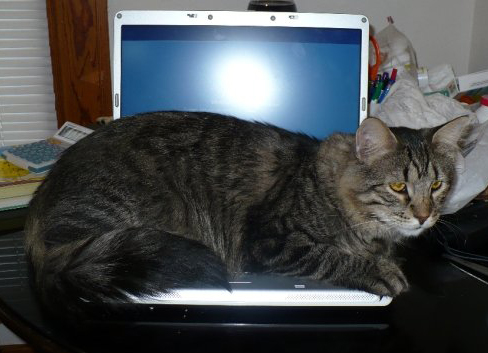
For my Morning Pages ritual, I settle in my recliner in front of the fireplace with a cup of coffee by my side and a cat in my lap. Sometimes I get to enjoy music when my husband joins Oley Cat and me to serenade us with sacred songs and folk tunes on his dulcimer. 

I journal about my priorities for the coming day. Or I write thoughts and insights generated by homework assignments my spiritual director gives me. Some mornings the writing consists largely of prayers of petition and intercession. Other times I make a gratitude list or offer prayers of thanksgiving. 

Recently I’ve been recording my real feelings about my ongoing medical saga. I’m tired of doctors pushing pills. … I’m tired of bouncing from one specialist to the next like a human ping pong ball. … I’m tired of the feeling that I’m constantly at war with my own body. … I’m tired of symptoms that scare me. … I’m tired of being sick. … I’m sick of being tired. … I’m tired, I’m tired, I’m tired! The first time I wrote like that, tears were streaming down my face by the time I finished writing. But I felt better just getting it all on paper.

No matter what I choose to write about, my Morning Pages ritual continues to offer a great jumpstart to my day when I do it. And I’ve found this ritual to be a perfect form of prayer.

I’ve also continued to treat myself to occasional Artist Dates and expand my creativity in other ways. I may spend an hour or two walking around my backyard or the park snapping photos. Or I experiment with recipes. Or I play with Photoshop and design memes. Lately I’ve been teaching myself to use iMovie, a video editing software application that lets me create video clips.

In short, The Artist’s Way has given my creativity a significant boost over the years, and I highly recommend this book to anyone looking for a way to coax their own Muse out of hiding.

When Martha Stewart becomes a verb

During a recent church service, I heard the familiar story of Mary and Martha from Luke 10:38-42. The two sisters open their home to Jesus as he travels with his disciples. While Martha busies herself with preparations, Mary sits at the feet of Jesus and listens to his teaching. Martha complains to Jesus, “Lord, do you not care that my sister has left me to serve alone? Tell her to help me!” Jesus answers, “Martha, you are anxious and troubled about many things, but only one thing is needed. Mary has chosen what is better, and it will not be taken away from her.”

Now, I don’t need to take any of those Are-You-Mary-Or-Martha quizzes on Facebook to figure out which sister I am. As someone who struggles constantly with perfectionism in areas ranging from my diet and my housekeeping to my writing and my spiritual life, I seriously relate to Martha. 

In fact, the Mary-versus-Martha story reminds me of a visualization exercise my spiritual director recommended shortly after we began working together. She instructed me to imagine myself in my ideal spiritual state. As I did this exercise, I realized I’d been imagining my “idealized state” (not to be confused with “ideal spiritual state”) for most of my life. I have daydreams that would rival Walter Mitty’s about an amazing woman I facetiously call Super Me. This marvelous creature is a slightly older version of myself, and she has her life TOTALLY UNDER CONTROL. 

Not only can Super Me leap tall buildings in a single bound, she has a meticulously ordered household, with a place for everything and everything in its place – even in the garage and the basement. She frequently invites family and friends to splendid gatherings, where she serves up a banquet better than anything Martha Stewart could produce. She has managed to achieve a svelte figure by adhering to an eating plan that is not only healthy, but painless, because she has re-educated her palate to prefer vegetables over chocolate-covered peanut butter cookie bars and she never misses her Stay Fit exercise class even during an ice storm. She volunteers for various organizations that work to make the world a better place, and she even serves on the board of directors for a couple of them, but she never gets burned out because she’s learned how to set appropriate boundaries without people getting mad at her. Her recently published book sits atop the New York Times bestseller list. And she never loses sleep at 3 a.m. wondering who God is and what God wants from her, because she has finally discerned ALL the answers to life’s “ultimate” questions.

The Super Me fantasy is particularly potent when I’m working on New Year’s resolutions, or engaging in my annual birthday tradition of evaluating my priorities and setting goals for the coming year. Coupled with the Super Me fantasy is what I’d call the Ultimate Rejection fantasy, in which people wrinkle their noses in utter disgust when they find out what my house really looks like if I’m not expecting company. I wouldn’t have been surprised if Luke had told us that Martha harbored both of these fantasies from time to time.

I’m relieved whenever I discover I’m not alone in having “Martha” tendencies. I laughed out loud when Alicia, author of the blog For His Purpose, used “Martha Stewart” as a verb. “I like to say I can just Martha Stewart everything,” Alicia confessed in one of her posts (link HERE), as she expressed her fear that the exchange student coming to live with her family would decide that her whole household was nuts and run screaming back to Russia in response to the chaos. In my own case, I feel compelled to warn houseguests not to venture into my basement or garage lest I find it necessary to file a missing persons report and organize a search party to rescue them.

“As an overachieving Martha myself, I am trying to understand Mary doing the better thing first,” said Elizabeth, author of Saved By Words (link HERE), in response to my birthday blog post, in which I outlined my priorities for the coming year (link HERE). “Not that Martha is doing anything wrong. Just that at the time sitting at Jesus’ feet was more important.” In the ensuing discussion, she and I agreed we both might possess some Martha-like traits.

The dilemma is real. 

I struggle with the advice Jesus gave Martha. I agree that we need to keep what’s really important at the forefront. This was brought home to me rather painfully over the summer. With my beloved mother in hospice, the past few months represented my last chance to “visit with her more often.”

On the other hand, doesn’t Galatians 5:22-23 remind us that one of the fruits of the Spirit is self-control? In my mind, self-control equals the self-discipline to maintain healthy eating habits, family obligations, a clean house and active participation in church and community, among other things. 

And then, of course, we women have the Proverbs 31 Woman often held up by fellow believers as an example to emulate. If the Proverbs 31 Woman were transported to the 21st Century, I can imagine her having Ruth Bader Ginsberg’s career, Christie Brinkley’s looks and Martha Stewart’s homemaking and entertaining skills. For starters.

Besides, I’ve found that several of the priorities I identified in my birthday post are really no longer optional for me. For example, with my newly-diagnosed diabetes, healthy eating is no longer simply a worthy goal, but a medical necessity.

While perhaps less crucial, crossing backlog tasks off my to-do list actually makes my life easier in the long run. Certain things really do need to get done, like it or not. Keeping the fridge and pantry in order reduces food waste – better for both our budget and the environment. When the clutter around the house gets out of control, my whole life feels out of control. It’s stressful to have deadlines hanging over my head all the time.

And I have one priority that hasn’t changed since I was 10: Write a book! The fact that I’m retired means I have never been in a better position to achieve this dream, and the time to do it is now, not some future date when everything will have settled down and fallen into place so I can start living my life in earnest.

All of this requires some level of the self-control spelled out in Galations 5:23 as a “fruit of the spirit.”

The good news is, my life does not feel nearly as out of control as it did prior to my retirement, when I was juggling the 24/7 demands of running a social service organization. And I do like to think my current priorities are a vast improvement over the ones I had in high school, when being popular was my number one goal, or even in my 40s and 50s, when my top priority (judging by my behavior) was chasing after brass rings and fancy job titles. 

Before I retired, it seemed as if my life had been reduced to crossing items off endless To-Do lists: my To-Do List for work, my To-Do List for household chores, my To-Do List of personal self-care routines, my To-Do List of urgent matters, even a Master List to keep track of all the To-Do Lists. This elaborate system of lists was suggested by the day-planner I carried around constantly and jokingly called “my conscience.” I constantly juggled so many balls in the air, I was convinced I had to keep these multiple To-Do Lists or I wouldn’t remember to do simple things like brush my teeth. Despite all the To-Do lists designed to help me hold myself accountable for how I spent my time, I couldn’t seem to keep up with all the demands.

Even now, however, repeated efforts to get my life under better control often leave me feeling more frustrated than ever. I’m reminded of the Apostle Paul, when he says in Romans 7: “I don’t understand myself, for I want to do what is right, but I don’t do it. … I want to do what is good, but I don’t. I don’t want to do what is wrong, but I do it anyway.” 

So yes, I do need to practice some reasonable self-discipline. But at the same time, I also want the next chapter of my life to amount to more than eating, sleeping, dodging other people’s dramas and crossing items off To-Do lists. In other words, I’d like for my life to include a few more “Mary” moments.

It’s nice to be able to find things when I need them without sorting through mounds of clutter. But I probably need to face the fact that our home will always look like real people (and pets) live here, no matter how much time I spend cleaning. There will never be a time when my house is in perfect order inside and out, including the closets, the garage and the basement. The perfectly clean house exists only in Better Homes and Gardens – and then only for the hour or so needed to photograph it. Unless you’re Martha Stewart, who probably not only has a full-time housekeeper, but a full-time housekeeping staff. (Speaking of Martha Stewart, is she the ultimate “Martha” in the Mary and Martha story?)

 “Baby steps,” my spiritual director often advises when I complain of my life feeling out of control. “That’s what matters.” The baby-steps advice does seem to work when I heed it. In the past month, I’ve finished cleaning the fridge (one shelf at a time), the freezer in the basement (one shelf at a time) and the pantry (one shelf at a time), as well as sorting through several weeks’ accumulation of junk mail. I’m finding ways to make the food preparation required for healthy eating easier – batch cooking, for example. 

Meanwhile, I try to muster the self-discipline to include morning meditation in my daily routine as often as possible. This reminds me to keep my relationship with God “in the #1 slot,” as the folks around the tables in 12-Step groups would say.

Of course, when it comes to Super Me, I’m in no danger of achieving that exalted state anytime soon. One thing coping with multiple medical issues over the past few months has done for me is, I’ve stopped trying to Martha-Stewart anything. At least for now, while I’m healing. And maybe, as Martha Stewart herself would say, “That’s a good thing.”

As I write this, it occurs to me that if I really did manage to achieve the level of perfection I fantasize about in my Super Me daydreams, people might not necessarily like me. After all, I personally find other people intimidating when their lives seem too perfect.

Fortunately, I’ve learned that God loves me the way I am – not because I’m perfect, but because God is perfect. Good news, indeed, even if I have to remind myself of this from time to time.

There’s a secret part of me, however, that still hopes Mary helped Martha wash the dishes after Jesus left. After all, food preparation and clean-up don’t happen by themselves.

An abundantly extravagant greeting

When people read John 10:10, we may be tempted to think of abundance in terms of wealth or possessions. But I sense that Jesus had something entirely different in mind.

This past Sunday evening represented the tail end of a bruising week that began with my spending the night in a hospital emergency room and ended with my mother’s funeral.

Needless to say, the week had left me feeling both emotionally and physically exhausted.

In a show of support, some longtime friends of ours invited my husband and I to join them at an all-you-can-eat buffet for a feast of serious comfort food.

As I stepped out of the car and walked through the restaurant’s parking lot, God greeted me with a stunning display of abundantly extravagant beauty. The photo below doesn’t begin to do it justice.

But it does offer evidence that the “abundance” Jesus talks about in John 10:10 has to do with much more than money or material goods.

A blessed day

On my birthday, I resolved to begin each new day of the coming year by reminding myself, “This is the day that the Lord has made. Let us rejoice and be glad in it!”

I must admit the past couple of days posed a challenge to this resolution. 

I got a message from one of my sisters telling me that Mom – who had been in hospice care since May – might not make it through the night.

“How can I possibly rejoice in a day that may include the loss of a person I love dearly?” I asked God as Pete and I drove the two-and-a-half hours up to the farm where Mom lives, and where my sisters and I grew up.

I prayed and hoped against hope that we would make it there in time for me to hug Mom and talk to her at least once more.

Thankfully that prayer was answered. Mom did survive long enough for me to get there and hug her good-bye.

My last words to her were, “I love you!”

Her last words to me were, “I love you too!” 

“We need to regard each day we still have her as a blessing,” my husband had said repeatedly over the past few weeks.

I was indeed blessed to have that last day with her. Thanks be to God!

I know she is now with God and happily reunited with Dad, whom she has missed terribly over the past six years.

One of my sisters snapped this photo of the sun rising on our family farm. I think it makes the perfect background for Psalm 118:24.

A mix of science, religion and some creative fun

One of my favorite pastimes is playing with Photoshop, especially when the mid-to-late summer heat keeps me mostly indoors. And I’ve always been a Nerd Girl at heart, so of course I love NASA’s Image and Video Library (link HERE).

NASA has made its entire collection of images, sounds and video available and publicly searchable online, including more than 140,000 photos and other resources we can download and use any way we like. The images are available to everyone free of charge and free of copyright – NASA simply asks to be acknowledged as the source of the material.

So take Photoshop, plus NASA’s Image and Video Library, plus a few of my favorite Bible verses, and what does this add up to? Several hours of creative fun in honor this summer’s 50th anniversary of Neil A. Armstrong and Edwin “Buzz” Aldrin taking humanity’s first steps on the moon. (Wow, has it really been that long? I remember this monumental event like it was yesterday.)

The photo below, captured by Hubble, depicts a small region within M17 (the Omega Nebula or Swan Nebula). M17 is one of the largest star-forming regions in the Milky Way galaxy. The image provides the perfect background for Psalm 19:1, don’t you think?

On a visit with Mom to her church, the pastor declared during a sermon, “I have no problem with the Big Bang Theory. God said, ‘Let there be light.’ And BANG! We got millions of stars and galaxies.” I like that. And this photo from the NASA library of NGC 602 – a portion of the Small Magellanic Cloud, one of the Milky Way’s closest galactic neighbors – makes a perfect background for Genesis 1:3.

Sometimes – especially during the kind of trying times I’ve been having lately – I just don’t understand what God must be thinking! But then I have to remind myself God’s ways are not our ways and we have to trust God even when we don’t understand God. The NASA image popularly named “Earthrise” – one of my favorites! – serves as a potent reminder of this differing perspective, as outlined in Isaiah 55:8-9.

The iconic image “Blue Marble,” taken by the crew of the Apollo 17 spacecraft on its way to the moon, has to be my all-time favorite NASA photo. Notice how no national borders or other human distinctions can be seen here. The image seems like a fitting background for Galatians 3:28, one of my favorite Bible verses.

I love this montage of planetary images taken by spacecraft managed by the Jet Propulsion Laboratory in Pasadena, CA. Included, from top to bottom, are images of Mercury, Venus, Earth (and moon), Mars, Jupiter, Uranus and Neptune. (I have to admit I miss Pluto.)

The author of the blog Seeking Divine Perspective (link HERE) suggested the following image of the Helix Nebula, popularly nicknamed “The Eye of God.” Does this image look like a giant cosmic eye, or what? At any rate, it makes a perfect background for Job 28:24. Thanks, Ann!

Shortly after touching down on the moon for the first time, Buzz Aldrin took communion while reading John 15:5, which he had written down on a note card. (And I thought taking communion on a boat in the middle of the Sea of Galilee was amazing.) “At the time, I could think of no better way to acknowledge the enormous achievement of Apollo 11 than by giving thanks to God,” Aldrin later wrote in his 2016 memoir No Dream Is Too High.

Aldrin’s historic communion in 1969 is still commemorated every year at his church, Webster Presbyterian, just down the road from NASA’s mission control center in Houston. Now known as the Church of the Astronauts, Webster Presbyterian is spiritual home to dozens of NASA scientists, engineers, astronauts, lunar mission contractors and their families. The stained glass windows feature images of the moon, the stars and distant nebulae, according to an article in the Houston Chronicle (link HERE).

What’s really great about the NASA site is that the thousands upon thousands of photos of our amazing universe serve to remind me that religion and science need not be seen as opposed to each other. Who can look at these astonishing photos and not see evidence of a Creator? And I like knowing that many of the the astronauts and other scientists who work at NASA share a strong faith as well.

Nature prayer

Martin Luther is said to have observed, “God writes the gospel not in the Bible alone, but on trees and flowers and clouds and stars.” 

Tertullian is quoted by Galileo (link HERE) as saying, “We conclude that God is known first through Nature, and then again, more particularly, by doctrine; by Nature in His works, and by doctrine in His revealed word.”

In other words, one can think of nature as God’s “other book.”

Regardless of the weather, I like to start my day by feeding the birds (and squirrels) while my morning coffee brews. During the growing season I tend several veggie, herb and flower beds. On warm sunny days, I take walks along an amazing tree-lined bike trail that runs beside a creek near our house. Sometimes I grab my camera and visit a neighborhood park.

Whether I’m feeding the critters, admiring the flowers in our backyard, snapping photos of flora and fauna at the park or strolling along the bike path, experiencing God’s creation with all my senses ranks as one of my favorite activities. Not to mention one of my most effective forms of relaxation and stress relief. (It sure beats arguing with complete strangers about politics on Facebook.) 

Immersing myself in nature’s majesty continually reminds me there is an ultimate Creator. As I’ve said before, I find it almost impossible to deny God’s existence when I’m outdoors with the evidence all around me. So, to ward off those nagging doubts that surface from time to time, I try to get outside as much as possible and engage in what has become my most potent form of prayer: Nature prayer.

According to the Rev. James Martin, a Jesuit priest, author and editor-at-large of America magazine (link HERE), nature prayer is simply being “attentive to the presence of God in nature.” 

For me, this form of prayer doesn’t even necessarily need words. Just looking at the vibrant colors of spring blossoms and fall leaves. Listening to birds singing and cicadas humming. Drinking in the scent of lilacs. Feeling a gentle breeze against my face. Tasting the sweetness of a vine-ripened strawberry. 

I’m aware some Christians eye nature prayer with suspicion. Isn’t it too “New Agey?” Too “pagan?” Aren’t we worshipping creation instead of the Creator? Resistance to nature prayer has always baffled me, frankly, because the Bible itself is chock full of passages that extole nature and invite us to immerse ourselves in it, appreciate it and learn from it.

Psalm 19:1 says, “The heavens declare the glory of God; the skies proclaim the work of his hands.” 

Luke 12:27 says, “Consider the lilies, how they grow; they neither toil nor spin; yet I tell you, even Solomon in all his glory was not clothed like one of these.” 

Being in nature not only brings us close to God, but can restore us physically and spiritually. The opening verses of the 23rd Psalm affirm, “The Lord is my shepherd; I shall not want. He maketh me to lie down in green pastures: he leadeth me beside the still waters. He restoreth my soul.”

Psalm 104:24 exclaims, “O Lord, how manifold are your works! In wisdom you have made them all; the earth is full of your creatures.” In fact, Psalm 104 in its entirety presents one long ode to the natural world – mountains that smoke, melodious birds, wine that gladdens the heart, trees and streams that protect and feed wildlife of all kinds.

Even Jesus found nature conducive to prayer and meditation. After a long day of healing, teaching and preaching to crowds, “he withdrew himself into the wilderness and prayed,” says Luke 5:16.

For those interested in pursuing nature prayer from a Christian perspective, the Web site Busted Halo (link HERE) offers suggestions for an “outdoor retreat.” Designed to “deepen our relationship with God and nature,” this retreat has three parts, each involving prayer and reflection – seeing God, listening to God, and breathing in God. To access the retreat guide, click HERE.

As I engage in nature prayer, I sense God speaking to me every bit as directly as God speaks to me while I’m in church or reading the Bible. 

When I watch a brilliant sunset dance along the tops of rioting fall leaves, I sense that God loves beauty.

When I watch a hummingbird flit from blossom to blossom sipping nectar while its tiny wings flap 70 times per second, I sense that God wants to inspire awe.

When I observe the more than three dozen varieties of flowers just in my own backyard, I sense that God prefers diversity.

When jonquils poke up through snow, I sense that God encourages us to feel hope. No matter how cold, dark and bleak life may seem, spring will come eventually.

Most importantly, when I’m immersing myself in nature, I understand at the deepest level that we are meant to appreciate and care for God’s creation. Because nature is part of God’s creation and a gift to us, we have an obligation to protect and preserve it.

God’s other book: A lesson in acceptance

Sometimes compromise really is the best answer, especially when one’s conflict is with a small animal.

I used to get so frustrated with the squirrels in our backyard because they wouldn’t stay out of the bird feeders. I tried everything to thwart the little trespassers – putting feeders in hard-to-reach places, using safflower seeds (which they’re rumored not to like), and investing in every allegedly-squirrel-proof contraption I could find.

As anyone reading this will probably guess, nothing worked for very long. Squirrels, I discovered, have amazing problem-solving skills. Give them a day or two and they’ll figure out how to overcome every obstacle we place between them and the tasty treats we were hoping would entice cardinals and goldfinches.

One day when I stopped at Wild Birds Unlimited to pick up some goodies for my feathered friends, a photo of a chubby-cheeked squirrel greeted me at the front door along with a sign that read, “Oh go ahead. Feed them too.” Just inside the door sat a display of feeders and a feast prepared especially for them. We could choose from corn on the cob, peanuts in the shell, or a special Wildlife Blend. We could put this bounty in a simple tray feeder or opt for a fancier Squirrel Table and Chair Feeder.

At long last, I decided to enjoy the squirrels instead of fighting them. After all, I’m pretty sure our bushy-tailed buddies never got the memo that all the enticing delicacies were for birds and not for them. Besides, where is it written that we’re supposed to feed birds but not squirrels? Yes, I know they’re rodents, but hey – they’re really kind of cute little acrobats.

I’ve now installed a couple of the tray-style feeders so my furry marauders can sit instead of hanging upside-down while they eat. If they want to …

Both the birds and squirrels love that tray and have even gotten somewhat good at sharing space – except for the blue jays, who dive-bomb squirrels and other birds alike when they decide it’s their turn to eat.

But the jays seem to come later, after the other critters have been gorging for a while, and hey – blue jays are really pretty and they don’t understand memos any better than squirrels do.

Spiritual lessons from animals

But ask the beasts, and they will teach you; the birds of the air, and they will tell you; or the plants of the earth, and they will teach you; and the fish of the sea will declare to you. Who among all these does not know that the hand of the Lord has done this? In his hand is the life of every living thing and the breath of all mankind. – Job 12:7-10

God has blessed me with a fine parade of pets over my lifetime, and these precious companions have taught me valuable spiritual lessons. 

Throughout my childhood, I often related to pets better than I could to people. From this photo, it’s clear that Dad and our first dog taught me to respect animals from an early age.

Mewlinda, a friendly gray farm cat who lived to be about 25 years old, exhibited saintly patience with small children – which is fortunate, since I liked to dress cats in doll clothes. I wish I had a photo, but she looked a lot like this cute girl we met at a state park last fall.

My pets prompted me to learn healthy assertiveness. When I first lived on my own, any “no pets” rule was a deal-breaker, no matter how nice the apartment I wanted to rent. I offered to pay an extra deposit if necessary, but potential landlords had to understand that my furry roommates and I were a package deal.

The critters in my life continue to impart lessons. Here, Oley gently coaxes me to keep my priorities straight …

… while Champaign – basking in a small patch of morning light on our sun porch – teaches me the importance of mindfulness and living in the present moment.

They remind my husband and I that companionship makes just about any activity more fun – or at least more endurable. Here’s Oley, helping Pete grade papers …

Torbjorn helping me assemble a newsletter …

… and Champaign helping me wake up in the morning. (Who knows? If I didn’t have that little cat alternately purring and howling in my ear at 6 a.m., I might sleep all day!)

The creatures who share our space in the backyard have taught me we don’t always need to fear strangers, especially when we learn more about them. My first impulse when I discovered a fox living under our deck was to call animal control. But a bit of quick Google research assured Pete and I that foxes pose no threat to humans as long as we maintain respectful distance, and we grew to love Roxy and her kits.

Several animals demonstrate for us the art of seizing opportunity: Oley likes to sneak a drink of water straight from the bathroom faucet.

Vixen and DW, the horses who live next door to our North Carolina cousins, know they’ll probably get a treat if they greet visitors at the fence.

A goose in our neighborhood park eagerly anticipates a slice of bread.

And the squirrels in our backyard figure, “Why let the birds have all the good stuff?

My friends and relatives have some cuties I adore almost as much as my own. Piccolo shows us how to be way cool without even trying – by simply being himself.

Nala derives pleasure from simple things … like watching the popcorn popper perform its task.

Millie, an adorable beagle we like to think of as our semi-official church dog, shows us how to win friends and influence people as she visits sick congregation members (including me, when I was in the hospital). She’s such a good sport, she allows us to dress her up as a sheep for our annual Christmas pageant. 

Animals have thoroughly convinced me that some angels have four legs, fur and whiskers.

During a particularly challenging time in my life – when I was enduring both work and health problems – our sweet Angie Cat sat with me in my recliner every single morning as I poured my feelings of fear, anger, resentment and despair onto my journal pages. I can only aspire to practice such unconditional love. May you rest in peace, my beautiful little friend!

Bear, a magnificent Great Pyrenees, helped his human buddy though some of his darkest hours, staying faithfully by his side as he put his life back together. And then, one day this past winter, this beautiful boy was gone. Everyone in his Nashville, Tennessee neighborhood misses him greatly.

Members of our church had only begun to love Creed – our new pastor’s dog – when God called him home suddenly. Creed left behind a heartbroken congregation.

Finally, some animals teach us to risk loving again, even after a painful loss. 

When I’ve lost beloved pets over the years, I’ve often been tempted to say, “Next time I’m not going to get q-u-i-t-e so attached.” Friends have confessed similar thoughts. Invariably the new pet has other ideas – and before we know it, we’re absolutely smitten. Again. 

“Grief isn’t just something to endure,” says clinical psychologist Mary Pipher, author of Women Rowing North, Reviving Ophelia and several other books. “It also is a reflection of our capacity to love.” Our new fur babies don’t replace the ones we’ve lost, of course. Instead, they expand our hearts and show us that love is an endlessly abundant and renewable resource.

My friend who lost his beautiful Bear over the winter posted a photo last week and asked, “Should I take him, yay or nay?” Of course the pup went home with him. Who could possibly resist this furry little bundle of pure tail-wagging joy?

Gospel, our congregation’s newest church dog, came home with our pastor a few days ago. How long before our pastor and the rest of the congregation start spoiling him absolutely rotten? Can anyone count to one?? Oh wait … I can see the spoiling has already begun.

Perhaps the most important lesson our animal companions teach us is this: LOVE WINS.

Every. Single. Time.

Praying for pets

Pete and I live with two furry bundles of love and mischief – Olaf DaVinci, a gorgeous Maine Coon, and Champaign Le Chat, a beautiful cream-colored domestic longhair. Needless to say, we absolutely adore them.

About four months ago, we noticed Oley had started to limp and could no longer jump up onto the bed or his other favorite perches without a struggle. He was insatiably thirsty and peed copiously. I took him to the vet. The verdict: Diabetes.

No sooner had we begun to absorb this distressing news, when the vet delivered another whammy: Champaign had early-stage kidney disease.

Is it permissible to pray for pets? I certainly hope so, because my intercessory prayers began the minute I got the news about our furbabies:

Dear God, please take care of our sweet kitties. Help them respond to treatment and don’t let them suffer. Please, please, please! I love these little guys. Amen.

Fortunately, I’ve never encountered anyplace in the Bible that suggests we shouldn’t pray for our beloved companions. “Ask, and it shall be given you,” says Matthew 7:7. The verse doesn’t tell us what to ask for – it simply says, “Ask.”

While I haven’t found specific references to pets in the Bible, several passages indicate God cares about animals and expects us to care about them too.

“You, Lord, preserve both people and animals,” says Psalm 36:6.

 “Not one sparrow … can fall to the ground without your Father knowing it,” says Matthew 10:29.  

“The righteous care for the needs of their animals,” says Proverbs 12:10.

The Bible points out that animals can impart spiritual lessons. “But ask the beasts, and they will teach you,” says Job 12:7. 

Animals even show up in the Ten Commandments. Not only should we take time off on the Sabbath, but our animals should as well, says Exodus 23:12: “Six days do your work, but on the seventh day do not work, so that your ox and your donkey may rest.” 

And who can imagine heaven without critters? In God’s future kingdom, “the wolf shall dwell with the lamb, and the leopard shall lie down with the kid, and the calf and the lion and the fatling together, and a little child shall lead them,” says Isaiah 11:6. 

In other words, God loves His creation – all of it!

As if I needed further assurance that God listens to prayers on behalf of our furry (or feathered or finned) companions, I’ve learned that many Christian churches ranging from Lutheran and Methodist to Catholic and Episcopalian hold a special “Blessing of the Animals” ceremony on the Feast Day for St. Francis of Assisi, who was famous for his love of all living things. 

Kevin E. Mackin, OFM, a Franciscan friar of the Holy Name Province, offers a delightful description of one such service in an article on franciscanmedia.org [link HERE]: “Usually the Blessing of Pets is held outdoors. But I remember it rained one year, and all were invited inside St. Stephen’s Church in Manhattan. It was quite a sight to see pairs of creatures—one human, one animal—sitting in the pews. The pastor joined right in with his beagle. Noah’s Ark was never like this!”

“It’s okay to pray for anything that is on your heart,” says Linda Evans Shepherd, an evangelical Christian speaker, author and president of Right to the Heart Ministries (link HERE]. “After all, God not only created animals, but He’s interested in the things you’re interested in.”

At any rate, I’ve concluded it’s absolutely appropriate to keep Oley and Champaign in my prayers and I’ve been asking God for wisdom to make the right decisions regarding their medical care. 

The vet prescribed a diabetic diet for Oley and a kidney-support diet for Champaign. I would need to give Oley medication twice a day and bring him to the vet’s office every other week for testing. 

At first the logistics seemed impossible. With the kitties on separate special diets, how could I keep them out of each other’s food? Besides, Champaign was such a picky eater. What if he simply refused to touch the food prescribed for him?

I worried that medicating Oley might prove to be an insurmountable task. In the past, when I needed to give him meds, he resisted me to the point of running and hiding whenever he saw me. How on earth would I be able to do this twice a day for the rest of his life? 

And the doctor had to be kidding about bringing Oley to the vet’s office every two weeks, I thought. Both cats had let me know in no uncertain terms how much they hated vet visits – and that was when I only took them once or twice a year.

However, when we went on Facebook to solicit some crowd-sourced prayers, several friends shared their personal experiences of caring for pets who had either diabetes or kidney disease. After hearing their stories, Pete and I began to relax.

The good news: Treatment has gone better than we dared to hope. 

We keep the cats out of each other’s bowls by feeding them in separate rooms. I’ve minimized trips to the vet by learning how to do some of Oley’s testing at home. And whoever invented Pill Pockets deserves the Nobel Peace Prize. Oley thinks his pills are treats!

When an office visit can’t be avoided, I try to reduce Oley’s anxiety as much as possible by giving him a mild sedative. One of the vet techs has invited me to call her when I’m in the parking lot so we can take him straight to a room where he doesn’t have to meet any dogs. 

Lately, I’ve been offering prayers of thanksgiving:

Dear God, getting a urine sample from Oley was WAY easier than I thought it would be. Thank-you for inspiring the person who invented Nosorb kitty litter!

Dear God, I was worried that Champaign might not eat enough. But I’ve been sneaking more and more of his prescription food into his Gravy Lover’s salmon. So far, this is working. Thank-you! 

Our experience of the past several weeks has even taught me to be grateful when our little darlings get ornery – especially Oley, since mischievous behavior signals that he’s feeling better. Here he is, eyeing Pete’s cereal. 

“Some people criticize the amount and cost of care given to pets,” says Franciscan friar Kevin E. Mackin. “People are more important, they say. … However, I believe every creature is important. The love we give to a pet, and receive from a pet, can draw us more deeply into the larger circle of life, into the wonder of our common relationship to our Creator.”

“So when you pray, pray for the provisions you need, your family members, your church, nation, hurting friends and world peace,” says author Linda Evans Shepherd. “Only don’t forget to pray for your pet. God’s grace is big enough to cover your prayers for even the little paws in your life.”

For me, the fear that we might love and care for our pets more than we love and care for other people represents a false dichotomy. I love people and pray for them. I love my pets and pray for them too. This is not an either/or proposition. Love and prayer are not limited commodities or finite resources. There is enough of both to go around!

Meeting the Risen Christ in a hospital room … and at church

When I visit various churches, I usually encounter one of two symbols – a crucifix or an empty cross. During my recent hospital stay, however, I came across a symbol I hadn’t seen before. 

While propped up in bed doing my morning meditation, I noticed what looked like a crucifix – only different somehow – hanging on the wall a few feet away. I had begun to recover after a stint in intensive care, so I got out of bed and walked over to take a closer look. 

Jesus stood in front of the cross – alive – his arms outstretched as if beckoning me to follow him. 

When I looked it up online later, I saw the cross advertised on a Catholic web site as “The Risen Christ.” I’m pretty sure it’s been around for a while and I had simply never noticed it. At any rate, I liked this particular cross.

The traditional crucifix reminds us of Christ’s suffering and sacrifice on Good Friday, while the empty cross prompts us to meditate on Easter and the resurrection. But as I stood looking at the cross in front of me on that Sunday morning just before the beginning of Lent, I found myself meditating on a different subject: “What does it mean to actually follow Jesus?”

I must say that question took on a bit more urgency in the face of a medical trauma that forced me to look my own mortality straight in the eye without blinking. Not only that, but my mother had just been in the hospital twice in as many months, and I’ve had to face the fact that I may not have her in my life much longer. For good measure, my brother-in-law was hospitalized the same time I was and both my cats had just been diagnosed with chronic medical conditions. Yikes!

The cross on the hospital room wall seemed like an appropriate symbol for the occasion. It not only signified the death and resurrection of Jesus, but the cross we all are asked to bear when we become followers. There will be hardship, sacrifice and struggle, the Bible tells us. But this cross also reminded me that we can overcome hard times with God’s help.

This morning I encountered the same “Risen Christ” symbol again, this time at church. 

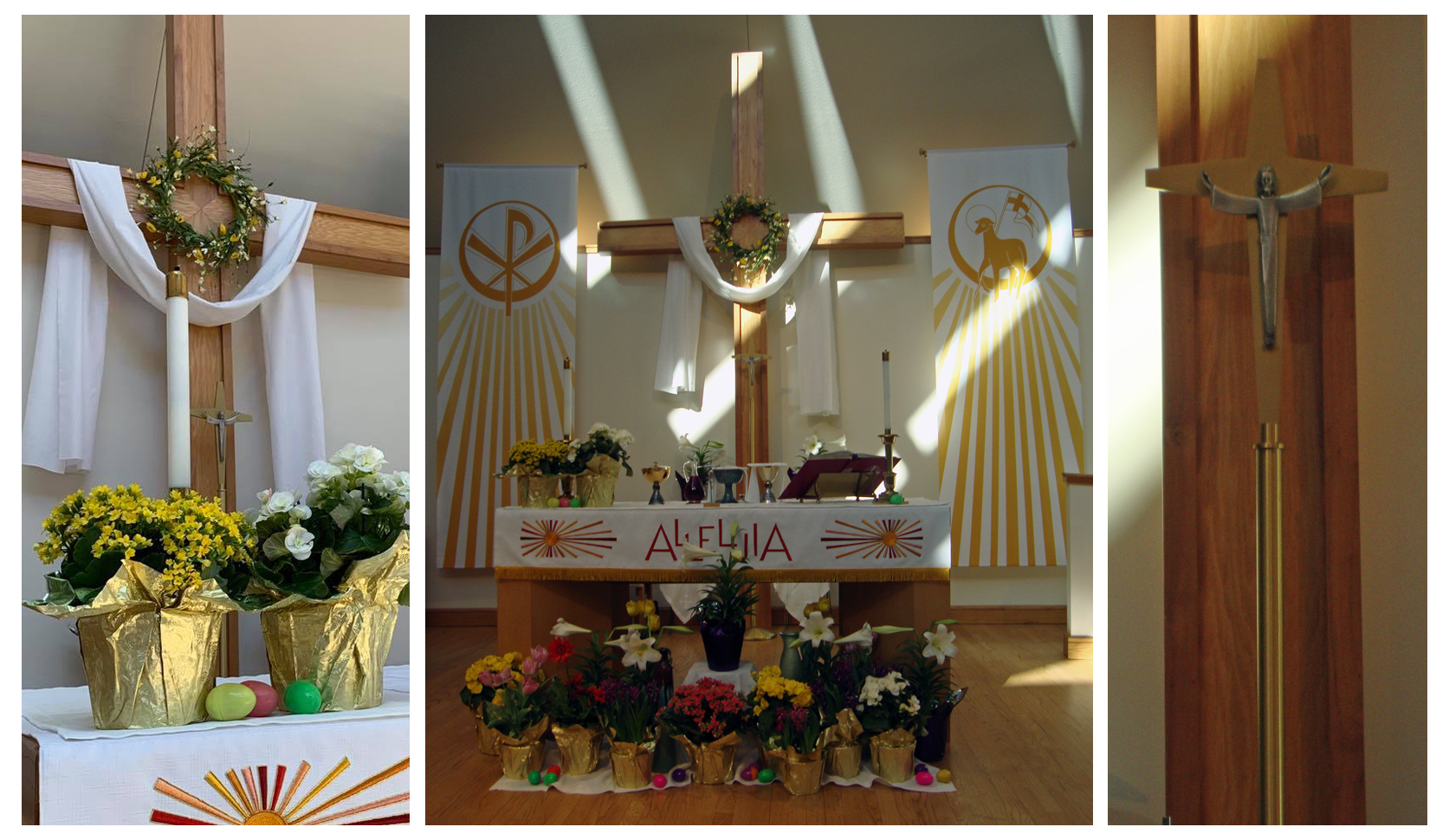
The altar was all decked out for the Easter Sunday service. A white cloth and a crown of white and yellow flowers draped the empty cross. Easter lilies and other spring flowers filled the entire front of the church. The sanctuary was gorgeous! As was the music – complete with a trumpet, maracas and drums. (The photos below don’t begin to do the scene justice.)

In the middle of all this, I saw the now-familiar figure of “The Risen Christ” on the processional cross carried down the aisle and placed in a stand behind the altar. Jesus was alive, arms outstretched, beckoning us all to follow.

Congregation members and our minister exchanged this greeting:

“Christ is risen!”

“Christ is risen indeed!”

In her sermon, our minister spoke of emerging from our personal “tombs” – sickness, loss of loved ones, broken relationships – and I reflected on the hospital rooms I’d been in over the past couple of months.

As I came forward for communion, I thanked God for having shepherded me – and my mother and my husband and my brother-in-law and my cats – through this unusually challenging Lenten season.

And the real Risen Christ, alive and present among us, seemed to say, “You won’t be able to avoid pain and suffering, but you will transcend it.” 

Happy Easter, everyone!