Conscious contact with God

Note: I’ve been taking a short break from writing the past few weeks to focus on a couple of important offline projects, so I’m reposting one of my personal favorites from a couple of years ago. This was first posted in September of 2023, and I still refer to it from time to time when looking for inspiration for my prayer life.

For several years now, my number one priority has been to develop a better understanding of God, so I can fulfill God’s purpose for my life, discern what my core values should be and live accordingly. As I have sought to improve my relationship with God, a key part of my spiritual direction journey has involved exploring prayer.

My Bible study has yielded an abundance of models for how to pray – Matthew 6:9-16 gives us the Lord’s prayer, of course, and the Psalms provide dozens of other examples. At church, I’m invited to join the congregation in liturgical prayer. My 12-step groups introduced me to the Serenity Prayer, and my parents and grandparents taught me still others, from table grace to my favorite childhood bedtime prayer.

My first spiritual director was fond of pointing out that prayer is – quite simply – a conversation with God, and there is an almost infinite variety of ways to pray. We can offer up confessional prayers and liturgical prayers, prayers of intercession and prayers of thanksgiving, foxhole prayers and prayers of lament, nature prayer and even crowd-sourced prayers.

Types of prayer

Here are several types of prayer that I’ve personally engaged in.

  • Foxhole prayer. A popular saying posits that “there are no atheists in foxholes.” While the Bible doesn’t explicitly mention the term “foxhole prayer,” Scripture is chock-full of desperate prayers from people in distress or danger. I must acknowledge that my prayer life during a crisis is quite often of the “foxhole” variety. Many of my prayers this past year happened in doctors’ offices and hospital rooms, and to say I was scared would be an understatement. So, this type of prayer is definitely part of my repertoire.
  • Prayers of petition and intercession. When it comes to praying on behalf of ourselves or others, I know there is some concern about regarding God as a magic genie to whom we bring our shopping list. However, the Bible is jam-packed with prayers of petition and intercession, so I’m assured this type of prayer is perfectly appropriate. In fact, Philippians 4:6 encourages us to “let your requests be known to God,” and one could say most of the Lord’s Prayer qualifies as a prayer of petition.
  • Confessional prayer. The Bible frequently emphasizes the importance of confession in seeking reconciliation with God. Proverbs 28:13 reminds us that “whoever conceals their sins does not prosper, but the one who confesses and renounces them finds mercy.” I’ve engaged in confessional prayer both privately, during morning meditation or as part of an evening Examen, and with others, as part of the prayer of confession and absolution during Sunday church services.
  • Liturgical prayer. Liturgical prayers follow a prescribed order and include specific rituals and readings from sacred texts. Examples during Sunday services at my church include the invocation, confession and absolution, the collect, prayers of intercession, the Lord’s prayer and the benediction. I have always found the ritual aspect appealing, because it is conducive to contemplation and reflection. Plus, I feel a historical connection to other Christians who have been saying these same prayers for hundreds of years.
  • Lament. Prayers of lament allow us to fully face and name the pain in our lives, and we need look no further than the Bible for numerous examples. The Psalms brim with prayers about pain, anguish, fear and grief. Jesus wept. More than once. Chapter 3 of Ecclesiastes reminds us that for everything, there is a season – a time to weep and a time to mourn are sanctified, right along with a time to laugh and a time to dance.
  • Crowd-sourced prayer. This is what I like to call the prayers solicited on Facebook and other social media. Often responders not only pledge to offer up prayers themselves, but promise to put the original poster on their church’s prayer lists. When I’m the one asking for prayers, I like to visualize all those prayers wending their way up to heaven – prayers from my family, my friends and the folks who respond to the prayer lists at all the different churches my family and friends attend. Talk about feeling loved and supported!
  • Nature prayer. Nature prayer – encountering and being attentive to God’s presence in creation – has been my most consistently reliable way to address my occasional doubts about God’s existence. For me, it involves experiencing God’s handiwork with all my senses – seeing the vibrant colors of spring blossoms and fall leaves, listening to birds singing and cicadas humming, drinking in the scent of lilacs or honeysuckle, feeling a gentle breeze against my face, tasting the sweetness of a vine-ripened strawberry. 
  • Listening prayer. This form of prayer involves quieting ourselves and intentionally seeking to hear God’s voice by being still and receptive. As Psalm 46:10 tells us, “Be still and know that I am God.” One of my spiritual directors suggested that I say or write a prayer, then be completely silent for a few minutes while I quiet my mind and wait for God’s response. Then ask myself, “What is God saying to me right now?”
  • Prayers of thanksgiving. 1 Chronicles 16:13 says: “Give thanks to the Lord, for he is good; his steadfast love endures forever.” Even in tough times – or maybe I should say, especially in tough times – expressing gratitude for answered prayers and other blessings can help lift me out of despair. I also remind myself that, while prayers of petition and intercession are fine, I must not forget to thank God when those prayers are answered.

Some prayer techniques worth trying

There are also several techniques designed to facilitate prayer that I’ve personally found helpful – some of them suggested by my spiritual directors and some that I’ve employed for nearly as long as I can remember:

  • Memorization. Ever since I was a child and learned the bedtime prayer that begins with “now I lay me down to sleep,” there has been a place in my life for “rote” – or memorized – prayers. When I am too overwhelmed to think straight, rote prayers such as the Lord’s Prayer or the Serenity Prayer can help calm me and give me the words I need. The fact that a prayer is memorized, or is being recited in unison with others, or has been offered a gazillion times before, need not mean it’s “empty” as long as I pay attention to the words while I say them.
  • Meditation. Morning meditation has been a vital part of my daily routine for more than a quarter century. I might journal about my priorities for the coming day, or make a gratitude list, or work on a homework assignment my spiritual director has given me. While the content may vary from one day to the next, I’ve found that I often feel more “centered” after a meditation session and sense that something is missing if I skip it.
  • Writing/journaling. Writing, which has been a major part of my morning meditation sessions for years, helps me focus my thoughts in an organized way. This makes it a valuable tool, even when I’m communicating with God. Keeping a journal also encourages me to record the fruits of my prayers, which in turn reminds me that God does answer prayer more often than I appreciate.
  • Photography. I’ve found that photography can serve as a potent medium for reflection and contemplation. It invites me to slow down and take notice of my surroundings, increases my awareness of the visual richness in ordinary objects such as an acorn or a flower blossom, and cultivates receptivity to God’s beauty all around me. Most of all, it demands that I pay attention and stay in the moment.
  • Music. St. Augustine has been quoted as saying, “Whoever sings, prays twice.” I’ve long considered both making and listening to music conducive to prayer. For me, music has the power to cut through mental chatter and quiet my mind. Making music is a great way to offer a positive contribution to other Christians as well. For years, Pete and I sang in the church choir and sometimes Pete even serenades me with his dulcimer while I engage in morning meditation.
  • Mindfulness. 1 Thessalonians 5:17 tells us to “pray without ceasing.” For me, this has come to mean mindfulness – living with a moment-by-moment awareness of God’s presence as I go about my daily activities, or at least trying not to get distracted by my own random thoughts while immersed in Bible study or listening to a sermon. I’ve found that mindfulness is definitely a learned skill, more easily said than done!
  • Lectio divina. A Latin phrase meaning “sacred reading,” lectio divina is a form of prayer that can help us get more from our personal Bible study. This technique, suggested by my first spiritual director, encourages us to ask questions as we carefully and mindfully read scripture: What does the text say? What do I want to ask God about this text? What will be different in my daily life as a result of reading this passage, and how can I put its teaching into action?
  • Examen. This technique, also suggested by one of my spiritual directors, is a time specifically set aside for reflective prayer. It may involve an examination of my conscience, prayerful reflection on the events of the day to detect God’s presence, expressions of thanksgiving and gratitude, or a request for the grace I will need to get through the following day. It’s a great way to wrap up my day before I go to sleep.

I’ve used some of these prayers and techniques off and on for years, while others have been added to my repertoire more recently. I’d like to commit to doing them all on a more regular, disciplined basis as I continue my spiritual journey.

Conscious contact with God

For several years now, my number one priority has been to develop a better understanding of God, so I can fulfill God’s purpose for my life, discern what my core values should be and live accordingly. As I have sought to improve my relationship with God, a key part of my spiritual direction journey has involved exploring prayer.

My Bible study has yielded an abundance of models for how to pray – Matthew 6:9-16 gives us the Lord’s prayer, of course, and the Psalms provide dozens of other examples. At church, I’m invited to join the congregation in liturgical prayer. My 12-step groups introduced me to the Serenity Prayer, and my parents and grandparents taught me still others, from table grace to my favorite childhood bedtime prayer.

My first spiritual director was fond of pointing out that prayer is – quite simply – a conversation with God, and there is an almost infinite variety of ways to pray. We can offer up confessional prayers and liturgical prayers, prayers of intercession and prayers of thanksgiving, foxhole prayers and prayers of lament, nature prayer and even crowd-sourced prayers.

Types of prayer

Here are several types of prayer that I’ve personally engaged in.

  • Foxhole prayer. A popular saying posits that “there are no atheists in foxholes.” While the Bible doesn’t explicitly mention the term “foxhole prayer,” Scripture is chock-full of desperate prayers from people in distress or danger. I must acknowledge that my prayer life during a crisis is quite often of the “foxhole” variety. Many of my prayers this past year happened in doctors’ offices and hospital rooms, and to say I was scared would be an understatement. So, this type of prayer is definitely part of my repertoire.
  • Prayers of petition and intercession. When it comes to praying on behalf of ourselves or others, I know there is some concern about regarding God as a magic genie to whom we bring our shopping list. However, the Bible is jam-packed with prayers of petition and intercession, so I’m assured this type of prayer is perfectly appropriate. In fact, Philippians 4:6 encourages us to “let your requests be known to God,” and one could say most of the Lord’s Prayer qualifies as a prayer of petition.
  • Confessional prayer. The Bible frequently emphasizes the importance of confession in seeking reconciliation with God. Proverbs 28:13 reminds us that “whoever conceals their sins does not prosper, but the one who confesses and renounces them finds mercy.” I’ve engaged in confessional prayer both privately, during morning meditation or as part of an evening Examen, and with others, as part of the prayer of confession and absolution during Sunday church services.
  • Liturgical prayer. Liturgical prayers follow a prescribed order and include specific rituals and readings from sacred texts. Examples during Sunday services at my church include the invocation, confession and absolution, the collect, prayers of intercession, the Lord’s prayer and the benediction. I have always found the ritual aspect appealing, because it is conducive to contemplation and reflection. Plus, I feel a historical connection to other Christians who have been saying these same prayers for hundreds of years.
  • Lament. Prayers of lament allow us to fully face and name the pain in our lives, and we need look no further than the Bible for numerous examples. The Psalms brim with prayers about pain, anguish, fear and grief. Jesus wept. More than once. Chapter 3 of Ecclesiastes reminds us that for everything, there is a season – a time to weep and a time to mourn are sanctified, right along with a time to laugh and a time to dance.
  • Crowd-sourced prayer. This is what I like to call the prayers solicited on Facebook and other social media. Often responders not only pledge to offer up prayers themselves, but promise to put the original poster on their church’s prayer lists. When I’m the one asking for prayers, I like to visualize all those prayers wending their way up to heaven – prayers from my family, my friends and the folks who respond to the prayer lists at all the different churches my family and friends attend. Talk about feeling loved and supported!
  • Nature prayer. Nature prayer – encountering and being attentive to God’s presence in creation – has been my most consistently reliable way to address my occasional doubts about God’s existence. For me, it involves experiencing God’s handiwork with all my senses – seeing the vibrant colors of spring blossoms and fall leaves, listening to birds singing and cicadas humming, drinking in the scent of lilacs or honeysuckle, feeling a gentle breeze against my face, tasting the sweetness of a vine-ripened strawberry. 
  • Listening prayer. This form of prayer involves quieting ourselves and intentionally seeking to hear God’s voice by being still and receptive. As Psalm 46:10 tells us, “Be still and know that I am God.” One of my spiritual directors suggested that I say or write a prayer, then be completely silent for a few minutes while I quiet my mind and wait for God’s response. Then ask myself, “What is God saying to me right now?”
  • Prayers of thanksgiving. 1 Chronicles 16:13 says: “Give thanks to the Lord, for he is good; his steadfast love endures forever.” Even in tough times – or maybe I should say, especially in tough times – expressing gratitude for answered prayers and other blessings can help lift me out of despair. I also remind myself that, while prayers of petition and intercession are fine, I must not forget to thank God when those prayers are answered.

Some prayer techniques worth trying

There are also several techniques designed to facilitate prayer that I’ve personally found helpful – some of them suggested by my spiritual directors and some that I’ve employed for nearly as long as I can remember:

  • Memorization. Ever since I was a child and learned the bedtime prayer that begins with “now I lay me down to sleep,” there has been a place in my life for “rote” – or memorized – prayers. When I am too overwhelmed to think straight, rote prayers such as the Lord’s Prayer or the Serenity Prayer can help calm me and give me the words I need. The fact that a prayer is memorized, or is being recited in unison with others, or has been offered a gazillion times before, need not mean it’s “empty” as long as I pay attention to the words while I say them.
  • Meditation. Morning meditation has been a vital part of my daily routine for more than a quarter century. I might journal about my priorities for the coming day, or make a gratitude list, or work on a homework assignment my spiritual director has given me. While the content may vary from one day to the next, I’ve found that I often feel more “centered” after a meditation session and sense that something is missing if I skip it.
  • Writing/journaling. Writing, which has been a major part of my morning meditation sessions for years, helps me focus my thoughts in an organized way. This makes it a valuable tool, even when I’m communicating with God. Keeping a journal also encourages me to record the fruits of my prayers, which in turn reminds me that God does answer prayer more often than I appreciate.
  • Photography. I’ve found that photography can serve as a potent medium for reflection and contemplation. It invites me to slow down and take notice of my surroundings, increases my awareness of the visual richness in ordinary objects such as an acorn or a flower blossom, and cultivates receptivity to God’s beauty all around me. Most of all, it demands that I pay attention and stay in the moment.
  • Music. St. Augustine has been quoted as saying, “Whoever sings, prays twice.” I’ve long considered both making and listening to music conducive to prayer. For me, music has the power to cut through mental chatter and quiet my mind. Making music is a great way to offer a positive contribution to other Christians as well. For years, Pete and I sang in the church choir and sometimes Pete even serenades me with his dulcimer while I engage in morning meditation.
  • Mindfulness. 1 Thessalonians 5:17 tells us to “pray without ceasing.” For me, this has come to mean mindfulness – living with a moment-by-moment awareness of God’s presence as I go about my daily activities, or at least trying not to get distracted by my own random thoughts while immersed in Bible study or listening to a sermon. I’ve found that mindfulness is definitely a learned skill, more easily said than done!
  • Lectio divina. A Latin phrase meaning “sacred reading,” lectio divina is a form of prayer that can help us get more from our personal Bible study. This technique, suggested by my first spiritual director, encourages us to ask questions as we carefully and mindfully read scripture: What does the text say? What do I want to ask God about this text? What will be different in my daily life as a result of reading this passage, and how can I put its teaching into action?
  • Examen. This technique, also suggested by one of my spiritual directors, is a time specifically set aside for reflective prayer. It may involve an examination of my conscience, prayerful reflection on the events of the day to detect God’s presence, expressions of thanksgiving and gratitude, or a request for the grace I will need to get through the following day. It’s a great way to wrap up my day before I go to sleep.

I’ve used some of these prayers and techniques off and on for years, while others have been added to my repertoire more recently. I’d like to commit to doing them all on a more regular, disciplined basis as I continue my spiritual journey.

A new commitment

Retirement had already represented a major transition. Now that my husband and I no longer punched a time clock, we had entered a new chapter of our lives and – as part of my spiritual direction journey – I had started asking myself a serious question: “What should this next chapter look like?”

Then COVID-19 upended our lives even more. After a year and a half of pandemic restrictions, Pete and I were beginning to feel like characters in the movie Groundhog Day – living the same day again and again … and again. Last fall, a scary hospital experience convinced both of us: “Groundhog Day is over!” Time to turn the calendar to a new day, we decided.

So, we embarked on something quite new and different: We began the formation process to join the Associates Program for the Dominican Sisters in our community.

Dominican Associates are people who embrace the Dominican traditions of prayer, study, community and ministry. Associates undertake individual volunteer ministries in their own churches/parishes and communities. They may also join the Sisters on committees and boards, work side-by-side with the Sisters in their ministries, or provide logistical support for the Sisters’ public events. 

As the Dominican Sisters’ website (link HERE) says – and I just love this: Associates “respond to God’s call to share the Gospel by preaching it through the witness of their lives.”

Pete and I had long admired the Dominican Sisters. During our 20-plus years of working for human service agencies (for me) and teaching at the local Catholic university (for Pete), we saw up close the many valuable contributions the Sisters made to our community (mentoring and helping not-for-profit organizations by serving as board members or in other volunteer capacities) and in other parts of the world (working with the Christian community in Iraq and Kurdistan).

Over the years, we also got to know some of the Sisters very well personally. One Sister in particular was a wonderful mentor to me professionally during my career in human services, coaching me on everything from how to manage a staff to locating possible funding sources for the agencies where I worked. We did lunch together often and she remains a personal friend. Two other Sisters have provided spiritual direction for Pete and me.  

When we learned that the Dominican Sisters were seeking applicants for their Associates Program, and that this opportunity was open to all baptized Christians, Pete and I very quickly decided we would be honored to partner with them in some way.

We completed a several-months-long formation process in which we learned about the dimensions of Dominican life as they are interwoven in study, prayer, community and ministry. The formation process concluded with a one-day retreat during which we were asked to discern the next step of commitment. Pete and I appreciated that the formation sessions were offered via Zoom so we could participate despite our pandemic restrictions.

One of the things we focused on as part of our formation process was discerning where God wants to use us next. We were asked to come up with “commitment statements” in which we agreed to join the Sisters in preaching the Word and witnessing Gospel values through various activities. These activities could include a renewed commitment to things we were already doing, or something entirely new.

Among other things, we learned that Associates in our community assist with the local Sisters’ social justice activities. A couple of these proved particularly attractive to Pete and me – the Sisters’ anti-racism efforts and their coordinating committee working on environmental issues. We decided we will join their efforts in these areas.

We will continue to be involved in our own church congregation as well, but in some rather new ways. When COVID broke out and many of our own church activities moved online, we found new ways to contribute our time and talents. I have been serving on our church’s community service committee (via Zoom) and helping keep our church’s micro pantry stocked. Since the beginning of the year, Pete and I have been leading an adult faith formation group on Zoom.

Our formation process as Dominican Associates was formalized and celebrated this past weekend through a commitment ceremony held in the convent’s beautiful chapel. In the photo below, I’m reading my commitment statements while my sponsor stands by my side.

Here are my commitments as I join the Sisters in preaching the Word and witnessing Gospel values:

  • Continuing with spiritual direction, in which I examine my relationship with God, prayer, my personal values, my investment decisions and various lifestyle choices.
  • Continuing to be an active member of my own church congregation by teaching (with Pete) a “Sundays @ 6” faith formation class offered via Zoom, serving on the congregation’s community service committee and helping with food pantry efforts.
  • Serving as a bridge-builder for peace and reconciliation through my writing, my interpersonal relationships and my involvement in social justice work. This will include participation in the Dominican Sisters’ anti-racism efforts.
  • Doing my part to preserve and protect the environment through my own habits, such as better recycling, environmentally-friendly gardening and lawn care, creating flower beds for pollinators and reducing our household’s use of fossil fuels. I will also be joining the Dominican Sisters in their Laudato Si’ Action Platform efforts.

Pete and I are definitely looking forward to this new chapter in our spiritual journey.

Tribute to a terrific mentor

In a year of losses, I’m now facing another one. My spiritual director for the past three years died this month following a valiant fight with multiple sclerosis and cancer.

Prior to beginning my journey with Sister M, I had found myself at a spiritual crossroads. My husband and I attended church almost weekly, and I had read the Bible from cover to cover, along with shelves full of books on religion and spirituality. Yet I still found myself asking the “big” or “ultimate” questions. What do I actually believe about God and why? What is God’s purpose for my life? What are my values, or what should they be? How do I live my life in a way that is consistent with my beliefs and values?

Several factors had led to this renewed questioning. The transition in focus and priorities prompted by my retirement. The “time is limited” epiphany that comes with being 60-something, losing loved ones and developing chronic health problems myself. Questions about faith and a church’s true purpose raised by reading the Bible and serving on my congregation’s evangelism committee. The internal tug-of-war over my own values brought on by the increasing divisiveness and polarization in our society.

I made a commitment: Develop a better understanding of God, so I can fulfill God’s purpose for my life, discern what my values should be, and live accordingly. Toward this end, I engaged Sister M to help me sort through my bushel basket full of questions. It’s important for me to point out here that seeing Sister M did not replace going to church. Spiritual direction is a one-on-one partnership in which one Christian helps another grow in a personal relationship with God. It’s a supplement to — rather than a substitute for — church. 

Sister M and I met monthly for one-hour sessions. She offered a variety of suggestions for homework assignments, allowing me to choose which ones I might find most helpful. Sometimes she would have me write my thoughts about a topic. Other times she might have me create an image, or take my camera and go for a walk, or read a book. 

I had already developed a morning meditation ritual — sitting in my recliner in front of the fireplace with a cat in my lap and a cup of coffee by my side while I journaled about my priorities for the coming day. I began using this time to write out my thoughts and insights generated by the homework assignments. 

I must admit the idea of working with a spiritual director made me a bit nervous at first. While I hoped this person would ask the hard questions, I didn’t want someone who would merely push me to adopt their own belief system. I needed this person to be nonjudgmental and open to the idea that I was questioning all kinds of dogma, from the spiritual and religious to the political and ideological. 

Sister M, thankfully, was patient as I grappled with questions some would say I shouldn’t even be asking. Her demeanor was very pleasant, and we immediately discovered one thing in common — we both grew up on farms.

One of her first assignments: Come up with an image that best symbolizes my present spiritual condition. I created a Photoshop image of myself buried under a mountain of clutter. A pair of arms juggled several balls in the air — family, friends, volunteer work, the house. More balls had been dropped and were nestled on the ground at the bottom of the heap — my writing, self-care, God.

I listed those areas of my life that felt not-so-well-ordered. My relationships. A messy house. My frantic, overloaded schedule. Health issues. My writing, which seemed to languish. My emotional life, which often left me feeling like a walking bundle of anxieties. The suspicion I entertained from time to time that my life had been reduced to crossing items off endless to-do lists. My spiritual life, with all those questions and doubts.

Sister M listened to my litany without negative judgment — at least none that I could detect. I half expected her to supply some relevant Bible verses about the Godliness of cleanliness and self-discipline. Instead, she suggested I spend an hour each day tackling the clutter — just one hour — and leave the rest for the next day. Baby steps.

One of the first questions Sister M asked me was, “Have you ever questioned the existence of God?” She didn’t flinch when I said, “Oh yeah. More than once.” For most of my life, I had leaned toward the idea that there probably is a God. Yet, nagging doubts continued to creep in from time to time. I didn’t voice them to anyone, though. If the Christians around me ever doubted God’s existence, they certainly weren’t letting on.

As I began taming my schedule and tackling the endless clutter — one hour and one day at a time — a flash of insight occurred to me. A little epiphany, one might say. Could the question of God’s existence be what I was distracting myself from with all the to-do lists, the frantic scheduling, the endless cleaning and the mindless Internet surfing that cluttered my life and unquieted my mind? My spiritual director agreed that I might be on to something. 

I confessed that what I really wanted was the “blinding light” experience the Apostle Paul had on the road to Damascus, or the burning bush Moses encountered. I wanted to be like those people who saw the blinding light or the burning bush, just knew what they knew about God, and had their mission in life spelled out for them. 

She recommended I use part of my morning meditation time to be completely quiet. “Listen for God’s voice,” she said. Well, the blinding light hasn’t happened for me — at least not yet. But what has happened is nearly as amazing. 

I walked outside. Dismissing the existence of a God is tempting when so many people who claim to speak in God’s name spew hatred for their fellow and sister human beings while committing assorted hypocrisies and evil deeds. Denying God’s existence gets even easier when watching one terrible event after another unfold on the news. But I’ve found it’s almost impossible to deny the existence of a Creator when I’m outdoors with evidence of God all around me.

Sister M helped me explore various kinds of “spiritual clutter” that was crowding attention to God out of my life — and I eliminated a major distractor by walking away from an incredibly abusive volunteer work situation. As much as leaving the organization saddened me, I immediately felt so much “lighter” — like I put down the 100-pound bag of stress I had carried around for five years. 

When my spiritual director asked me point-blank if I ever doubted the existence of God, her question gave me permission to “go there.” For the next leg of my spiritual journey, I wanted to keep being honest about the questions I had. And I had LOTS of them.

Who, or what, exactly, is this Entity I choose to call God? What is my authority for what I believe? The Bible? Church tradition? Why go to church, when by my own admission, I feel the presence of God most while immersed in nature? What is prayer and how should we pray? Can writing, singing and gardening be forms of prayer? Is it okay to ask God for things? What does salvation mean, actually? How do I relate the 10 Commandments to 21st Century issues? In a world where many “sins” have been reframed as “diseases” or “dysfunctional behavior,” is sin still a legitimate concept? How would liberal Christians define sin versus how conservative Christians define it? Considering that no creed exists anywhere in the Bible and a number of Christian churches don’t have one, do we need a creed? If so, what should be in it? Is there a common core of beliefs shared by most Christians, regardless of sect or denomination? Do all of these denominations offer equally legitimate paths to God? Is there a way to heal the divisions between believers and relate respectfully to people whose viewpoints differ from ours?

That was just for starters. When I shared this list of questions with Sister M, as usual, there were no lectures. She just smiled and asked, “Where do you want to start?”

We explored a variety of prayer techniques. Among them: morning meditation, nature prayer, prayers of petition and intercession, prayers of thanksgiving, writing and journaling as a form of prayer, and practicing better mindfulness in church. While I had used some of these prayer techniques off and on for years, I committed to doing them on a more regular, disciplined basis. 

When it came to my dreams, one goal on my bucket list remained elusive. From age 10 onward, I’d dreamed of writing a book. More than 50 years later, that goal was … still on my bucket list. So, with encouragement from Sister M, I decided it was time. My book — with the working title We Need to Talk — will examine the polarization ripping apart our society and share my personal search for an appropriate Christian response.

My spiritual progress may seem agonizingly slow to some who are reading this. But for me, finding a way to effectively address my occasional doubts about God’s existence was HUGE. Summoning the self-respect and courage to walk away from an abusive situation was an enormous step in the right direction. My creativity has soared. I’ve now written several book excerpts, I recently posted my 100th blog entry, and I’ve discovered a new hobby – nature photography. And while I haven’t yet tamed all the clutter in my house, I’ve gotten much more comfortable with incremental progress. Baby steps, as Sister M would say. 

The graphic I produced for her at the beginning of our work together would now look more like this.

As they say around the tables at 12-Step meetings, we aim for spiritual progress rather than spiritual perfection. One thing I do know for sure: I’m grateful God gave me the opportunity to make a portion of this journey with Sister M.

Rest in peace, dear sister in Christ. In your honor, I’m going to keep asking those pesky questions.

Spiritual progress as I begin 2020

My current spiritual journey began with a bushel basket full of pesky questions and a commitment.

About two years ago, I found myself at a spiritual crossroads. My husband and I attended church almost weekly, and I had read the Bible from cover to cover, along with shelves full of books on religion and spirituality. Yet I still found myself asking the “big” or “ultimate” questions. What do I actually believe about God and why? What is God’s purpose for my life? What are my values, or what should they be? How do I live my life in a way that is consistent with my beliefs and values?

Several factors led to this renewed questioning. The transition in focus and priorities prompted by my retirement. The “time is limited” epiphany that comes with being 60-something, losing loved ones and developing chronic health problems myself. Questions about faith and a church’s true purpose raised by reading the Bible and serving on my congregation’s evangelism committee. The internal tug-of-war over my own values brought on by the increasing divisiveness and polarization in our society.

My commitment: Develop a better understanding of God, so I can fulfill God’s purpose for my life, discern what my values should be and live accordingly. 

I engaged a spiritual director to help me sort through my basket of “ultimate” questions, challenge all kinds of dogma from the spiritual and religious to the political and ideological, and reorder my beliefs and values as necessary. For the past two years, we have met monthly for one-hour sessions. She offers a variety of suggestions for homework assignments, allowing me to choose which ones I might find most helpful, and she recommends various reading materials as well.

It’s important for me to point out that seeing a spiritual director has not replaced going to church. Spiritual direction is a one-on-one partnership in which one Christian helps another grow in a personal relationship with God. It’s a supplement to – rather than a substitute for – church. 

One of the first questions my spiritual director asked me was, “Have you ever questioned the existence of God?” She didn’t flinch when I said, “Oh yeah. More than once.” For most of my life, I had leaned toward the idea that there probably is a God. Yet, nagging doubts continued to creep in from time to time. I didn’t voice them to anyone, though. If the Christians around me ever doubted God’s existence, they certainly weren’t letting on.

I confessed that what I really wanted was the “blinding light” experience the Apostle Paul had on the road to Damascus, or the burning bush Moses encountered. I wanted to be like those people who saw the blinding light or the burning bush, just knew what they knew about God, and had their mission in life spelled out for them. Well, the blinding light hasn’t happened for me – at least not yet. But what has happened is nearly as amazing. 

I started spending more time outside. Dismissing the existence of a deity is tempting when so many people who claim to speak in God’s name spew hatred for their neighbors while committing assorted hypocrisies and evil deeds. Denying God’s existence gets even easier when watching one terrible event after another unfold on the news. But I’ve found it almost impossible to deny the existence of a Creator when I’m outdoors with evidence of God all around me.

Because the natural world constantly reassures me of God’s existence, I’ve discovered that going outside is something I can easily do whenever I encounter those pesky doubts. I can watch sunsets. Listen to cicadas. Smell some flowers. Feel the breeze against my face. Take a walk. Dig around in the dirt and plant flowers or veggies. Experience evidence of God with all my senses. Immersing myself in nature’s majesty continually reminds me there is an ultimate Creator.

Once I discovered a reliable way to address my occasional doubts about God’s existence, it was time for the next step in my spiritual direction journey – improving my conscious contact with God. For the past year, I’ve been exploring a variety of prayer techniques. Among them: morning meditation, nature prayer, prayers of petition and intercession, prayers of thanksgiving, writing and journaling as a form of prayer and practicing better mindfulness in church. While I’ve used some of these prayer techniques off and on for years, I’ve committed to doing them on a more regular, disciplined basis. 

As I’ve engaged in nature prayer, I’ve acquired a new hobby – photography. I even invested in a new camera recommended to me by the author of From My Window, a blog featuring amazing nature photography (link HERE). The Canon PowerShot SX720 HS camera is a simple “point-and-shoot,” but it has a 40X zoom, which has allowed me to capture stunning close-up photos of birds and other wildlife. I’ll be sharing more of my favorites on my own blog in the coming months.

1 Corinthians 6:19 reminds us that our bodies are the temple of the Holy Spirit, and my medical adventures of the past year have sent an unmistakable message that I need to take better care of mine. Toward that end, I’ve been experimenting with recipes designed to make my healthy eating plan more enticing. After much adjusting and tweaking of ingredients, I’ve managed to come up with a few recipes that are worth sharing, so I’ll be doing that from time to time as well.

So what’s next as I continue my spiritual journey?

Part of my initial motivation for seeking spiritual direction was the extreme level of vitriol permeating our society in recent years, and the stressful impact all the fighting has had in my personal life. I must say I’m dreading the 2020 election season here in the U.S. I’ve begun to suspect I’m part of an “exhausted majority” of folks who feel pressured to take sides in the Culture Wars, but at the same time, I don’t fit neatly into either the left-wing progressive or the right-wing conservative camp. As the increasingly polarized positions have hardened, and the endless bickering has begun to penetrate every area of our lives, common sense seems to have flown out the window. 

This situation has prompted me to ask: What are my own beliefs about the hot-button issues that consume our nation’s culture warriors and what is my role as a Christian in fighting or mitigating society’s political battles? How do I engage people who disagree with me, while keeping in mind God’s commandment to love my neighbor as myself? Even if we think someone’s values are totally wrong, how do we as Christians change hearts and minds if we demonize certain people and won’t have anything to do with them? And perhaps more importantly, how do I avoid becoming part of the problem as our society grows ever more partisan and angry? I will be exploring these issues and questions with my spiritual director in the coming year.

Time to fasten my seatbelt and embark on the next leg of my spiritual journey. 

Nature prayer

Martin Luther is said to have observed, “God writes the gospel not in the Bible alone, but on trees and flowers and clouds and stars.” 

Tertullian is quoted by Galileo (link HERE) as saying, “We conclude that God is known first through Nature, and then again, more particularly, by doctrine; by Nature in His works, and by doctrine in His revealed word.”

In other words, one can think of nature as God’s “other book.”

Regardless of the weather, I like to start my day by feeding the birds (and squirrels) while my morning coffee brews. During the growing season I tend several veggie, herb and flower beds. On warm sunny days, I take walks along an amazing tree-lined bike trail that runs beside a creek near our house. Sometimes I grab my camera and visit a neighborhood park.

Whether I’m feeding the critters, admiring the flowers in our backyard, snapping photos of flora and fauna at the park or strolling along the bike path, experiencing God’s creation with all my senses ranks as one of my favorite activities. Not to mention one of my most effective forms of relaxation and stress relief. (It sure beats arguing with complete strangers about politics on Facebook.) 

Immersing myself in nature’s majesty continually reminds me there is an ultimate Creator. As I’ve said before, I find it almost impossible to deny God’s existence when I’m outdoors with the evidence all around me. So, to ward off those nagging doubts that surface from time to time, I try to get outside as much as possible and engage in what has become my most potent form of prayer: Nature prayer.

According to the Rev. James Martin, a Jesuit priest, author and editor-at-large of America magazine (link HERE), nature prayer is simply being “attentive to the presence of God in nature.” 

For me, this form of prayer doesn’t even necessarily need words. Just looking at the vibrant colors of spring blossoms and fall leaves. Listening to birds singing and cicadas humming. Drinking in the scent of lilacs. Feeling a gentle breeze against my face. Tasting the sweetness of a vine-ripened strawberry. 

I’m aware some Christians eye nature prayer with suspicion. Isn’t it too “New Agey?” Too “pagan?” Aren’t we worshipping creation instead of the Creator? Resistance to nature prayer has always baffled me, frankly, because the Bible itself is chock full of passages that extole nature and invite us to immerse ourselves in it, appreciate it and learn from it.

Psalm 19:1 says, “The heavens declare the glory of God; the skies proclaim the work of his hands.” 

Luke 12:27 says, “Consider the lilies, how they grow; they neither toil nor spin; yet I tell you, even Solomon in all his glory was not clothed like one of these.” 

Being in nature not only brings us close to God, but can restore us physically and spiritually. The opening verses of the 23rd Psalm affirm, “The Lord is my shepherd; I shall not want. He maketh me to lie down in green pastures: he leadeth me beside the still waters. He restoreth my soul.”

Psalm 104:24 exclaims, “O Lord, how manifold are your works! In wisdom you have made them all; the earth is full of your creatures.” In fact, Psalm 104 in its entirety presents one long ode to the natural world – mountains that smoke, melodious birds, wine that gladdens the heart, trees and streams that protect and feed wildlife of all kinds.

Even Jesus found nature conducive to prayer and meditation. After a long day of healing, teaching and preaching to crowds, “he withdrew himself into the wilderness and prayed,” says Luke 5:16.

For those interested in pursuing nature prayer from a Christian perspective, the Web site Busted Halo (link HERE) offers suggestions for an “outdoor retreat.” Designed to “deepen our relationship with God and nature,” this retreat has three parts, each involving prayer and reflection – seeing God, listening to God, and breathing in God. To access the retreat guide, click HERE.

As I engage in nature prayer, I sense God speaking to me every bit as directly as God speaks to me while I’m in church or reading the Bible. 

When I watch a brilliant sunset dance along the tops of rioting fall leaves, I sense that God loves beauty.

When I watch a hummingbird flit from blossom to blossom sipping nectar while its tiny wings flap 70 times per second, I sense that God wants to inspire awe.

When I observe the more than three dozen varieties of flowers just in my own backyard, I sense that God prefers diversity.

When jonquils poke up through snow, I sense that God encourages us to feel hope. No matter how cold, dark and bleak life may seem, spring will come eventually.

Most importantly, when I’m immersing myself in nature, I understand at the deepest level that we are meant to appreciate and care for God’s creation. Because nature is part of God’s creation and a gift to us, we have an obligation to protect and preserve it.

God’s other book: A lesson in acceptance

Sometimes compromise really is the best answer, especially when one’s conflict is with a small animal.

I used to get so frustrated with the squirrels in our backyard because they wouldn’t stay out of the bird feeders. I tried everything to thwart the little trespassers – putting feeders in hard-to-reach places, using safflower seeds (which they’re rumored not to like), and investing in every allegedly-squirrel-proof contraption I could find.

As anyone reading this will probably guess, nothing worked for very long. Squirrels, I discovered, have amazing problem-solving skills. Give them a day or two and they’ll figure out how to overcome every obstacle we place between them and the tasty treats we were hoping would entice cardinals and goldfinches.

One day when I stopped at Wild Birds Unlimited to pick up some goodies for my feathered friends, a photo of a chubby-cheeked squirrel greeted me at the front door along with a sign that read, “Oh go ahead. Feed them too.” Just inside the door sat a display of feeders and a feast prepared especially for them. We could choose from corn on the cob, peanuts in the shell, or a special Wildlife Blend. We could put this bounty in a simple tray feeder or opt for a fancier Squirrel Table and Chair Feeder.

At long last, I decided to enjoy the squirrels instead of fighting them. After all, I’m pretty sure our bushy-tailed buddies never got the memo that all the enticing delicacies were for birds and not for them. Besides, where is it written that we’re supposed to feed birds but not squirrels? Yes, I know they’re rodents, but hey – they’re really kind of cute little acrobats.

I’ve now installed a couple of the tray-style feeders so my furry marauders can sit instead of hanging upside-down while they eat. If they want to …

Both the birds and squirrels love that tray and have even gotten somewhat good at sharing space – except for the blue jays, who dive-bomb squirrels and other birds alike when they decide it’s their turn to eat.

But the jays seem to come later, after the other critters have been gorging for a while, and hey – blue jays are really pretty and they don’t understand memos any better than squirrels do.

Spiritual lessons from animals

But ask the beasts, and they will teach you; the birds of the air, and they will tell you; or the plants of the earth, and they will teach you; and the fish of the sea will declare to you. Who among all these does not know that the hand of the Lord has done this? In his hand is the life of every living thing and the breath of all mankind. – Job 12:7-10

God has blessed me with a fine parade of pets over my lifetime, and these precious companions have taught me valuable spiritual lessons. 

Throughout my childhood, I often related to pets better than I could to people. From this photo, it’s clear that Dad and our first dog taught me to respect animals from an early age.

Mewlinda, a friendly gray farm cat who lived to be about 25 years old, exhibited saintly patience with small children – which is fortunate, since I liked to dress cats in doll clothes. I wish I had a photo, but she looked a lot like this cute girl we met at a state park last fall.

My pets prompted me to learn healthy assertiveness. When I first lived on my own, any “no pets” rule was a deal-breaker, no matter how nice the apartment I wanted to rent. I offered to pay an extra deposit if necessary, but potential landlords had to understand that my furry roommates and I were a package deal.

The critters in my life continue to impart lessons. Here, Oley gently coaxes me to keep my priorities straight …

… while Champaign – basking in a small patch of morning light on our sun porch – teaches me the importance of mindfulness and living in the present moment.

They remind my husband and I that companionship makes just about any activity more fun – or at least more endurable. Here’s Oley, helping Pete grade papers …

Torbjorn helping me assemble a newsletter …

… and Champaign helping me wake up in the morning. (Who knows? If I didn’t have that little cat alternately purring and howling in my ear at 6 a.m., I might sleep all day!)

The creatures who share our space in the backyard have taught me we don’t always need to fear strangers, especially when we learn more about them. My first impulse when I discovered a fox living under our deck was to call animal control. But a bit of quick Google research assured Pete and I that foxes pose no threat to humans as long as we maintain respectful distance, and we grew to love Roxy and her kits.

Several animals demonstrate for us the art of seizing opportunity: Oley likes to sneak a drink of water straight from the bathroom faucet.

Vixen and DW, the horses who live next door to our North Carolina cousins, know they’ll probably get a treat if they greet visitors at the fence.

A goose in our neighborhood park eagerly anticipates a slice of bread.

And the squirrels in our backyard figure, “Why let the birds have all the good stuff?

My friends and relatives have some cuties I adore almost as much as my own. Piccolo shows us how to be way cool without even trying – by simply being himself.

Nala derives pleasure from simple things … like watching the popcorn popper perform its task.

Millie, an adorable beagle we like to think of as our semi-official church dog, shows us how to win friends and influence people as she visits sick congregation members (including me, when I was in the hospital). She’s such a good sport, she allows us to dress her up as a sheep for our annual Christmas pageant. 

Animals have thoroughly convinced me that some angels have four legs, fur and whiskers.

During a particularly challenging time in my life – when I was enduring both work and health problems – our sweet Angie Cat sat with me in my recliner every single morning as I poured my feelings of fear, anger, resentment and despair onto my journal pages. I can only aspire to practice such unconditional love. May you rest in peace, my beautiful little friend!

Bear, a magnificent Great Pyrenees, helped his human buddy though some of his darkest hours, staying faithfully by his side as he put his life back together. And then, one day this past winter, this beautiful boy was gone. Everyone in his Nashville, Tennessee neighborhood misses him greatly.

Members of our church had only begun to love Creed – our new pastor’s dog – when God called him home suddenly. Creed left behind a heartbroken congregation.

Finally, some animals teach us to risk loving again, even after a painful loss. 

When I’ve lost beloved pets over the years, I’ve often been tempted to say, “Next time I’m not going to get q-u-i-t-e so attached.” Friends have confessed similar thoughts. Invariably the new pet has other ideas – and before we know it, we’re absolutely smitten. Again. 

“Grief isn’t just something to endure,” says clinical psychologist Mary Pipher, author of Women Rowing North, Reviving Ophelia and several other books. “It also is a reflection of our capacity to love.” Our new fur babies don’t replace the ones we’ve lost, of course. Instead, they expand our hearts and show us that love is an endlessly abundant and renewable resource.

My friend who lost his beautiful Bear over the winter posted a photo last week and asked, “Should I take him, yay or nay?” Of course the pup went home with him. Who could possibly resist this furry little bundle of pure tail-wagging joy?

Gospel, our congregation’s newest church dog, came home with our pastor a few days ago. How long before our pastor and the rest of the congregation start spoiling him absolutely rotten? Can anyone count to one?? Oh wait … I can see the spoiling has already begun.

Perhaps the most important lesson our animal companions teach us is this: LOVE WINS.

Every. Single. Time.

Praying for pets

Pete and I live with two furry bundles of love and mischief – Olaf DaVinci, a gorgeous Maine Coon, and Champaign Le Chat, a beautiful cream-colored domestic longhair. Needless to say, we absolutely adore them.

About four months ago, we noticed Oley had started to limp and could no longer jump up onto the bed or his other favorite perches without a struggle. He was insatiably thirsty and peed copiously. I took him to the vet. The verdict: Diabetes.

No sooner had we begun to absorb this distressing news, when the vet delivered another whammy: Champaign had early-stage kidney disease.

Is it permissible to pray for pets? I certainly hope so, because my intercessory prayers began the minute I got the news about our furbabies:

Dear God, please take care of our sweet kitties. Help them respond to treatment and don’t let them suffer. Please, please, please! I love these little guys. Amen.

Fortunately, I’ve never encountered anyplace in the Bible that suggests we shouldn’t pray for our beloved companions. “Ask, and it shall be given you,” says Matthew 7:7. The verse doesn’t tell us what to ask for – it simply says, “Ask.”

While I haven’t found specific references to pets in the Bible, several passages indicate God cares about animals and expects us to care about them too.

“You, Lord, preserve both people and animals,” says Psalm 36:6.

 “Not one sparrow … can fall to the ground without your Father knowing it,” says Matthew 10:29.  

“The righteous care for the needs of their animals,” says Proverbs 12:10.

The Bible points out that animals can impart spiritual lessons. “But ask the beasts, and they will teach you,” says Job 12:7. 

Animals even show up in the Ten Commandments. Not only should we take time off on the Sabbath, but our animals should as well, says Exodus 23:12: “Six days do your work, but on the seventh day do not work, so that your ox and your donkey may rest.” 

And who can imagine heaven without critters? In God’s future kingdom, “the wolf shall dwell with the lamb, and the leopard shall lie down with the kid, and the calf and the lion and the fatling together, and a little child shall lead them,” says Isaiah 11:6. 

In other words, God loves His creation – all of it!

As if I needed further assurance that God listens to prayers on behalf of our furry (or feathered or finned) companions, I’ve learned that many Christian churches ranging from Lutheran and Methodist to Catholic and Episcopalian hold a special “Blessing of the Animals” ceremony on the Feast Day for St. Francis of Assisi, who was famous for his love of all living things. 

Kevin E. Mackin, OFM, a Franciscan friar of the Holy Name Province, offers a delightful description of one such service in an article on franciscanmedia.org [link HERE]: “Usually the Blessing of Pets is held outdoors. But I remember it rained one year, and all were invited inside St. Stephen’s Church in Manhattan. It was quite a sight to see pairs of creatures—one human, one animal—sitting in the pews. The pastor joined right in with his beagle. Noah’s Ark was never like this!”

“It’s okay to pray for anything that is on your heart,” says Linda Evans Shepherd, an evangelical Christian speaker, author and president of Right to the Heart Ministries (link HERE]. “After all, God not only created animals, but He’s interested in the things you’re interested in.”

At any rate, I’ve concluded it’s absolutely appropriate to keep Oley and Champaign in my prayers and I’ve been asking God for wisdom to make the right decisions regarding their medical care. 

The vet prescribed a diabetic diet for Oley and a kidney-support diet for Champaign. I would need to give Oley medication twice a day and bring him to the vet’s office every other week for testing. 

At first the logistics seemed impossible. With the kitties on separate special diets, how could I keep them out of each other’s food? Besides, Champaign was such a picky eater. What if he simply refused to touch the food prescribed for him?

I worried that medicating Oley might prove to be an insurmountable task. In the past, when I needed to give him meds, he resisted me to the point of running and hiding whenever he saw me. How on earth would I be able to do this twice a day for the rest of his life? 

And the doctor had to be kidding about bringing Oley to the vet’s office every two weeks, I thought. Both cats had let me know in no uncertain terms how much they hated vet visits – and that was when I only took them once or twice a year.

However, when we went on Facebook to solicit some crowd-sourced prayers, several friends shared their personal experiences of caring for pets who had either diabetes or kidney disease. After hearing their stories, Pete and I began to relax.

The good news: Treatment has gone better than we dared to hope. 

We keep the cats out of each other’s bowls by feeding them in separate rooms. I’ve minimized trips to the vet by learning how to do some of Oley’s testing at home. And whoever invented Pill Pockets deserves the Nobel Peace Prize. Oley thinks his pills are treats!

When an office visit can’t be avoided, I try to reduce Oley’s anxiety as much as possible by giving him a mild sedative. One of the vet techs has invited me to call her when I’m in the parking lot so we can take him straight to a room where he doesn’t have to meet any dogs. 

Lately, I’ve been offering prayers of thanksgiving:

Dear God, getting a urine sample from Oley was WAY easier than I thought it would be. Thank-you for inspiring the person who invented Nosorb kitty litter!

Dear God, I was worried that Champaign might not eat enough. But I’ve been sneaking more and more of his prescription food into his Gravy Lover’s salmon. So far, this is working. Thank-you! 

Our experience of the past several weeks has even taught me to be grateful when our little darlings get ornery – especially Oley, since mischievous behavior signals that he’s feeling better. Here he is, eyeing Pete’s cereal. 

“Some people criticize the amount and cost of care given to pets,” says Franciscan friar Kevin E. Mackin. “People are more important, they say. … However, I believe every creature is important. The love we give to a pet, and receive from a pet, can draw us more deeply into the larger circle of life, into the wonder of our common relationship to our Creator.”

“So when you pray, pray for the provisions you need, your family members, your church, nation, hurting friends and world peace,” says author Linda Evans Shepherd. “Only don’t forget to pray for your pet. God’s grace is big enough to cover your prayers for even the little paws in your life.”

For me, the fear that we might love and care for our pets more than we love and care for other people represents a false dichotomy. I love people and pray for them. I love my pets and pray for them too. This is not an either/or proposition. Love and prayer are not limited commodities or finite resources. There is enough of both to go around!

Meeting the Risen Christ in a hospital room … and at church

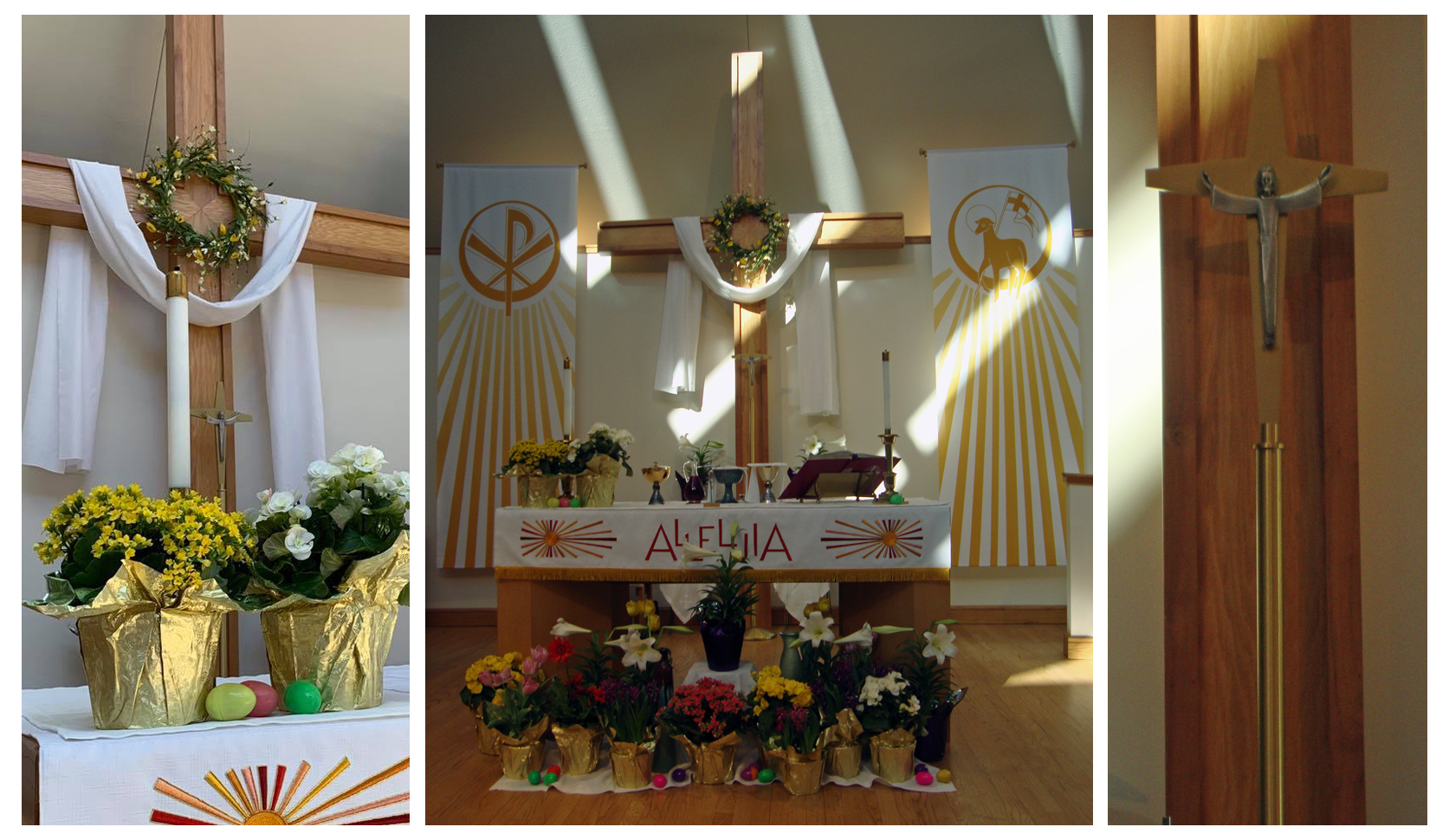
When I visit various churches, I usually encounter one of two symbols – a crucifix or an empty cross. During my recent hospital stay, however, I came across a symbol I hadn’t seen before. 

While propped up in bed doing my morning meditation, I noticed what looked like a crucifix – only different somehow – hanging on the wall a few feet away. I had begun to recover after a stint in intensive care, so I got out of bed and walked over to take a closer look. 

Jesus stood in front of the cross – alive – his arms outstretched as if beckoning me to follow him. 

When I looked it up online later, I saw the cross advertised on a Catholic web site as “The Risen Christ.” I’m pretty sure it’s been around for a while and I had simply never noticed it. At any rate, I liked this particular cross.

The traditional crucifix reminds us of Christ’s suffering and sacrifice on Good Friday, while the empty cross prompts us to meditate on Easter and the resurrection. But as I stood looking at the cross in front of me on that Sunday morning just before the beginning of Lent, I found myself meditating on a different subject: “What does it mean to actually follow Jesus?”

I must say that question took on a bit more urgency in the face of a medical trauma that forced me to look my own mortality straight in the eye without blinking. Not only that, but my mother had just been in the hospital twice in as many months, and I’ve had to face the fact that I may not have her in my life much longer. For good measure, my brother-in-law was hospitalized the same time I was and both my cats had just been diagnosed with chronic medical conditions. Yikes!

The cross on the hospital room wall seemed like an appropriate symbol for the occasion. It not only signified the death and resurrection of Jesus, but the cross we all are asked to bear when we become followers. There will be hardship, sacrifice and struggle, the Bible tells us. But this cross also reminded me that we can overcome hard times with God’s help.

This morning I encountered the same “Risen Christ” symbol again, this time at church. 

The altar was all decked out for the Easter Sunday service. A white cloth and a crown of white and yellow flowers draped the empty cross. Easter lilies and other spring flowers filled the entire front of the church. The sanctuary was gorgeous! As was the music – complete with a trumpet, maracas and drums. (The photos below don’t begin to do the scene justice.)

In the middle of all this, I saw the now-familiar figure of “The Risen Christ” on the processional cross carried down the aisle and placed in a stand behind the altar. Jesus was alive, arms outstretched, beckoning us all to follow.

Congregation members and our minister exchanged this greeting:

“Christ is risen!”

“Christ is risen indeed!”

In her sermon, our minister spoke of emerging from our personal “tombs” – sickness, loss of loved ones, broken relationships – and I reflected on the hospital rooms I’d been in over the past couple of months.

As I came forward for communion, I thanked God for having shepherded me – and my mother and my husband and my brother-in-law and my cats – through this unusually challenging Lenten season.

And the real Risen Christ, alive and present among us, seemed to say, “You won’t be able to avoid pain and suffering, but you will transcend it.” 

Happy Easter, everyone!