Unknown's avatar

About seriouslyseekinganswers

I am on a spiritual journey in which I'm questioning everything I think I know.

God’s other book: Pastel hallelujah

Thanks be to God for blooming trees!

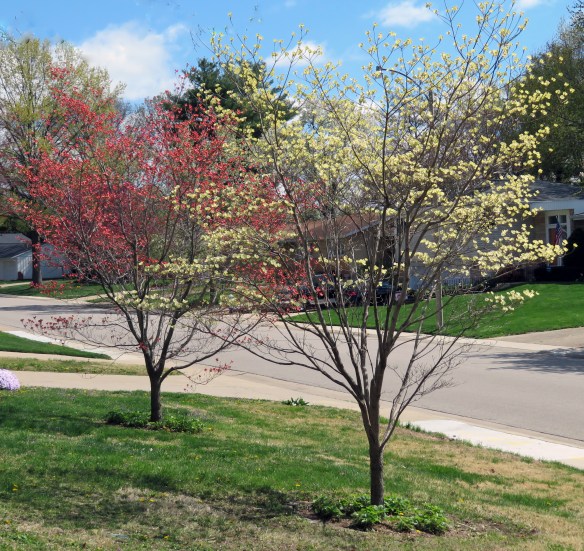
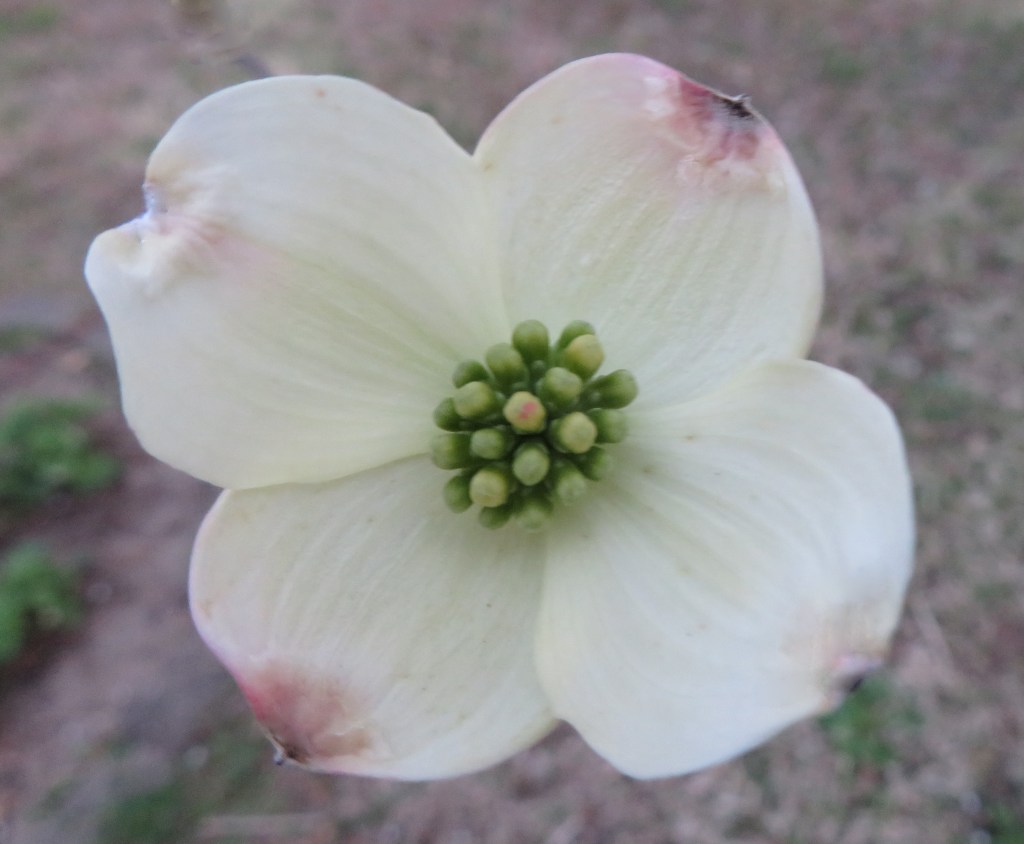
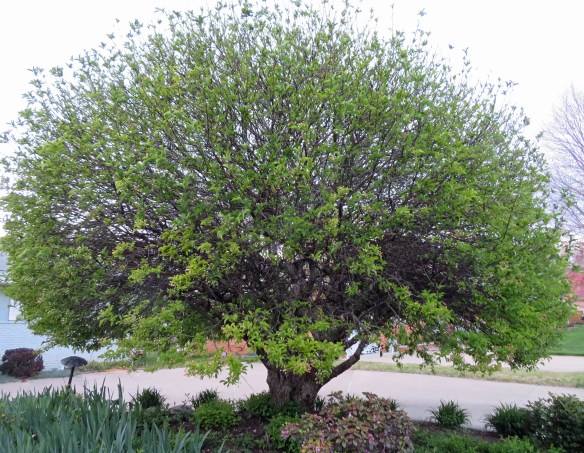
This time of year, our trees are loaded with blossoms and the whole yard, front and back, is awash in lovely spring colors — as if singing a pastel hallelujah.

The trees pictured here, from top to bottom, are crabapple, black cherry, pink and white dogwood, pear, redbud, and a small tree we call “the clubhouse” because dozens of little brown birds gather in its branches for their own choir practice.

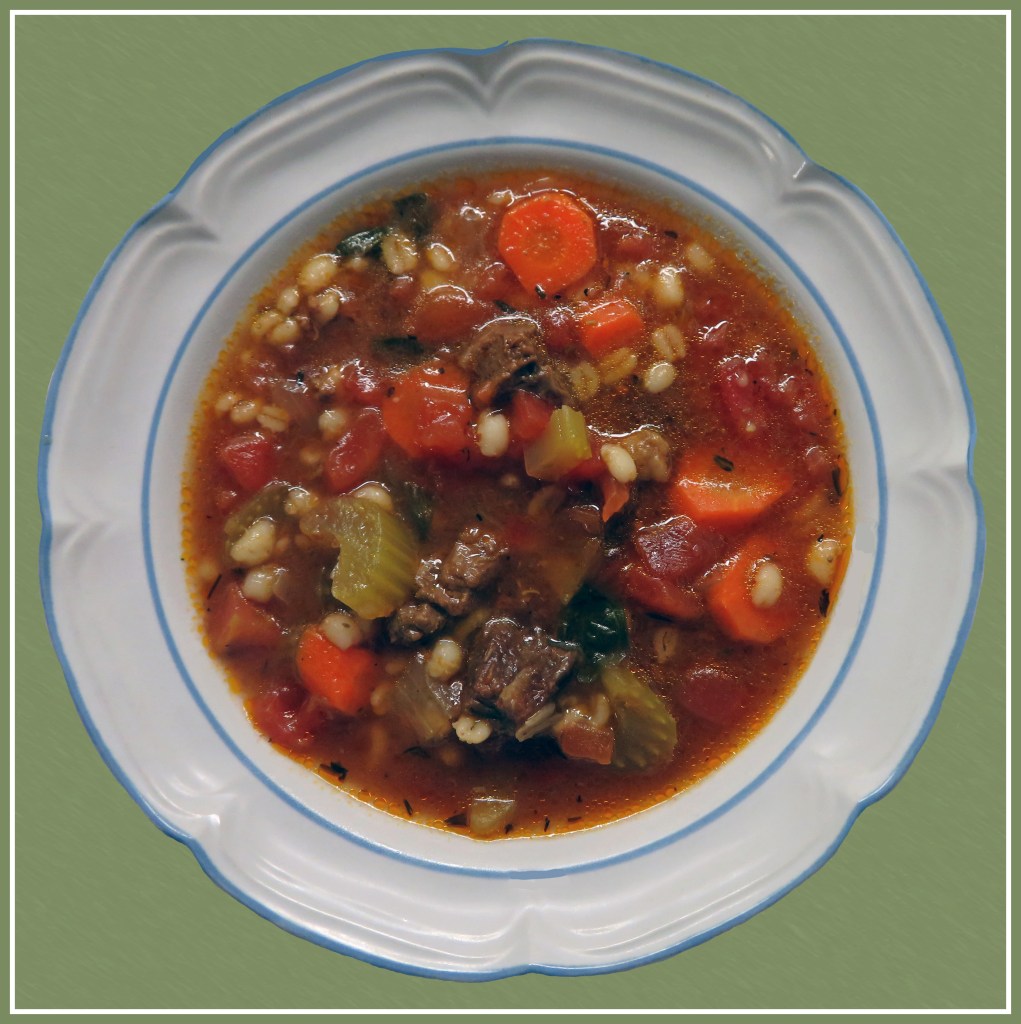
Recipe: Vegetable beef barley soup

One of my best-loved comfort foods is homemade soup, and vegetable beef barley is one of my favorites. 

As I almost always do with home-cooked meals, I’ve tweaked the traditional recipe to make it healthier. I leave out the teaspoon or so of salt the recipe usually calls for, use reduced-salt or no-added-salt ingredients, and substitute a bit more spice to retain flavor. I also cut the amount of meat in half to lower both the calorie count and the cholesterol/saturated fat levels and double the veggies. The result is nutritious as well as delicious.  

The soup is super easy to make. As a bonus, it freezes well for up to three months, and therefore lends itself to batch cooking. This recipe makes approximately 10 one-cup servings.

Ingredients

  • 1 pound beef cubes or crumbled ground beef, browned and drained
  • 2 32-ounce cartons unsalted beef broth
  • 2-3 cups water, as needed
  • 16-ounce can no-added-salt diced tomatoes with juice
  • 16-ounce can no-added-salt whole kernel corn, drained
  • 6 carrots, peeled and diced
  • 6 stalks celery, diced
  • 1 medium onion, diced
  • 1 cup quick pearled barley
  • 1 teaspoon minced garlic
  • 1 teaspoon dried basil
  • 1 tablespoon oregano
  • 1/4 teaspoon black pepper
  • 2-3 small bay leaves

Directions

Cut beef into 1/2-inch cubes, or crumble and brown ground beef, and drain well.

Peel and dice carrots, celery and onion.

Combine all ingredients in a large pot or dutch oven and bring to a boil. Turn down the heat and allow to simmer, stirring occasionally, for approximately a half hour, or until the meat, barley and vegetables are tender.

If the soup begins to get too thick, add water a cup at a time, as needed, to achieve desired consistency.

Nutrition information

Serving size: 1 cup | Calories: 168 | Carbohydrates: 23 g | Protein: 12 g | Fat: 4 g | Saturated fat: 2 g | Cholesterol: 28 mg | Sodium: 78 mg | Potassium: 475 mg | Fiber: 4 g | Sugar: 5 g | Vitamin A: 128% | Vitamin C: 24% | Calcium: 3% | Iron: 6% 

Meet our newest family members

Two furry little friends joined our household shortly before Christmas, and they certainly have made life interesting around here as they bless us with their unique personalities.

We first met Bryce and Elizabeth at The Cat’s Pyjamas, a new “cat cafe” in our community that we were visiting regularly in an attempt to soothe our broken hearts after losing our beloved Champie.

For those who have never been to one, a cat cafe is a coffee shop where people can interact with cats who are available for adoption. The Cat’s Pyjamas works closely with the Animal Protective League, a nonprofit no-kill animal rescue and adoption organization.

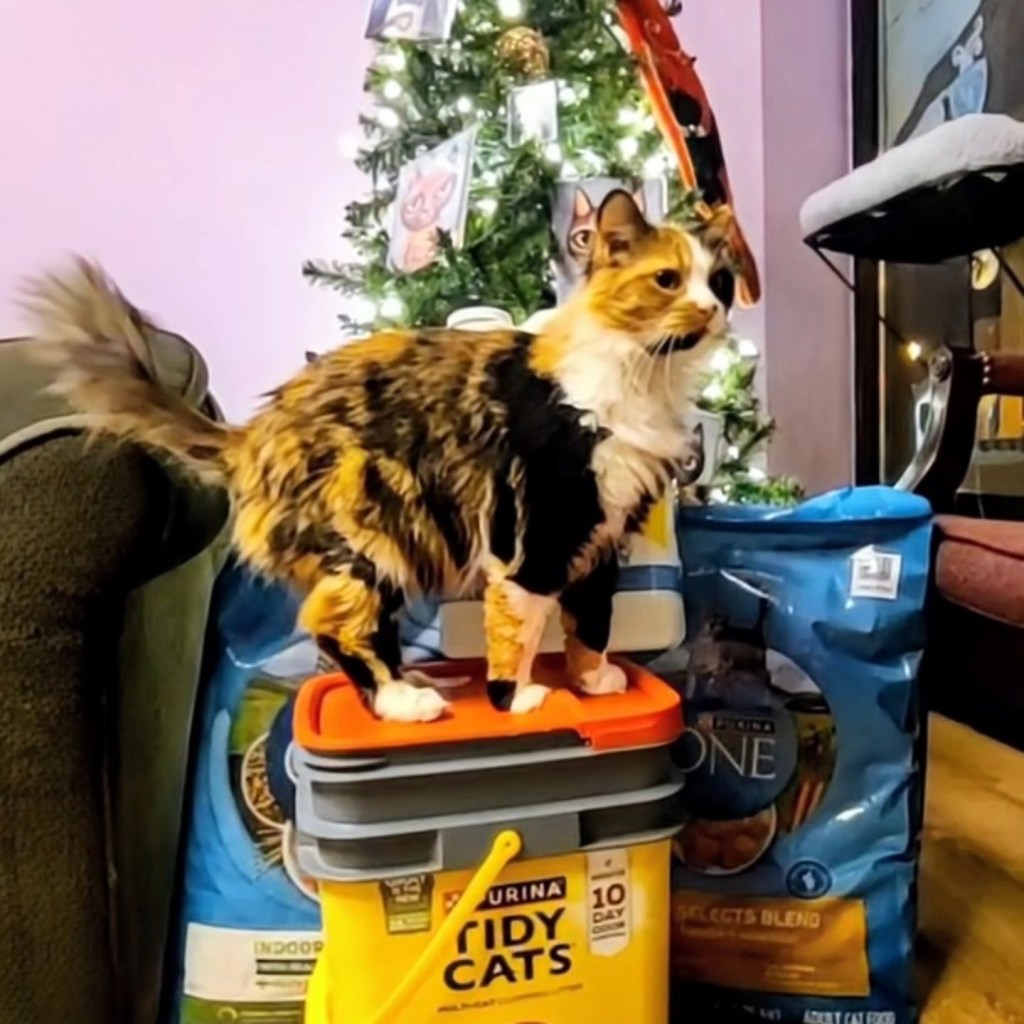
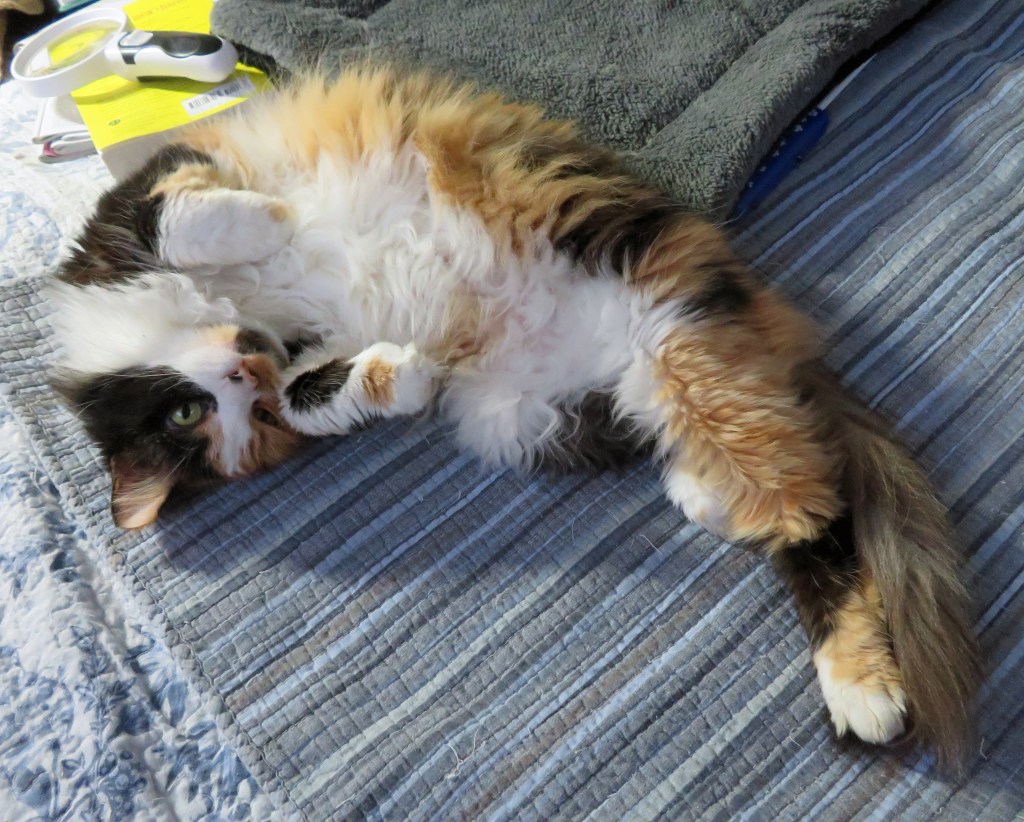
At the cafe, I immediately fell in love with Elizabeth, a gorgeous 10-year-old “tortico” (a combination calico and tortoiseshell). This adorable creature knew how to be the center of attention. We’ve decided her full name should be Queen Elizabeth III.

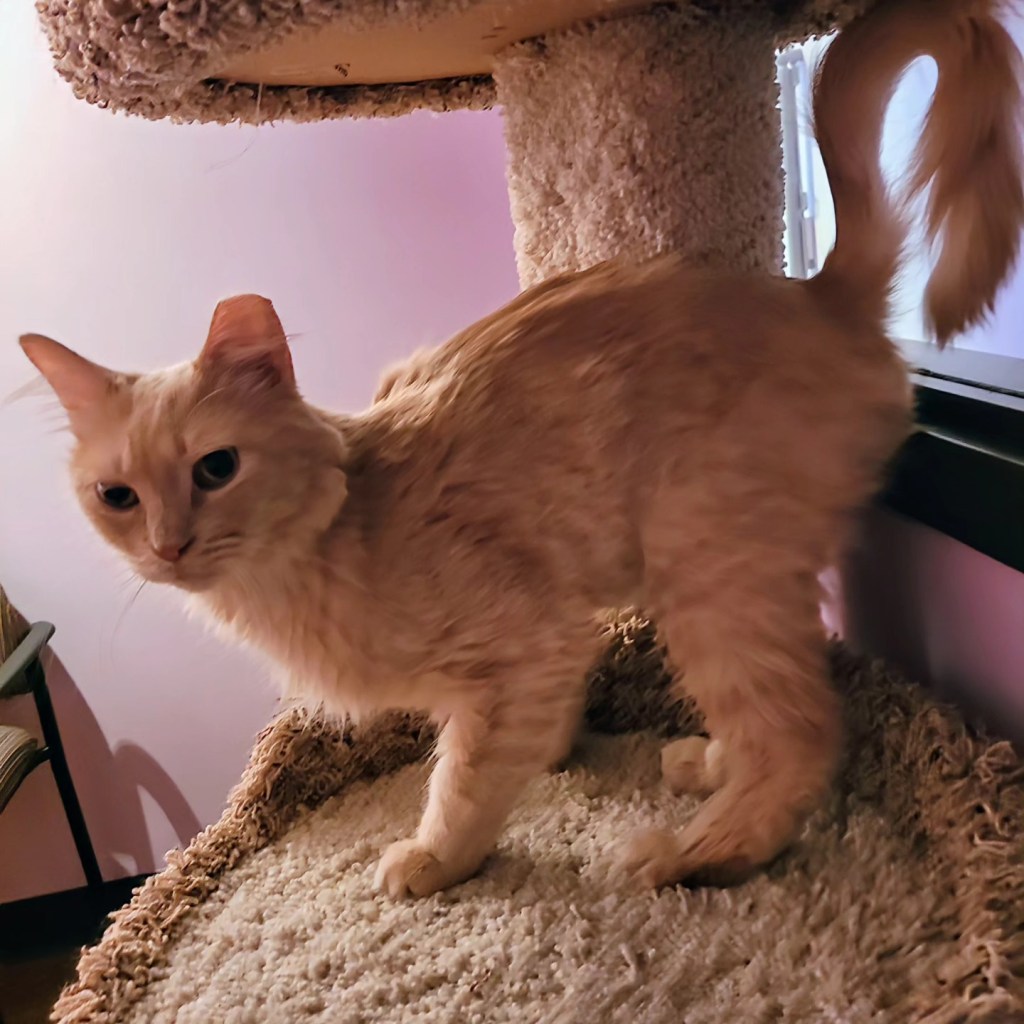
Here’s Bryce posing for the camera on one of the cat trees at the cafe. This cutie was quite a bit more shy than Elizabeth, but he did allow me to pet him and tickle his tummy on one of our visits. Staff told us the reason for his shyness around humans was that he had been rescued from a hoarding situation where he was often bullied by other cats.

As soon as we got our kitties home, Elizabeth spent the first several minutes sniffing every square inch of the house before making herself right at home on our bed. She has been affectionate and engaging and utterly irrepressible from the start.

Within a half hour of arrival at her new home, Lizzie was already rolling over and playing cute for us, and we knew this little girl was going to be quite a character! She loves to hop up on the kitchen table and beg for food, or sit on the back of my chair while I’m at my computer. She also joins me for morning meditation in front of the fireplace.

Alas, for the first several weeks, our little Bryce seemed most comfortable when he was hiding. He disappeared into a pile of boxes in Pete’s office and would not come out as long as either one of us was in the room. We took to calling him Sir Bryce of Boxington Manor and were advised by friends that we should let him get to know us at his own pace.

Elizabeth has fully made our house her own, except for Pete’s office, which we’ve decided is Bryce’s territory. Lizzie is obviously convinced our bed belongs to her, but thankfully she shares it with us.

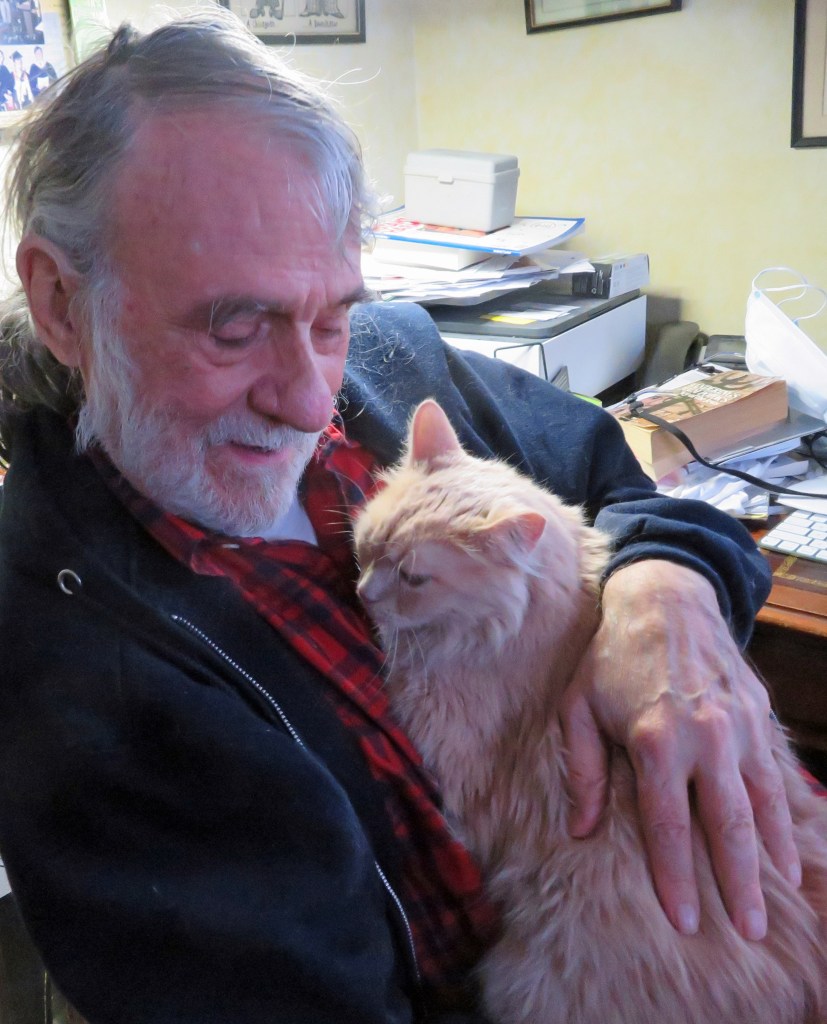
Pete’s tummy, and mine, make perfect cat beds. At least Lizzie thinks so.

After several weeks of attempts on our part to coax little Brycie out of hiding, the co-owner of the Cat’s Pyjamas — who had managed to gain our kitty’s trust while he was living at the cafe — came out to our house and captured the little guy. He placed Bryce on each of our laps so we could finally hold him and pet him. This seems to have prompted a breakthrough.

Brycie has finally begun to get a little more bold. While he continues to stay in Pete’s office, he now comes out of hiding long enough to eat, use his litter box and play with his toys while Pete and I are in the room. I was able to snap this photo of him cuddling up with Pete a couple of weeks ago. What a sweet sight! I hope to see more of this soon and get my own chance to cuddle him.

I consider this photo of Brycie — stretched out on the floor at the Cat Cafe — to be aspirational. Sir Bryce does look like a little lion, doesn’t he? Staff at the cafe said it took several weeks for him to feel comfortable with folks there. So we’re hoping that, with time, he will feel secure and brave enough to lounge in the middle of our living room floor as he learns to feel at home with us.

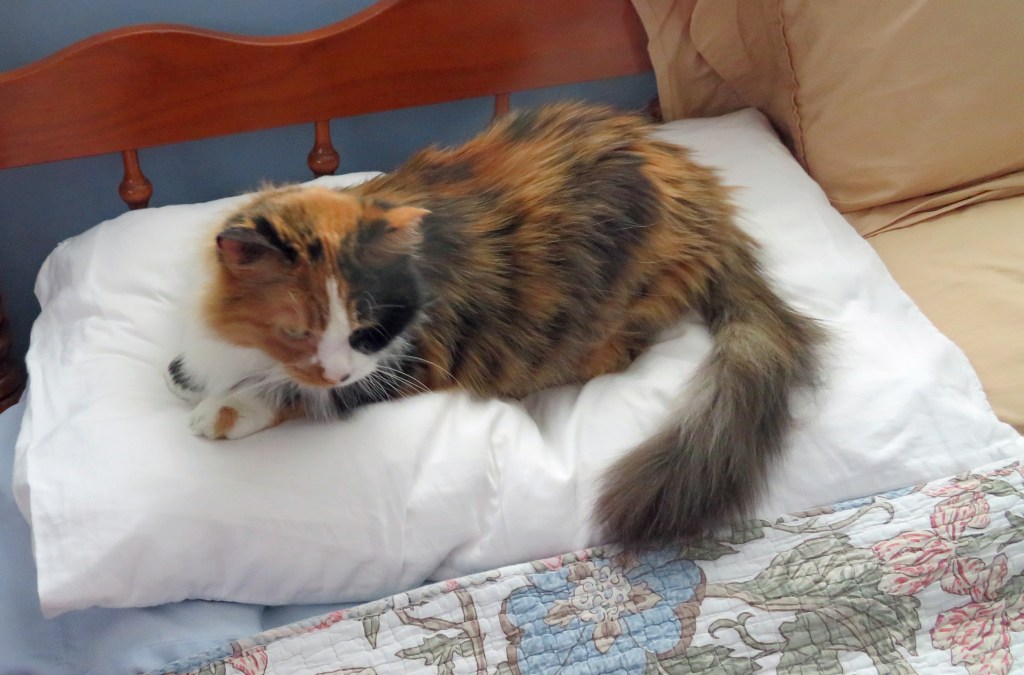
Meanwhile, Queen Elizabeth has made one of my pillows her throne. Or is this a scene from the Princess and the Pea?

The camera just loves this sweet adorably ornery little girl. Doesn’t she look like the Queen of all she surveys?

At any rate, our newest family members have been such a blessing! They’re both so beautiful and adorable. We thank God for them. And we thank the Cat’s Pyjamas and the Animal Protective League for bringing them into our lives.

One small step

As I’ve studied the polarization problem caused by our endless Culture Wars and the negative impact on both ourselves and our society, I’ve begun asking myself these questions:

How do we engage people who disagree with us, while keeping in mind God’s commandment to love our neighbors as ourselves? 

How can we be part of the solution and avoid becoming part of the problem as our society grows ever more partisan and angry?

I’ve decided one of the first small steps I can personally take is to examine my relationship with social media. As I’ve begun doing so, I’ve come to an inescapable conclusion: I need to pay much more conscientious attention to what I post, share and “like” on sites like Facebook and X (formerly known as Twitter). 

If there’s one thing many conservatives and progressives agree on, it’s that social media have played a huge role in keeping the Culture Wars going. In one survey by the Pew Research Center (link HERE), 55 percent of adult social media users said they felt “worn out” by how many combative political posts and discussions they see on these platforms. 

Seven in 10 respondents also said they found it “stressful and frustrating” to communicate on social media with people they disagree with about politics. The sense of exhaustion and frustration held true across political parties, according to the report. 

Several culprits contribute to social media’s role in dividing us. Algorithms that create “echo chamber” bubbles of one-sided information and opinions. Viral spread of false or misleading information in “fake news” stories with click-bait headlines. Political “discussions” that amount to little more than judgmental blaming and shaming, name-calling, insults, character assassination and demonization of opponents. Endless memes promoting hateful and inflammatory messages.

The worst part? I have to admit I’ve been part of the problem from time to time. Too often in recent years, I’ve found myself getting sucked into social media fights – even with people I ordinarily like – over politics and contentious “hot-button” ideological issues.

Whenever a Facebook skirmish erupts – whether the trigger is a Supreme Court decision, a political candidate’s suitability for office, or a crisis playing out on the news – my first instinct is to try and stay out of the fray. 

Alas, I tend to have strong opinions about a lot of issues (imagine that!) and sooner or later, someone will post a meme that I just can’t seem to resist sharing against my better judgment. Okay, I know it’s a bit snarky. Maybe a bit judgmental or even mean. But it’s SO clever. Then, of course, someone on “the other side” will beg to differ with my assessment of the meme’s cleverness, and before I know it, I’m bogged down in another argument.

One evening, I realized I had just spent the better part of a whole day arguing with total strangers on a Christian Facebook page over this question: “Is it racist to make jokes about lutefisklefse and jello at Lutheran potlucks?” (No, I’m afraid I’m not making this up.) I further realized it wasn’t the first time something like this had happened.

So what can I start doing differently?

I’m not ready to go “off the grid” when it comes to social media. With family and friends scattered over two continents, I would not be able to stay connected so well without Facebook. This was especially true during the recent pandemic. 

However, I’ve decided I can take some constructive steps to avoid getting lured into flame wars and to be part of the solution rather than part of the problem when it comes to divisive social media behavior.

I can fact-check articles I want to share before posting them. I personally see nothing wrong with sharing thoughtful, well-researched articles about issues I care about. But I have a responsibility to double-check these for accuracy. Some good sites for fact-checking my sources include Snopes.com (link HERE), FactCheck.org (link HERE) and PolitiFact (link HERE).

I can respect people who don’t agree with me. I’ve learned it’s best to resist lecturing people on their lack of personal integrity or intelligence, even if I think what they’ve shared is just plain wrong. I can’t remember ever changing anyone’s mind about an issue because I sufficiently shamed them. If a Facebook friend posts an inaccurate or misleading article, meme or video, I can skip the snark and simply respond with a link to a Snopes.com article debunking the item in question.

I can practice selective attention. If I don’t agree with someone’s post, I always have the option to keep on scrolling and not respond at all. (What a thought!) 

I can set my own standards of behavior for my own posts. When the vitriol starts, I’ve begun deleting comments from people who choose not to respect others, and even blocking some of the worst offenders. I have blocked or “snoozed” both conservative and progressive Facebook friends who insist on insulting my other Facebook friends.

I can be aware of what I enable. What am I encouraging others to post by hitting the “like” button? Am I inadvertently rewarding name-calling, character assassination or polarizing comments? 

I can resist “click bait.” Sometimes I can tell from the headline that an article is pure negative spin. (Watch Politician A school Politician B on life in the real world.) Given the fact that clicks generate ad revenue, do I really need to contribute one more click in response to that scurrilous article? 

I can avoid using memes to convey complex ideas. One of the problems that keeps us all from resolving issues appropriately is our modern emphasis on brevity. It is nearly impossible to give an issue the depth it deserves when our communication is limited to 15-second sound bites, 280-character tweets, bumper stickers and t-shirt slogans – and all those endless memes.

I can reduce mindless surfing. If I go online with a specific purpose in mind – to check emails, research a blog article or catch up with the latest updates from Facebook friends – and limit my time on social media, I’m less likely to absent-mindedly click on headlines like 21 of the Biggest Political Scandals in History.

Finally, I can use Facebook for its original purpose – to help me keep up with family and friends. How are all my nieces and nephews and dozens of cousins doing? Who’s getting married? Who just had a baby? Which friend got a promotion at work or went on a fabulous vacation? Who just went to the emergency room and needs prayers?

Or I can share cute photos of all the adorable pets Pete and I have shared our home with since we first got married nearly 40 years ago. I’m happy to report I have never had anyone threaten to block or “snooze” me because I posted too many photos of these little sweethearts. 

Fortunately, my Facebook friends over the years have loved Elizabeth, Bryce, Champie, Oley, Angie and Torbjorn as much as my camera and I have.

Questions for readers: How has our society’s polarization impacted you personally? (If you live outside the U.S., is there similar polarization going on in your country?) How do we become part of the solution rather than part of the problem? I’d love to hear your responses to these questions, as well as your comments on this article. Just hit “Leave a Reply” below. When responding, please keep in mind the guidelines I’ve outlined on my Rules of Engagement page (link HERE).

God’s other book: Winter wonder

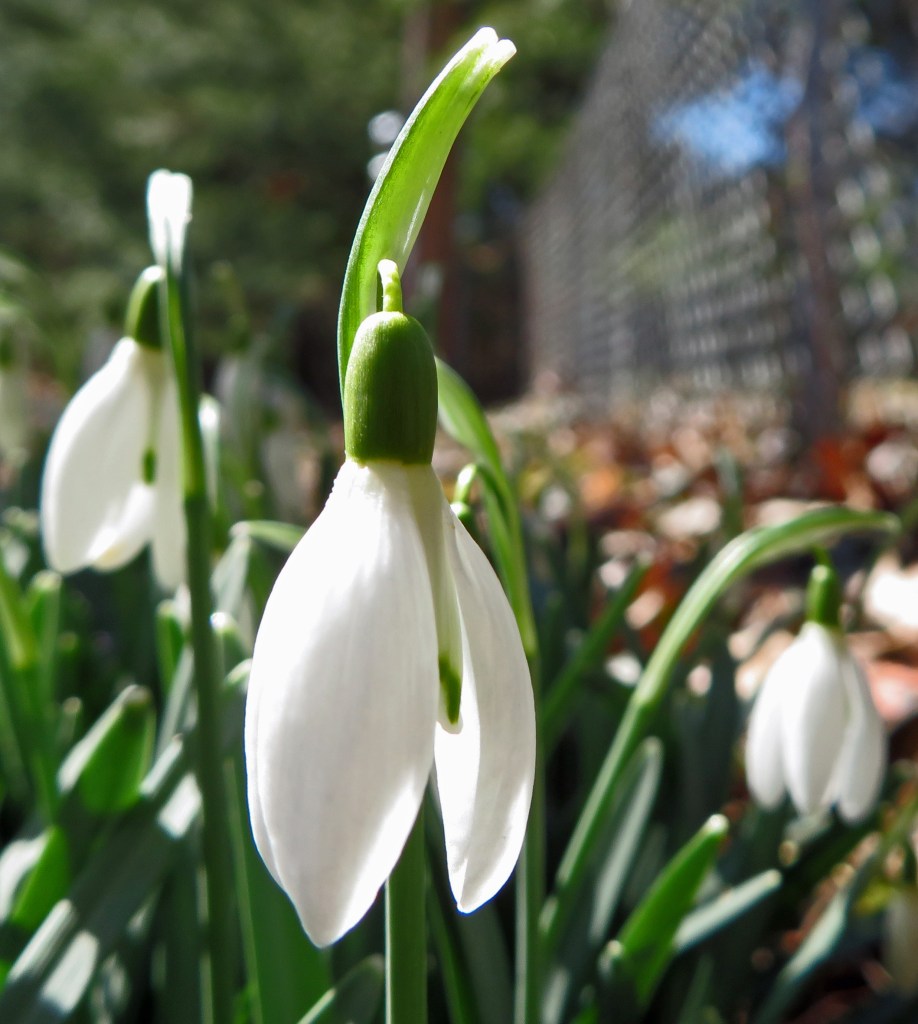
When the weather turns cold, I’m usually tempted to stay inside and hibernate. Alas, God creates such breathtaking beauty with snow (and even ice!) that I’ve been richly rewarded whenever I bring my camera and immerse myself in the great outdoors instead. Here are some of my favorite winter scenes that I’ve managed to capture over the years.

Spiritual direction: Moving beyond survival

As the new year gets underway, I’m looking forward to beginning another year of spiritual direction.

For those unfamiliar with the concept, spiritual direction is a partnership in which one Christian helps another grow in a personal relationship with God, usually through regular one-on-one meetings. The meetings are tailored to each individual’s needs and can include anything from scripture study, prayer and reflection to discernment, goal setting and accountability. My husband Pete and I have been working with specially-trained Dominican Sisters. It’s important to point out that, for us, spiritual direction has been a supplement to – rather than a substitute for – church. 

Several factors led me to seek such direction – the transition in focus and priorities prompted by my retirement; the “time is limited” epiphany that comes with aging, losing loved ones and developing chronic health problems; and the internal tug-of-war over my personal values brought on by the increasing divisiveness and polarization in our society. When Pete saw how much I was benefitting from the process, he decided to embark on a spiritual direction journey of his own.

I can’t help but regard this decision as a “God thing” that came at exactly the right time for us. Since beginning spiritual direction, Pete and I have lost what feels like an unbearably long list of loved ones. COVID-19 upended our lives relentlessly for the better part of two years. Just as everyone else was emerging from the pandemic, we got hit with a stage 4 cancer diagnosis (Pete) and the aftermath of a heart attack (me). As we struggled to cope with a world turned upside down, spiritual direction proved to be exactly what the doctor ordered.

Where I’ve been

I began my own spiritual direction journey by learning how to address those pesky doubts about God’s existence that creep up from time to time – mostly by going outside and immersing myself in nature, which constantly reassures me of the presence of a Creator. I’ve also explored a variety of prayer techniques ranging from meditation, prayers of petition/intercession, prayers of thanksgiving and nature prayer to writing, photography or journaling as forms of prayer.

After about three years of spiritual direction, Pete and I decided to try something completely new and became Dominican Associates – lay people who embrace the Dominican Sisters’ traditions of prayer, study, community and ministry. Associates may undertake individual volunteer ministries in their own churches/parishes and communities, or they may join the Sisters in their ministries by providing logistical support. As the Dominican Sisters told us during our training sessions (and I just love this): Associates “respond to God’s call to share the Gospel by preaching it through the witness of their lives.”

One of the Sisters’ activities that proved particularly attractive to Pete and me was their efforts to combat racism, and we decided to join their anti-racism task force’s Associates Committee. Our involvement in this group, which brings together people of different races to discuss how to address racism both in ourselves and in our society’s institutions, has proven to be an amazing learning experience.

Another of my commitments as an Associate has involved doing my part to preserve and protect the environment through my own habits, such as better recycling, environmentally-friendly gardening and lawn care, creating flower beds for pollinators and reducing our household’s use of fossil fuels. We’ve had extensive landscaping work done – turning our flower beds into a welcome center for hummingbirds, bees and butterflies. As a bonus, the yard is looking beautiful! I like to think of this project as “God’s work, our hands,” and have found gardening to be enormously therapeutic.

Other goals I’ve worked on as part of spiritual direction have included taking a more intentional look at our finances and investment decisions, and – of all things – decluttering.

Our financial “inventory” started with Pete and I updating our wills and power-of-attorney documents, something we’d been putting off. Then we established a donor-advised fund with our local community foundation in honor of Pete’s parents and mine, and have begun making small grants to community organizations that address food insecurity, social justice issues or environmental causes. We also engaged a faith-based organization whose financial advisors are helping us find investment opportunities that match our values.

Decluttering may seem like a trivial goal in the face of everything else we’re dealing with right now, but when the house is a mess, the rest of my life starts to feel unmanageable. Taming clutter is one small thing I can do to feel less helpless when life gets chaotic. My first spiritual director recommended I devote one hour each weekday to sorting through the physical clutter in our house. Alas, I still haven’t achieved my dream of a perfectly clean house with a place for everything and everything in its place, but our house does stay looking at least presentable most of the time.

Where I am now

I like to think of 2024 as a “year of emergence” for us. After what seemed like an endless siege of homebound isolation – first because of the pandemic and then because of our health issues – we’ve been able to return to in-person church services and get-togethers with family and friends, and we’re up to our eyeballs in volunteer commitments.

We help keep our church’s micro pantry filled with food we either buy with generous grant money or pick up from food drives conducted by various civic groups around the community. I’ve taken on the role of chairing our congregation’s community service committee, and I’ve been asked to serve on the church council beginning in 2025. We’re about to begin our fourth year of leading Sundays@6, an adult faith formation class which meets on Zoom. We’ve continued our involvement in the Dominican Sisters’ anti-racism associates’ committee.

While self-care, by necessity, continues to be a major overriding concern, I no longer think of “self-care” simply in terms of buying myself a new outfit or spending a day at the spa. It’s meant putting together a competent medical team and learning to be assertive with health care professionals. Over the past year, we’ve assembled a good medical team that can help both of us get the ongoing physical care we need. We’ve also worked on making our home more handicapped-accessible.

1 Corinthians 6:19 reminds us that our bodies are the temple of the Holy Spirit, and my recent medical adventures have sent an unmistakable message that I need to take better care of mine. My heart – quite literally – is telling me I really, really need to establish better eating habits and a sustainable exercise program, which can also help nurse Pete back to health as he joins me in these things.

I’ve made “emotional health” a priority as well. One might say this was the year I took off the pasted-on smile. In the aftermath of the pandemic and our medical issues, I struggled to establish new routines and ward off exhaustion, depression and despair. Serenity and gratitude are great, of course, but I’ve decided what I really need is to be in touch with all my emotions. Being able to acknowledge when I’m not fine and to reach out for help is essential.

Given our ongoing medical issues, I’ve slowly begun to accept that our lives aren’t going “back to normal” – that is, pre-2022, let alone pre-pandemic – anytime soon. If ever. So how do I continue to keep my most important priorities front and center in the face of our changed reality? Given the nerve-wracking unpredictablity Pete and I live with these days, and the frequency with which my priorities end up sidelined or completely hijacked, I’ve asked myself this question more than once: “Is it even worth it to have priorities, set goals or plan ahead at all?”

It has helped to remind myself that recent years have seen worthwhile accomplishments, despite the barriers created by the pandemic and our ongoing health issues. We’ve continued spiritual direction. Created pollinator beds in our backyard. Set up the donor-advised fund with the community foundation. Led the adult faith formation group at our church. Participated in the anti-racism task force. Maintained my blog and continued to work on my book.

Perhaps the biggest challenge has been learning to live with uncertainty as I adjust to the limitations posed by medical and disability issues, seek appropriate help, and learn to appreciate those ordinary days one day at a time in the face of not knowing what’s coming next. I’ve leaned on the Serenity Prayer more times than I can count: “God, grant us the serenity to accept the things we cannot change, the courage to change the things we can, and the wisdom to know the difference.”

When facing uncertainty, the Holden Village Prayer of Good Courage has also been especially helpful: “Oh God, you have called your servants to ventures of which we cannot see the ending, by paths as yet untrodden, through perils unknown. Give us faith to go out with good courage, not knowing where we go, but only that your hand is leading us and your love supporting us, through Jesus Christ our Lord. Amen.”

Where next?

So what’s ahead as I continue my spiritual direction journey in 2025?

In previous years, I’ve tended to create a fairly lengthy list of goals – lists that got seriously hijacked as health issues intervened and dominated our lives. My spiritual director has suggested I select no more than one or two areas to focus on – much more realistic, I would agree.

Okay, so I came up with three goals rather than one or two. But a couple of them are a continuation of things I’ve been working on already. Here’s where I want to focus my attention in the coming year:

Emotional and spiritual health. Because our physical health issues at this point are chronic rather than curable, keeping our heads above water is going to present a challenge for my husband and me going forward. Nevertheless, we want our lives to move from merely surviving to thriving. Hopefully, with God’s help, our continued spiritual direction work can be a key part of making that happen.

All three spiritual directors we’ve worked with so far have coped with cancer and other debilitating or disabling chronic conditions, and it has been inspiring to see the ways they’ve been able to contribute to their communities in spite of their challenges. Our first two spiritual directors are now, sadly, deceased. But they continued to do God’s work right up to the end, and Pete and I have been impressed enough to say to each other, “We want to be like that.”

My writing. I also want to focus more sustained attention on my writing, especially my book-in-progress. From age 10 onward, I’ve dreamed of writing a book. Almost 60 years later, that goal is … still on my bucket list. I have nearly two dozen excerpts written and need to stay motivated so I can make real progress on the book. I want to keep working on my blog. I’ve known since grade school that writing would play some role in my life’s purpose, whatever that turned out to be. I do consider my writing ability to be a gift from God that should not be wasted. 

Discernment. Finally, I want to focus more attention on the discernment process that led me to embark on this spiritual direction journey to begin with. What is God’s purpose or plan for my life going forward? How do I live my life in a way that is consistent with my beliefs and values? What are my own beliefs about the hot-button issues that consume our nation’s culture warriors? What is my role as a Christian in fighting or mitigating society’s problems and political battles?

From the beginning, I have been questioning all kinds of dogma, from the spiritual and religious to the political and ideological. This “deconstruction/reconstruction” work started with questioning a lot of things I thought I knew, along with beliefs and values other people – whether liberal or conservative – want me to hold. I want to continue developing a belief/value system that both my rational mind and my conscience can accept, rather than simply parroting a set of values and beliefs that will let me fit in chameleon-like with my peers.

This discernment process has gotten sidetracked several times, so I do want to make an especially conscientious effort this year to overcome my inertia – and fear, perhaps – so I can stay on track in this vital area.

Whatever happens in the days, weeks or months ahead – especially with our medical issues – I’m asking God for courage, wisdom, healing and hope for both Pete and me as we move forward. Meanwhile I can remind myself, in the words of the 23rd Psalm, “I will fear no evil, for thou art with me.”

Our annual Christmas letter

This past year, Pete and I have been truly blessed.

As most of you know, my husband has been battling Stage 4 cancer for two years. In November, Pete’s oncologist pointed out that his every-three-month scans have been coming back “unremarkable” (translation – no signs of recurring cancer) for at least a year. This means his immunotherapy treatments appear to be working, and even better, with minimal side effects. The doctor was practically ecstatic as he expressed cautious optimism about Pete’s prognosis.

Besides the good news about Pete, I received some good news of my own earlier this year: My cardiologist said tests show my heart sustained only minor damage from the heart attack I had in December of 2022. I continue to participate in cardiac rehab, and Pete has even joined me for the exercise portion. He has the honor of having been accepted into the hospital’s Stay Fit exercise program for both pulmonary and cardiac rehab. (Ah, the joys and perks of old age! We get to have Medicare pay for our fitness workouts.)

So, 2024 has given us a blessed reprieve from the ring-tailed monster of a year we experienced in 2023, thanks be to God, and life is slowly returning to … dare I say it? … normal. In other words, we have a LOT to be grateful for this year.

On a very sad note, we had to say goodbye in November to our lovable, ornery, beautiful Champaign Le Chat. Champie was a “rescue kitty” we adopted from the Animal Protective League shelter 17 years ago, but there could be a definite debate about who rescued whom. He was such a sweet little buddy to us as we endured our roller-coaster medical saga. We often referred to him as our furry little comforter. He had us utterly wrapped around his paw and we loved him SO MUCH!!!! We are SO grateful to have had him in our lives for so many years.

Here is one of my all-time favorite photos of our little Champster, which I like to call “The Prince and the Pea.” He was definitely one of our blessings.

After what seemed like an endless siege of homebound isolation – first because of the pandemic and then because of our health issues – we’ve been able to return to in-person church services and get-togethers with family and friends, and we’re up to our eyeballs in volunteer commitments.

We’ve committed to help keep our church’s micro pantry filled with food we either buy with generous grant money or pick up from food drives conducted by various civic groups around the community. This year, I took on the role of chairing our congregation’s community service committee, and I’ve been asked to serve on the church council beginning in 2025.

We’re about to begin our fourth year of leading Sundays@6, an adult faith formation class which meets on Zoom. So far, we’ve covered subjects ranging from the 10 Commandments to evangelism to how our faith should impact the way we address current issues. The group has about a dozen regulars who “attend” each week, and the discussions are quite lively. We absolutely love this group, and it has played a vital role in keeping members who are homebound connected to our congregation, including ourselves until May of this year when Pete’s oncologist finally let us come out and play with the other kids.

For the past two years, we’ve been involved in an anti-racism committee created by our community’s Dominican Sisters Associates program. The group, which meets on Zoom every other month, brings together people of different races to discuss how to recognize and address racism both in ourselves and in our society’s institutions. Participating in this group has been an amazing learning experience and we’ve been honored to be part of it.

We also continue to participate in spiritual direction with one of the Dominican Sisters. Spiritual direction – for those unfamiliar with the concept – is a partnership in which one Christian helps another grow in a personal relationship with God. Monthly one-on-one meetings have involved examining our prayer life, our personal values and various lifestyle choices. Another amazing learning experience for both of us!

For several years now, we’ve been working to make our yard an urban sanctuary for wildlife and turn our flower beds into a welcome center for hummingbirds, bees and butterflies. We try to add a few native perennials each year, as well as planting an abundance of annuals and avoiding lawn chemicals. I’ve found gardening to be therapeutic, and the yard is looking beautiful! Pete and I like to think of this project as “God’s work, our hands.”

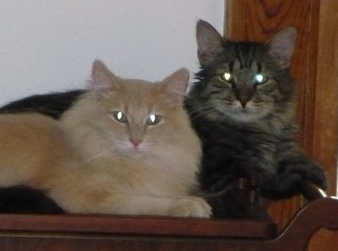
And … just in time for Christmas, the Animal Protection League has allowed us to adopt two new little blessings. The gorgeous “tortico” (a combination of torti and calico) is Queen Elizabeth. The handsome yellow guy is Bryce. We met them at the Cat’s Pyjamas Cat Café, a new business in town with lounges and refreshments for people who want to relax by petting cute kitties. Their cats are all adoptable through the APL. We’re sure these two will make our house theirs before too long.

If the past couple of years have taught us nothing else, they’ve taught us to appreciate the “boring” days we used to take for granted, or even complain about. Sometimes there’s nothing more wonderful than an uneventful day. No distressing symptoms. No rides to the emergency room in the back of an ambulance. No test results with nasty surprises. Just laundry, vacuuming, groceries, church committee meetings and other soothingly routine activities. 

I’ve been blown away by Pete’s extraordinary strength and courage as he has plowed through chemotherapy, major surgery, hospitalizations due to infections and other complications, and finally, immunotherapy treatments that are working so far. And now he joins me for my cardiac rehab exercise program at the Prairie Heart Center twice a week. He’s also been a great “therapy skunk” for me, coming with me to my medical appointments and backing me up when I need a doctor to take me seriously or answer my questions.

We are both beyond grateful for the mountain of get-well wishes and prayers, the delicious meals sent to our house when we didn’t feel like cooking, the cat photos and baby goat videos and bad puns posted to our Facebook pages to cheer us up, and the many other things our wonderful family members and friends did during our “walk through the valley” to help us feel supported and loved. The steady stream of prayers, cards and visits helped us more than people know.

Here’s hoping everyone has a merry Christmas and a happy and healthy New Year full of grace and peace!

Ostkaka

This Swedish dessert is a favorite at our house during the Christmas season, and has been passed down in my family for several generations.

The name ostkaka can be roughly translated as “cheesecake” – “ost” meaning “cheese” and “kaka” meaning “cake.” But the dessert is a bit different from American cheesecake, not quite as sweet and with a slightly different texture.
To make it, older generations of my family used curdled milk, produced by adding rennet to a mixture of warm milk and flour. They then added heavy cream, sugar and eggs to make a batter. My parents’ generation simplified the recipe, using cottage cheese in place of curdled milk, and it tastes the same (at least to me). Needless to say, the latter version is much easier to make.

Over the years, my mother and I developed a few additional recipe adjustments to accommodate diabetes and other dietary restrictions. I use fat-free cottage cheese, substitute egg beaters for the eggs, substitute half and half or even whole lactose-free milk for the heavy cream, and replace sugar with an equivalent amount of sugar substitute. Rice flour can be used to make the recipe gluten free. The result is still delicious.

Our family likes to serve the ostkaka with lingonberries, but if these prove hard to find, strawberry jam or sliced strawberries can also be used.

Ingredients

  • 4 eggs or 1/2 cup egg beaters
  • 3 cups fat-free cottage cheese
  • 2 cups half & half or whole milk
  • 1/3 cup regular or rice flour
  • 1 teaspoon vanilla or almond extract
  • Sweetener equivalent to 1/2 cup sugar
  • Lingonberries, strawberry jam or sliced strawberries

Directions

Blend together the eggs, sweetener, cream or milk, flour and extract until smooth.

Stir in the cottage cheese until well-blended and pour the mixture into a cake pan.

Bake in a 350-degree oven for an hour, or until it rises a bit and is slightly brown on top.

Allow the dessert to cool at least four hours or overnight in the refrigerator.

Top each individual serving with about a tablespoon of lingonberries, strawberry jam or sliced strawberries.

Nutrition information

My version, made with egg beaters, whole milk and sugar substitute, topped with a tablespoon of lingonberries.

Serving size: 3/4 cup | Calories: 120 | Carbohydrates: 14 g | Protein: 10 g | Fat: 2 g | Saturated Fat: 1 g | Cholesterol: 13 mg | Sodium: 300 mg | Potassium: 240 mg | Fiber: 1 g | Sugar: 9 g | Vitamin A: 9% | Vitamin C: 0% | Calcium: 17% | Iron: 1%