Thoughts on sacrifice

Each Lenten season, as I contemplate the subject of sacrifice, a favorite childhood memory comes to mind.

My sisters and I were sitting around the kitchen table one afternoon after school discussing what we planned to give up for Lent that year – cake, ice cream, candy, chocolate – when my father added his two cents to the conversation. “I’ve never been a fan of sacrifice just for the sake of it,” he said thoughtfully. “Not when life itself gives us so many opportunities to make real sacrifices. If you’re going to give something up, your sacrifice should actually make a difference.”

We all looked at him quizzically.

Dad grinned from ear to ear. “Instead of cake and ice cream, why don’t you kids give up fighting for Lent?”

“That’s a wonderful idea,” Mom chimed in. “Just imagine – six whole weeks with no kids fighting!

Being charitable toward a sibling guilty of looking at me the wrong way proved a bit more challenging than forgoing a candy bar. Nevertheless, I think my sisters and I may have accomplished this feat for a whole day or two.

A story circulating on Facebook quotes an anonymous priest whose approach to Lenten sacrifice echoes my father’s: “Jesus would probably laugh at us for giving up chocolate or coffee – things that bring us joy and make us happy. What he might suggest instead is giving up things that make us miserable – jealousy, greed, gossip.”

Both Dad’s observation and the priest’s seem to fit pretty well with what the Bible teaches about sacrifice.

“For I desire mercy and not sacrifice,” says Hosea 6:6, “and the knowledge of God more than burnt offerings.”

Isaiah 58:6-7 offers an example of sacrifice that really makes a difference. “Is not this the fast that I choose: to loose the bonds of injustice, to undo the straps of the yoke, to let the oppressed go free, and to break every yoke? Is it not to share your bread with the hungry and bring the homeless poor into your house; when you see the naked, to cover them and not to hide yourself from your own kin?”

Micah 6:8 elaborates. “And what does the Lord require of you but to do justice and to love kindness and to walk humbly with your God?”

In other words, not all sacrifices are created equal.

At its best, sacrificial giving offers an amazing way to show love for our neighbors, whether we do something small like filling a neighborhood micro pantry with groceries, or something major like assuming the caregiving role for a family member with dementia. At its worst, “sacrifice” can go horribly wrong – suicide bombers come to mind.

Even the best of us can make somewhat misguided sacrifices. We’ve all known parents who give their children everything – everything, that is, but their time and attention. Or we commit too much of our time to things that don’t really matter because we can’t say “no.” Such self-sacrifice often leads to resentment and, ironically, may not truly benefit anyone in the long run.

Then we have performative sacrifice – giving that lets us feel self-righteous and is designed more for our own benefit than for others. Some businesses make charitable contributions that seem like nothing more than a cynical ploy to keep their brand in front of the public. Or someone buys a meal for a homeless person and takes a selfie to post on social media. This virtue signaling may be what Jesus had in mind when he said in Matthew 6:2, “Whenever you give alms, do not sound a trumpet before you, as the hypocrites do … so that they may be praised by others.”

And how much sacrifice is enough? In recent years, some of us were only half-joking when we said it felt like Lent had been going on since Ash Wednesday in 2020, which came just days before the pandemic shut everything down. “Haven’t we given up enough already?” we asked plaintively.

In all seriousness, we may rightly decide a particular goal isn’t worth the sacrifices we would need to make in order to achieve it. Earlier in my life, I learned the hard way that we should not sacrifice too much of what is important to us at the altar of career success, only to discover that the brass ring isn’t so shiny once we’ve grabbed it.

Most of us don’t mind a certain amount of sacrifice as long as the expectations are fair. For example, we might agree that asking others to make sacrifices we wouldn’t make ourselves is manipulative and hypocritical. I’m thinking of corporate executives who exhort employees to “make sacrifices for the company” in the form of substandard pay and abysmal working conditions while awarding themselves exorbitant salaries and bonuses.

The scriptures in several places suggest tithing – sacrificing 10 percent of our income. In Mark 10:20, Jesus also tells a rich young man to “go, sell what you own, and give the money to the poor.” So far, I have yet to meet anyone who has actually followed the advice given to the rich young man, and many of us (myself included) have tended to regard tithing as “aspirational.”

Most of us would probably agree that those who have more should give more. Mark 12:41-44 comes to mind here: Jesus sat down and “watched the crowd putting money into the treasury. Many rich people put in large sums. A poor widow came and put in two small copper coins, which are worth a penny. Then he called his disciples and said to them, ‘Truly I tell you, this poor widow has put in more than all those who are contributing to the treasury.’” 

So if we’re giving up something for Lent – or making sacrifices any other time of the year, for that matter – what kinds of sacrifices are appropriate, reasonable and acceptable to God?

Like my father said, life itself presents us with plenty of opportunities to make real sacrifices. Examples that come to mind include our need to always be right, our desire to retaliate when someone offends us, our compulsion to multitask when someone needs our undivided attention, our mindless screen time that crowds out activities with family and friends.

In recent years, some of my friends, both Catholic and Protestant, have added a new tradition to their Lenten discipline. Instead of – or in addition to – giving something up, they approach Lent as a time to “take something on” and acquire a new positive habit. This could include anything from healthy eating and exercise to daily prayer and meditation to a new charitable commitment.

Since Ephesians 4:22-24 tells us to put off the “old self” and put on a “new self,” including such “add-ons” during Lent makes sense. Adding positive new habits often entails moving beyond our comfort zone, which can be a sacrifice in itself. Psychologists say it takes about 30 days for a new behavior to become a habit, so Lent gives us a bonus of 10 extra days to make a new habit our own.

Last year, my spiritual director suggested coming up with a list of fun or relaxing activities my husband and I could do together, which required both of us to pry ourselves away from our computers and sacrifice time spent doom-scrolling for salacious reporting about the latest political scandal. 

If we’re at all honest, we have to admit that we actually receive significant benefits from self-sacrifice. Giving to others helps us feel empowered and good about ourselves. This became more clear to me during the pandemic, when my husband and I found ourselves looking for ways to keep giving to others despite the COVID restrictions and our respective health problems. It reminded us that the world still needed what we had to offer. We need to feel needed.

We’ve also found that letting people give to us can, believe it or not, be a form of sacrifice. Doing so can mean surrendering our illusions of self-sufficiency, while at the same time giving others a chance to feel good about themselves. When Pete and I were both recuperating from hospital stays in the same month, friends and relatives were quick to offer various kinds of help. Our first impulse was to say, “We’re fine. We don’t need anything.” Instead, our cancer support group facilitator suggested, “Let them help.” The result was several delicious meals delivered to our door at a time when neither of us felt up to cooking.

Finally, in this era of relentless culture wars, I’m reminded of the Biblical passage about making peace with our neighbors before bringing our offering to the altar. Matthew 5:23-24 says, “When you are offering your gift at the altar, if you remember that your brother or sister has something against you, leave your gift there before the altar and go; first be reconciled to your brother or sister, and then come and offer your gift.”

It would seem that Dad was right after all: We need to give up incessant and pointless fighting. Then – maybe – let’s talk about forgoing chocolate ice cream.

Adding and subtracting for Lent

When it comes to healthy eating, I’m not one to weigh and measure every single thing I put on my plate. Nor do I have the patience to constantly track calories. My common sense tells me to avoid crash diets that ask us to eliminate whole food groups, even if they promise to take off ten pounds in one week. And I’ve learned the hard way that putting any item on a forbidden list only makes me suddenly crave it.

For me, taking off weight has required developing sustainable habits I don’t need to think about – at least not too much – once they’re established. And what better time to initiate a new positive habit than during Lent? Some experts say it takes about 30-40 days for a habit to get firmly established, so the time frame is perfect.

In recent years, some people I know have added a new tradition to their annual Lenten discipline. Instead of (or in addition to) giving something up, they approach Lent as a time to “take something on.” This could include anything from daily prayer and meditation to better self-care to a new charitable commitment.

Since Ephesians 4:22-24 tells us to put off the “old self” and put on a “new self,” I’ve begun including both a sacrifice – or “subtraction” – and an “add-on.” That is, I dedicate each Lenten season to acquiring a new positive eating habit as well as ditching a negative one. 

This addition/subtraction process makes sense to me psychologically. Experts agree shedding a habit can be hard unless we replace it with something else. Examples I’ve adopted include replacing salt with herbs and spices, replacing “refined” starches with more fiber-rich whole foods, and replacing sugar- and fat-laden munchies with “legal” snacks.

Over the years, these small tweaks to my eating habits have yielded great long-term benefits. Here are some habits I’ve added and subtracted during the past few Lenten seasons, along with a couple new ideas I will be working on this year:

  • Subtract added sugar. I’ve found that some things – cornbread, applesauce, dry cereal, iced tea – actually taste better when they’re not gunked-up with added sugar. I’ve also become an inveterate label reader because I’ve learned that manufacturers sneak the nefarious substance into all kinds of foods where one wouldn’t expect to find it, from ketchup and peanut butter to fat-free yogurt. Thankfully I’ve discovered “no added sugar” versions of all these things.
  • Add fruits and vegetables. The U.S.D.A. recommends we eat at least 3-5 vegetable and fruit servings per day. I’ve come up with several ways to slip more of these into my diet – adding a small salad to my lunch, adding spinach or other veggies to pasta dishes, replacing soda with a small glass of V-8 juice. See my blog post “Meeting My 3-5 Challenge” (link HERE) for a list of ideas.

  • Subtract added salt. Again, I always check labels – more and more popular brands now offer reduced-sodium versions of their soups, sauce mixes and other products. Frozen vegetables are just as nutritious as fresh produce, and less likely to contain salt than canned veggies. Since I’ve begun replacing the added salt called for in many of my recipes with herbs and spices, I’ve found I don’t even miss the salt.
  • Add fiber. One easy way to do this is to substitute whole-grain bread, cereal and pasta for the refined stuff. Other good sources of fiber include raw veggies, avocados, berries, legumes, nuts and seeds. I also don’t peel potatoes, cucumbers or apples.
  • Subtract red meat. Being a Midwesterner raised on a farm, I grew up eating lots of beef and pork. While I don’t plan to eliminate these from my diet – at least not at this time – I have begun to replace some “red-meat” meals each week with fish, chicken, eggs or a plant-based protein such as beans or lentils. 
  • Add healthy snacks. I’ve developed a repertoire of “legal” between-meal nibbles. Best are munchies that help me meet my daily quota of fruits and vegetables, such as fresh fruit chunks and raw veggies with dip. Also good are snacks that have higher protein content and fewer carbs, such as a small dish of sugar-free pudding made with fat-free milk, or snacks high in fiber such as air-popped popcorn.
  • Subtract impulse buys. I’ve found it much easier to avoid eating “junk” if I don’t bring it into the house in the first place. Grocery shopping with a list helps, as does not shopping when I’m hungry. Since the pandemic began, I’ve been ordering groceries online and having them delivered, which makes avoiding impulsive purchases so much easier that I plan to continue shopping this way once the quarantine is over.
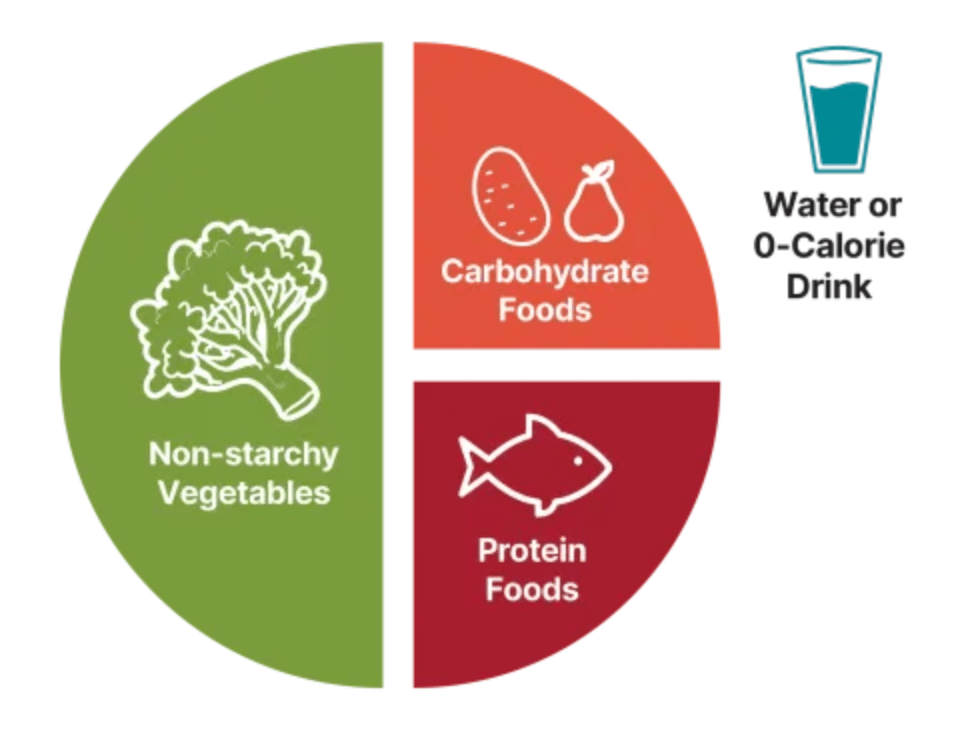
  • Add portion control. The “plate method” suggested by the American Diabetes Association is attractive because there’s no weighing, measuring or calorie-counting. (Note: You don’t have to be diabetic to use it.) The plate method involves filling half a nine-inch plate with non-starchy vegetables such as lettuce, broccoli or carrots, one-quarter of the plate with whole grains or starchy vegetables such as corn or potatoes, and one-quarter of the plate with a protein source. For detailed information on the plate method, link HERE and HERE.
Source: Centers for Disease Control

I feel it’s important for me to point out that I didn’t make all these changes at once. Each Lenten season, I’ve made one or two small changes at a time, which means the new habits have been acquired over a period of years. For example, the first year I focused on subtracting added sugar and adding more fruits and veggies on my plate. Since then, I’ve added/subtracted a new habit or two each year. This year I will be working on avoiding impulse buys and using the plate method for better portion control. Baby steps, as my spiritual advisor always liked to say.

The good news: These baby steps really do work. So far, I’m about 25 pounds down from my top weight. Yes, the weight has come off much more slowly than it would have with a crash diet, but the bottom line is that it’s staying off.