Recipe: Fruktsoppa

Fruktsoppa, a fruit soup using dried fruit, is a traditional dessert in Sweden and Norway. 

When I was growing up, this dish was a staple at extended-family gatherings during the holidays. But fruktsoppa is so tasty, why reserve it only for Christmas? 

The soup may be served as a side dish at breakfast or as a dessert at other meals. What a delicious way to help meet our goal of 3-5 servings of fruits or vegetables per day!

The original recipe calls for added sugar, but I totally leave it out. Because the fruit itself is naturally sweet enough, who needs the added carbs and calories?

The soup can be frozen up to three months, which makes it great for batch cooking.

This recipe makes approximately 10 half-cup servings.

Ingredients

  • 1 cup dried apricots
  • 1 cup dried prunes
  • 2 apples, sliced
  • 1/2 cup dried currants or raisins
  • 1-2 cinnamon sticks
  • 1 tablespoon lemon juice
  • 3 tablespoons quick-cooking tapioca
  • 6 cups water

Directions

Soak apricots in the water for at least a half hour. 

Add the apple slices, cinnamon sticks, tapioca and lemon juice and bring to a boil. Reduce heat and allow to simmer for about 10-15 minutes, stirring occasionally to keep fruit from sticking to the bottom of the pan.

Add prunes and currants and continue to simmer until all fruit is tender.

Serve hot or cold, depending on your preference.

Nutrition information

Calories: 115 | Carbohydrates: 30 g | Protein: 1 g | Fat: .3 g | Saturated Fat: 0 g | Cholesterol: 0 mg | Sodium: 7 mg | Potassium: 383 mg | Fiber: 3.5 g | Sugar: 22 g | Vitamin A: 12% | Vitamin C: 4% | Calcium: 2% | Iron: 4%

Recipe: Chicken and vegetable pozole

Pozole is a traditional Mexican soup made with hominy, meat (usually pork or chicken) and lots of delicious seasonings.

As anyone who regularly follows my blog knows, I’m always looking for ways to sneak more wholesome stuff like vegetables and fiber into my diet while ditching the bad stuff like added salt and sugar.

So I’ve created a variation on this favorite that reduces both calories and carbs, features extra veggies and eliminates added salt without sacrificing a bit of the flavor. It’s also gluten-free (be sure to check the label on the hominy). If you omit the chicken and substitute low-sodium vegetable broth for the chicken broth, it can even be made vegetarian.

This recipe makes about 10-12 cups of soup and is perfect for batch cooking. The soup can be frozen for up to three months.

Ingredients

  • 2 large boneless, skinless chicken breasts, diced
  • 1 32-ounce carton low-sodium chicken broth
  • 1 tablespoon oregano
  • 1 tablespoon ground cumin
  • 1 teaspoon basil
  • 1/2 teaspoon black pepper
  • 3 tablespoons lime juice
  • 3 bay leaves
  • 3 whole cloves
  • 2½ teaspoons chopped garlic cloves
  • 2 small zucchini or yellow squash, sliced and quartered 
  • 4-5 stalks of celery, sliced
  • 4-5 carrots, sliced
  • Medium green pepper, quartered and sliced
  • Medium onion, quartered and sliced
  • 1 16-ounce can white or golden hominy (pozole)

Directions

Stir together the oregano, cumin, basil and black pepper in a small bowl.

Add the chicken, blended spices, lime juice, bay leaves, garlic and cloves to the broth and bring to a boil. Reduce heat and allow to simmer.

While the soup is simmering, chop/slice the squash, celery, carrots, onion and pepper and add to the mixture.

Add 4-5 cups of water, or until the soup is of desired thickness.

Continue to simmer for about a half hour, or until vegetables reach desired softness (slightly al dente) and chicken is completely cooked.

Add the hominy when the vegetables are nearly cooked through.

Nutrition information

Serving size: 1 cup | Calories: 75 | Carbohydrates: 8 g | Protein: 9 g | Fat: 1 g | Saturated Fat: 0 g | Cholesterol: 25 mg | Sodium: 130 mg | Potassium: 372 mg | Fiber: 2 g | Sugar: 3 g | Vitamin A: 85% | Vitamin C: 30% | Calcium: 2% | Iron: 3% 

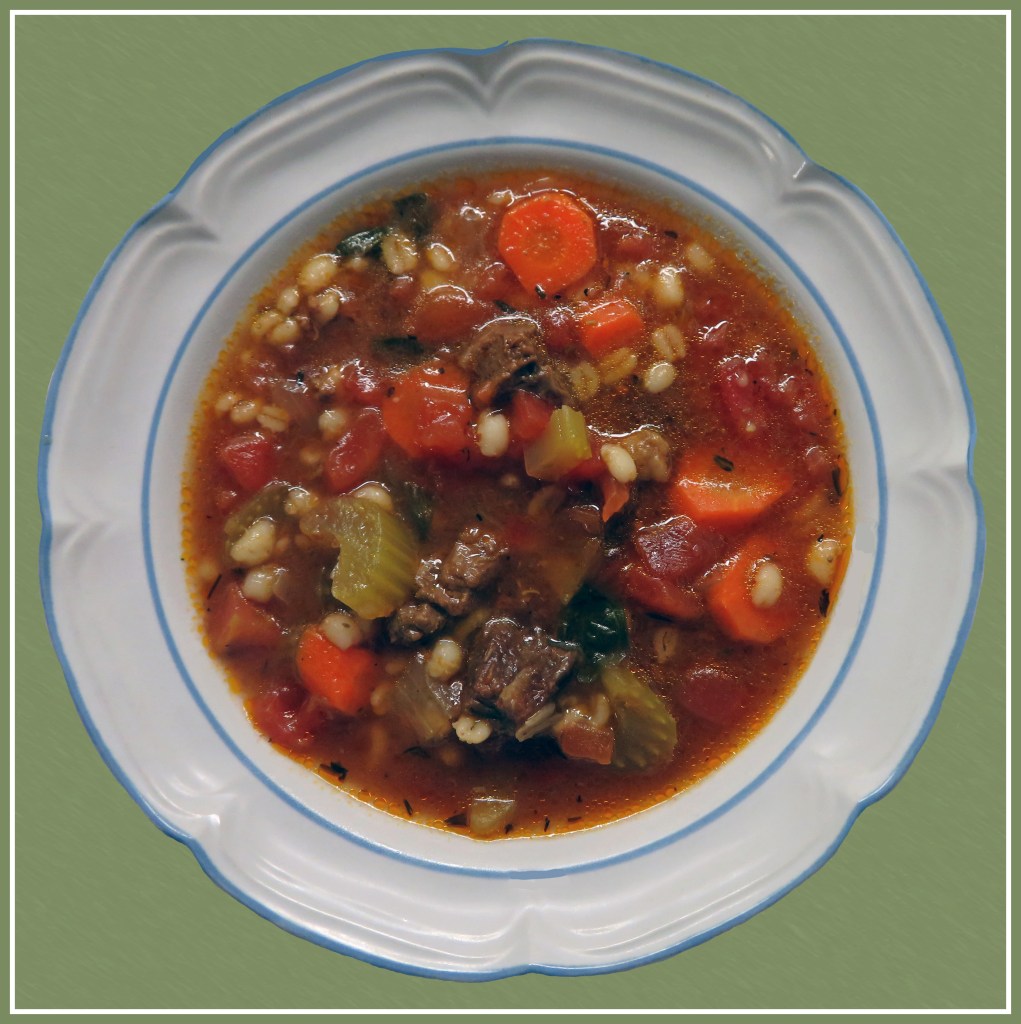
Recipe: Vegetable beef barley soup

One of my best-loved comfort foods is homemade soup, and vegetable beef barley is one of my favorites. 

As I almost always do with home-cooked meals, I’ve tweaked the traditional recipe to make it healthier. I leave out the teaspoon or so of salt the recipe usually calls for, use reduced-salt or no-added-salt ingredients, and substitute a bit more spice to retain flavor. I also cut the amount of meat in half to lower both the calorie count and the cholesterol/saturated fat levels and double the veggies. The result is nutritious as well as delicious.  

The soup is super easy to make. As a bonus, it freezes well for up to three months, and therefore lends itself to batch cooking. This recipe makes approximately 10 one-cup servings.

Ingredients

  • 1 pound beef cubes or crumbled ground beef, browned and drained
  • 2 32-ounce cartons unsalted beef broth
  • 2-3 cups water, as needed
  • 16-ounce can no-added-salt diced tomatoes with juice
  • 16-ounce can no-added-salt whole kernel corn, drained
  • 6 carrots, peeled and diced
  • 6 stalks celery, diced
  • 1 medium onion, diced
  • 1 cup quick pearled barley
  • 1 teaspoon minced garlic
  • 1 teaspoon dried basil
  • 1 tablespoon oregano
  • 1/4 teaspoon black pepper
  • 2-3 small bay leaves

Directions

Cut beef into 1/2-inch cubes, or crumble and brown ground beef, and drain well.

Peel and dice carrots, celery and onion.

Combine all ingredients in a large pot or dutch oven and bring to a boil. Turn down the heat and allow to simmer, stirring occasionally, for approximately a half hour, or until the meat, barley and vegetables are tender.

If the soup begins to get too thick, add water a cup at a time, as needed, to achieve desired consistency.

Nutrition information

Serving size: 1 cup | Calories: 168 | Carbohydrates: 23 g | Protein: 12 g | Fat: 4 g | Saturated fat: 2 g | Cholesterol: 28 mg | Sodium: 78 mg | Potassium: 475 mg | Fiber: 4 g | Sugar: 5 g | Vitamin A: 128% | Vitamin C: 24% | Calcium: 3% | Iron: 6% 

Ostkaka

This Swedish dessert is a favorite at our house during the Christmas season, and has been passed down in my family for several generations.

The name ostkaka can be roughly translated as “cheesecake” – “ost” meaning “cheese” and “kaka” meaning “cake.” But the dessert is a bit different from American cheesecake, not quite as sweet and with a slightly different texture.

To make it, older generations of my family used curdled milk, produced by adding rennet to a mixture of warm milk and flour. They then added heavy cream, sugar and eggs to make a batter. My parents’ generation simplified the recipe, using cottage cheese in place of curdled milk, and it tastes the same (at least to me). Needless to say, the latter version is much easier to make.

Over the years, my mother and I developed a few additional recipe adjustments to accommodate diabetes and other dietary restrictions. I use fat-free cottage cheese, substitute egg beaters for the eggs, substitute half and half or even whole lactose-free milk for the heavy cream, and replace sugar with an equivalent amount of sugar substitute. Rice flour can be used to make the recipe gluten free. The result is still delicious.

Our family likes to serve the ostkaka with lingonberries, but if these prove hard to find, strawberry jam or sliced strawberries can also be used.

Ingredients

  • 4 eggs or 1/2 cup egg beaters
  • 3 cups fat-free cottage cheese
  • 2 cups half & half or whole milk
  • 1/3 cup regular or rice flour
  • 1 teaspoon vanilla or almond extract
  • Sweetener equivalent to 1/2 cup sugar
  • Lingonberries, strawberry jam or sliced strawberries

Directions

Blend together the eggs, sweetener, cream or milk, flour and extract until smooth.

Stir in the cottage cheese until well-blended and pour the mixture into a cake pan.

Bake in a 350-degree oven for an hour, or until it rises a bit and is slightly brown on top.

Allow the dessert to cool at least four hours or overnight in the refrigerator.

Top each individual serving with about a tablespoon of lingonberries, strawberry jam or sliced strawberries.

Nutrition information

My version, made with egg beaters, whole milk and sugar substitute, topped with a tablespoon of lingonberries.

Serving size: 3/4 cup | Calories: 120 | Carbohydrates: 14 g | Protein: 10 g | Fat: 2 g | Saturated Fat: 1 g | Cholesterol: 13 mg | Sodium: 300 mg | Potassium: 240 mg | Fiber: 1 g | Sugar: 9 g | Vitamin A: 9% | Vitamin C: 0% | Calcium: 17% | Iron: 1%

Recipe: Kale salad with walnuts and cranberries

Who says salads have to be boring? This one is as chock full of deliciousness as it is full of nutrients.

The kale is rich in Vitamin C, while the cranberries add fiber and the walnuts and blue cheese crumbles contribute protein. As with all my recipes, I use products and ingredients that reduce the amount of sugar, salt and fat content.

This recipe makes a 1½-cup serving or two ¾-cup servings. Use the smaller serving as a side dish or the larger serving as a light lunch by itself.

Ingredients

  • 1 cup chopped fresh kale
  • 2 tablespoons chopped unsalted walnuts
  • 2 tablespoons reduced-sugar dried cranberries
  • 2 tablespoons reduced-fat blue cheese dressing
  • 2 tablespoons reduced-fat blue cheese crumbles (optional)

Directions

Remove large stems from the kale, rinse thoroughly and chop or rip into bite-size pieces.

Add walnuts, cranberries and dressing to the kale in a medium-size mixing bowl, and toss until everything is thoroughly covered with the dressing.

Pour into a salad bowl (for the main dish) or divide evenly into two smaller bowls (for the side dish) and sprinkle with the blue cheese crumbles.

Nutrition information

Serving size: ¾ cup | Calories: 112 | Carbohydrates: 13 g | Protein: 5 g | Fat: 6 g | Saturated Fat: 1.5 g | Cholesterol: 6 mg | Sodium: 160 mg | Potassium: 205 mg | Fiber: 4 g | Sugar: 5.5 g | Vitamin A: 65% | Vitamin C: 65% | Calcium: 10% | Iron: 3% 

Serving size: 1½ cups | Calories: 225 | Carbohydrates: 26 g | Protein: 10 g | Fat: 12 g | Saturated Fat: 3 g | Cholesterol: 12 mg | Sodium: 320 mg | Potassium: 410 mg | Fiber: 8 g | Sugar: 11 g | Vitamin A: 130% | Vitamin C: 130% | Calcium: 20% | Iron: 6% 

Recipe: Fresh tomato salad

It’s hard to beat fresh vine-ripened tomatoes from the garden.

One of my favorite ways to use them is in this sliced tomato salad with avocados and mushrooms, which is not only delicious, but chock full of good nutrition.

The salad is relatively low in the “bad” stuff like saturated fat, sodium and sugar, but rich in fiber, potassium and Vitamins A and C. Bolthouse Farms makes a delicious classic balsamic vinaigrette dressing with olive oil that only has 15 calories per tablespoon.

This side dish is also super easy-peasy to make – always a plus in my book. Just slice up the produce, toss with dressing and chill in the refrigerator. That’s all there is to it.

The recipe makes 2-3 generous-sized servings.

Ingredients

  • 2 medium-size tomatoes
  • 1 medium-size avocado
  • 6 large fresh mushrooms
  • 2-3 tablespoons balsamic vinaigrette dressing

Directions

Thoroughly wash produce, remove stems from tomatoes and mushrooms and peel avocado.

Thinly slice tomatoes, avocado and mushrooms.

Toss with the balsamic vinaigrette dressing.

To enhance flavor, refrigerate for a half hour or so before serving.

Nutrition Info

Calories per serving: 125 | Carbohydrates: 13 g | Protein: 3 g | Fat: 8 g | Saturated Fat: 1 g | Cholesterol: 0 mg | Sodium: 85 mg | Potassium: 610 mg | Fiber: 6 g | Sugar: 6 g | Vitamin A: 18% | Vitamin C: 31% | Calcium: 2% | Iron: 8%

Recipe: Lemony dill salmon

I am always, always, always looking for delicious ways to add fish to our diet, and this recipe definitely meets the “yum” test.

Better yet, both salmon and olive oil contain omega-3 fatty acids – the good kind of fat known to lower the risk of heart disease.

Plus, the recipe meets another test – it’s super easy to prepare.

The recipe also lends itself to batch cooking. It can keep in the refrigerator for up to three days and I just pop the leftovers in the microwave for 2-3 minutes.

This recipe makes 4 servings.

Ingredients

  • 4 salmon filets
  • 3 tablespoons extra virgin olive oil
  • 2 tablespoons lemon juice
  • 1 tablespoon dried dill weed
  • 1 teaspoon minced garlic
  • fresh ground pepper to taste

Instructions

Whisk together the olive oil, lemon juice, dill weed and garlic until well-blended.

Dip salmon filets in the mixture to coat thoroughly and place in a 9 X 9-inch baking dish.

Pour the remaining mixture over the top of the filets.

Bake in a 375-degree oven for 20-25 minutes, or until the fish flakes easily, basting filets with the liquid once or twice while baking.

Nutrition information

Serving size: 4-ounce filet | Calories: 300 | Carbohydrates: 0 g | Protein: 20 g | Fat: 27 g | Saturated Fat: 5 g | Cholesterol: 55 mg | Sodium: 60 mg | Potassium: 360 mg | Fiber: 0 g | Sugar: 0 g | Vitamin A: 1% | Vitamin C: 6% | Calcium: 0% | Iron: 1%

Recipe: Baptist Sangria

Image created using Imagine AI

A growing trend – “Dry January” – offers a chance to skip the alcohol and try something different for a change.

Dry January challenges people to abstain from alcohol for the entire month. The new custom has gained popularity in recent years as a response to the excesses of the holiday season, and many are using the occasion as an opportunity to reevaluate their relationship with alcohol, modify habits, or experience the physical and mental health benefits of sobriety.

The good news: People who want or need to avoid alcohol – whatever the reason or season – have an increasing number of fun options besides the usual diet cola or club soda. One can try a Mockmopolitan, Virgin Mojito, Cucumber Cooler, Mango Tango, Citrus Sparkler or a few dozen other enticing offerings.

One of my favorite drinks in this category is a Baptist Sangria – so named because it is, you guessed it, nonalcoholic. The colorful mocktail offers a delicious alternative to the traditional sangria, perfect for people who choose not to drink alcohol, even beyond January.

More good news: This delightful drink actually has nutritional value – lots of Vitamin C and at least one fruit serving to help meet our daily quota of fruits and veggies – not to mention a large glass of something liquid to aid hydration.

To make the drink, I fill a large glass with equal parts cranberry or pomegranate juice, sparkling water and fresh fruit. If I really want to get fancy, I can add a sprig of mint.

I make sure the fruit juice is actually 100 percent juice, not “juice drink,” which has far too much added sugar.

For the sparkling water, I use Sodastream – a wonderful contraption that turns plain old tap water into sparkling water with none of the sodium often found in the commercial variety.

I then add fresh fruit such as citrus slices or wedges, fruit chunks or berries. The possibilities here are endless. Oranges, lemons, limes, strawberries, cherries, grapes, kiwis, peaches, apples, pineapples and melons all work well.

Ingredients

  • Cranberry or pomegranate juice
  • Sparkling water or club soda
  • Sliced fresh fruit, fresh fruit chunks or whole berries
  • Sprig of mint (optional)

Directions

Fill your glass about a third full of chilled juice.

Add an equal amount of chilled sparkling water and stir.

Fill the remainder of the glass with any combination of sliced fruit, fruit chunks, fruit wedges or berries.

Garnish with a fruit slice and/or a sprig of mint.

That’s it. Easy-peasy. Enjoy!

Nutrition information*

For a drink made from 4 ounces of cranberry juice, 4 ounces of sparkling water and a half cup of lemon, lime and orange chunks:

Calories: 95 | Carbohydrates: 25 g | Protein: 1 g | Fat: 0 g | Saturated Fat: 0 g | Cholesterol: 0 mg | Sodium: 12 mg | Potassium: 290 mg | Fiber: 2.5 g | Sugar: 21 g | Vitamin A: 0% | Vitamin C: 130% | Calcium: 3% | Iron: 0%

* Nutritional values are approximate, and may depend on brands used and other variables.

Recipe: Fresh fruit parfait

A favorite breakfast treat or afternoon snack at our house is a fresh fruit parfait.

I start with fat-free plain Greek yogurt and pile on a generous layer of fresh fruit such as strawberries, raspberries, blueberries, pineapple or mango chunks. I sprinkle low-fat granola over everything, and top with a dollop of sugar-free whipped topping.

Not only is this comfort food tasty, but it is chock full of good-for-you protein, fiber, calcium, potassium and Vitamin C. And it takes only minutes to make.

Yummmmm!

This recipe makes 2 generous servings.

Ingredients

  • 1 cup fat-free plain Greek yogurt
  • 1 cup fresh fruit
  • 4 tablespoons fat-free granola
  • 4 tablespoons sugar-free whipped topping

Directions

Start with a layer of the Greek yogurt in the bottom of a tall glass.

Layer fresh fruit over the yogurt.

Add granola and sprinkle evenly over the yogurt and fruit.

Top with a generous dollop of whipped topping.

Nutrition information

Calories: 200 | Carbohydrates: 20 g | Protein: 16 g | Fat: 8 g | Saturated fat: 1 g | Cholesterol: 10 mg | Sodium: 65 mg | Potassium: 295 mg | Fiber: 4 g | Sugar: 11 g | Vitamin C: 50% | Calcium: 15% | Iron: 1% 

Recipe: Dreamsicle fluff dessert

This sweet treat was a staple at church potlucks and family get-togethers when I was growing up. And it’s been perfect for enticing my husband to eat, once he got home from the hospital.

As usual, I’ve modified the childhood comfort-food recipe to make it healthier – reducing the sugar and fat content by using sugar-free pudding and gelatin mixes and substituting fat-free milk for half the sugar-free whipped topping.

The milk also adds protein, and the mandarin oranges add plenty of potassium and Vitamin C.

The result is still delicious!

This recipe makes 4-6 servings.

Ingredients

  • 1 small box sugar-free fat-free vanilla pudding mix
  • 1 small box sugar-free orange gelatin mix
  • 15-ounce can no-sugar-added mandarin oranges
  • 1 cup sugar-free whipped topping
  • 1 cup fat-free milk
  • 3/4 cup water
  • 4-5 ice cubes

Directions

In a saucepan, bring the water to a boil and add the gelatin mix, stirring until completely dissolved. Add the ice cubes and stir until they are melted. Set aside.

Make pudding according to package directions, but using only one cup milk instead of two.

Add whipped topping to pudding and blend thoroughly, then add the liquid gelatin mix and blend.

Fold the mandarin oranges into the mixture.

Refrigerate overnight or until firm.

Nutrition information

Calories: 110 | Carbohydrates: 19 g | Protein: 1.5 g | Fat: 1.5 g | Saturated Fat: 1.5 g | Cholesterol: 0 mg | Sodium: 90 mg | Potassium: 180 mg | Fiber: 1 g | Sugar: 9 g | Vitamin A: 5% | Vitamin C: 24% | Calcium: 10% | Iron: .5%