Meeting the Risen Christ in a hospital room … and at church

When I visit various churches, I usually encounter one of two symbols – a crucifix or an empty cross. During my recent hospital stay, however, I came across a symbol I hadn’t seen before. 

While propped up in bed doing my morning meditation, I noticed what looked like a crucifix – only different somehow – hanging on the wall a few feet away. I had begun to recover after a stint in intensive care, so I got out of bed and walked over to take a closer look. 

Jesus stood in front of the cross – alive – his arms outstretched as if beckoning me to follow him. 

When I looked it up online later, I saw the cross advertised on a Catholic web site as “The Risen Christ.” I’m pretty sure it’s been around for a while and I had simply never noticed it. At any rate, I liked this particular cross.

The traditional crucifix reminds us of Christ’s suffering and sacrifice on Good Friday, while the empty cross prompts us to meditate on Easter and the resurrection. But as I stood looking at the cross in front of me on that Sunday morning just before the beginning of Lent, I found myself meditating on a different subject: “What does it mean to actually follow Jesus?”

I must say that question took on a bit more urgency in the face of a medical trauma that forced me to look my own mortality straight in the eye without blinking. Not only that, but my mother had just been in the hospital twice in as many months, and I’ve had to face the fact that I may not have her in my life much longer. For good measure, my brother-in-law was hospitalized the same time I was and both my cats had just been diagnosed with chronic medical conditions. Yikes!

The cross on the hospital room wall seemed like an appropriate symbol for the occasion. It not only signified the death and resurrection of Jesus, but the cross we all are asked to bear when we become followers. There will be hardship, sacrifice and struggle, the Bible tells us. But this cross also reminded me that we can overcome hard times with God’s help.

This morning I encountered the same “Risen Christ” symbol again, this time at church. 

The altar was all decked out for the Easter Sunday service. A white cloth and a crown of white and yellow flowers draped the empty cross. Easter lilies and other spring flowers filled the entire front of the church. The sanctuary was gorgeous! As was the music – complete with a trumpet, maracas and drums. (The photos below don’t begin to do the scene justice.)
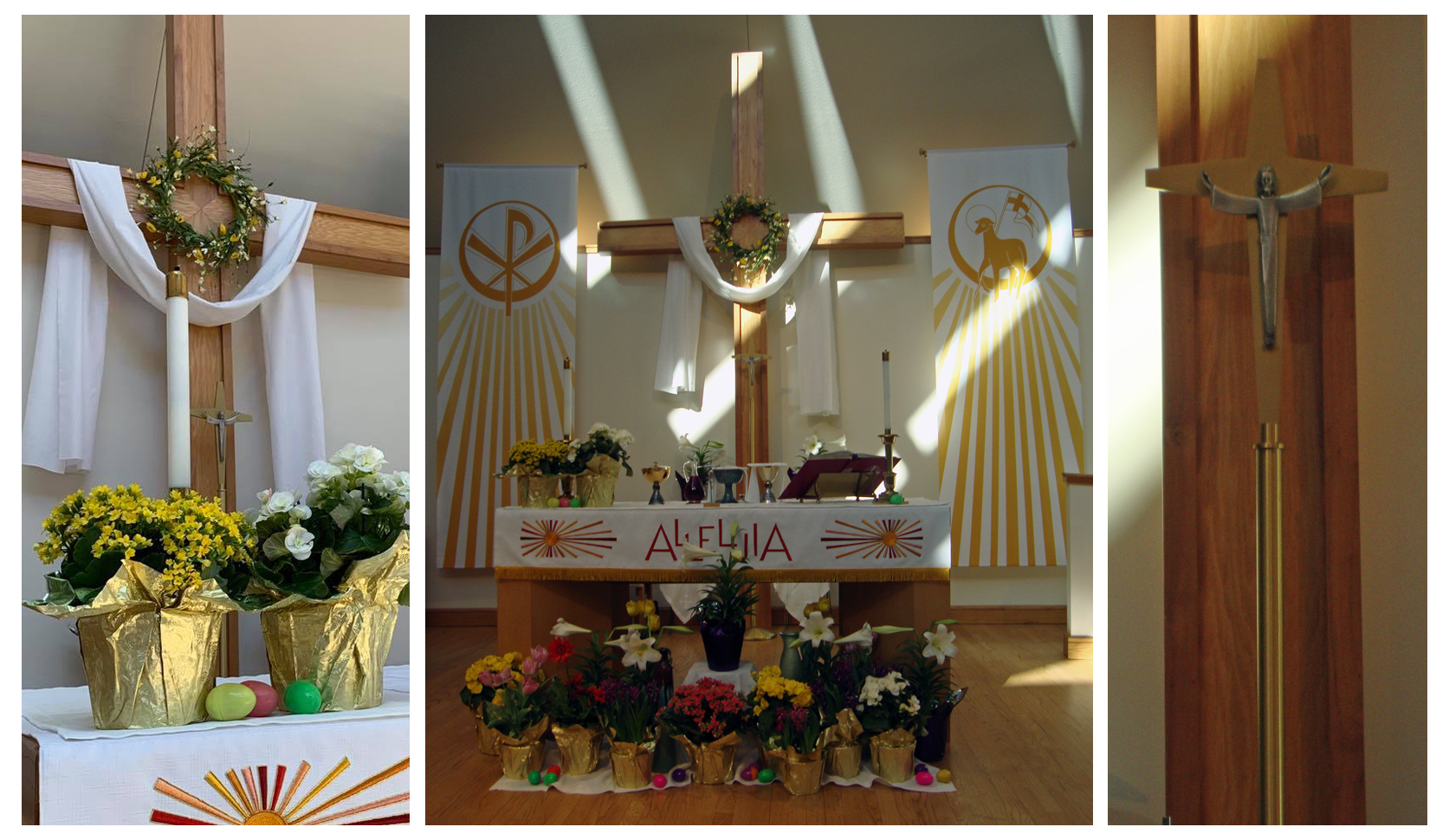
In the middle of all this, I saw the now-familiar figure of “The Risen Christ” on the processional cross carried down the aisle and placed in a stand behind the altar. Jesus was alive, arms outstretched, beckoning us all to follow.

Congregation members and our minister exchanged this greeting:

“Christ is risen!”

“Christ is risen indeed!”

In her sermon, our minister spoke of emerging from our personal “tombs” – sickness, loss of loved ones, broken relationships – and I reflected on the hospital rooms I’d been in over the past couple of months.

As I came forward for communion, I thanked God for having shepherded me – and my mother and my husband and my brother-in-law and my cats – through this unusually challenging Lenten season.

And the real Risen Christ, alive and present among us, seemed to say, “You won’t be able to avoid pain and suffering, but you will transcend it.” 

Happy Easter, everyone!

Prayers of petition and intercession: Can we ask God for things?

A week before Ash Wednesday, I landed in the intensive care unit at St. John’s Hospital after losing more than a third of my blood from a lesion in my stomach aggravated by blood-thinning medication. At first I thought I might be coming down with the flu – I had awakened with nausea and general achiness – but the symptoms grew progressively worse and by evening, I had muscle cramps and dizziness so severe I found it nearly impossible to walk. 

Fortunately, I decided to call an ambulance rather than try to tough it out and sleep off my “flu” symptoms. Emergency room staff told me I had dangerously low blood pressure, tachycardia and dehydration, and had already lost about 30 percent of my hemoglobin – which carries oxygen to my brain and other vital organs. Over the next 24 hours I received four units of blood. (Thanks to all you blood donors out there!)

To say I was scared would be an understatement. At one point, when I became increasingly worried about the mental confusion I was experiencing, staff sent for the hospital chaplain. Undeterred by my difficulty finding and forming words, the chaplain simply asked me to repeat after her: “Dear God, please help me.” We said this in unison several times, and I found the repetition amazingly calming.

Meanwhile, my husband alerted our pastor and church congregation, then got online and activated the Facebook prayer warriors. (I like to think of this as “crowd-sourced prayer.”) He even contacted our local Dominican Sisters community, which accepts prayer requests on their Web site – one doesn’t need to be Catholic to avail oneself of the service. 

My hospital adventure capped a rough couple of months which saw my mother hospitalized twice, my husband and I both sick with viruses and even our two kitties both newly diagnosed with chronic illnesses. One might say I had plenty of opportunities to practice prayers of petition and intercession – that is, prayers on behalf of oneself or others – along with some good old-fashioned foxhole spirituality.

Now I understand some people get squeamish about asking God for things. There is legitimate concern about regarding God as a combination Santa Claus/magic genie to whom we bring our shopping lists. In fact, I must acknowledge my own impatience with people who say “it’s a God thing” when a parking space opens up for them. However, the Bible is chock full of prayers of petition and intercession – not to mention a heavy dose of foxhole spirituality. 

Just a brief glance at the Psalms offers plenty of examples: 

  • Psalm 77:2 – In the day of my trouble I seek the Lord; in the night my hand is stretched out without wearying; my soul refuses to be comforted.
  • Psalm 27:12 – Give me not up to the will of my adversaries; for false witnesses have risen against me, and they breathe out violence.
  • Psalm 69:1-2 – Save me, O God! For the waters have come up to my neck. I sink in deep mire, where there is no foothold.

Several Biblical passages actually invite us to pray for ourselves and others this way:

  • Psalm 50:15 – Call on me in the day of trouble; I will deliver you, and you shall glorify me.
  • John 15:7 – If you abide in me, and my words abide in you, ask for whatever you wish, and it will be done for you. 
  • Philippians 4:6 – Do not worry about anything, but in everything by prayer and supplication with thanksgiving let your requests be made known to God. 

One could say the entire Lord’s Prayer (Matthew 6:9-13) qualifies as a prayer of petition:

Pray then like this: Our Father who art in heaven,
Hallowed be thy name.
10 Thy kingdom come,
Thy will be done,
On earth as it is in heaven.
11 Give us this day our daily bread;
12 And forgive us our debts,
As we also have forgiven our debtors;
13 And lead us not into temptation,
But deliver us from evil.

I have to admit at least half the prayers I write in my journal during my morning meditation sessions are prayers of petition/intercession – and that’s when I’m not facing a life-threatening emergency. 

A 2017 Barna Group study of American adults indicates I have a lot of company. In a recent article for the magazine Living Lutheran (link HERE), Kurt Lamont and John Potter make this observation about the study: “Aside from ‘gratitude and thanksgiving’ at the top and ‘reciting scripture passages, meditation or liturgies’ and ‘other’ at the bottom, all other prayer topics are asking for help in some way.”

So … is it okay to ask God for things? Based on my reading of the Bible, extensive church practice and my own experience, I think I can confidently say, “Absolutely!” 

Prayers of petition may encourage us to rely more on God and even rethink some of our priorities. According to the Catechism of the Catholic Church (paragraph 1501), “Illness can lead to anguish, self-absorption, sometimes even despair and revolt against God. [But] it can also make a person more mature, helping him discern in his life what is not essential so that he can turn toward that which is. Very often illness provokes a search for God and a return to him.” 

Prayers of intercession may remind us to consider the needs of others. During Sunday services, our church offers up prayers of intercession for everything from world peace to comfort for a congregation member who has lost a loved one. Our church secretary keeps a prayer list of people facing illnesses or other crises, as well as a list of people serving in the military, and the entire congregation is asked to keep these people in our personal prayers. Those who participate in our weekly men’s and women’s prayer breakfasts also use these lists as the basis for their group prayers. 

“Our praying does not change God. Instead, it is a way for God to change us,” Lamont and Potter  point out in their Living Lutheran article Pray without ceasing: A Lutheran approach to prayer. “In prayer, we admit that we are in need and we ask God to help us with those needs.”

The good news: I’m healing. My mother now has someone staying with her at night. Even our kitties are doing better. And my husband deserves a gold medal for his unwavering support for all of us over the past couple of months. 

But why is it that I often think to pray only when I’m in some kind of trouble? Foxhole spirituality has its place, but I would agree it should not be our sole motivation for prayer. That is why I’ve dedicated this Lenten season to experimenting with other kinds of prayer as well. 

And when God does answer my prayers, I must remember to say, “Thank you!” 

Morning meditation

Ever since I embarked on my 12-Step recovery journey 26 years ago, I’ve started my day with morning meditation whenever possible.

The Merriam-Webster dictionary defines meditate as “to engage in contemplation or reflection.” In 12-Step groups, members like to say prayer is talking to God and meditation is God talking to us. For me, meditation is a time set aside for both prayer and reflection. While my personal morning meditation ritual has evolved over the years and may change content from one day to the next, I’ve found that my meditation time easily accommodates several forms of prayer. 

Most days I begin with “nature prayer.” I feed my cats, the birds and (yep!) the squirrels. If nice weather beckons, I may stroll around my backyard and admire the flowers. Right now, early spring has arrived in central Illinois and my snowdrops and crocuses are blooming. Soon they will be joined by jonquils, violets, tulips, pear and crabapple blossoms and the ever-ubiquitous dandelions. These flowers make me so happy! 

Back inside, I settle in my recliner in front of the fireplace with a cup of coffee by my side and Oley Cat in my lap and engage in “writing as prayer.” I may journal about my priorities for the coming day – or what I think they should be, at least. I’ve also used this time to write out my thoughts and insights generated by homework assignments my spiritual director gives me. 

Some mornings the journaling portion of my meditation largely consists of prayers of petition and intercession. Other times I may make a gratitude list or offer prayers of thanksgiving. Sometimes I even get to enjoy music when my husband joins Oley Cat and I to serenade us with sacred songs on his dulcimer.

Lately I have adopted a suggestion from my spiritual director as well: As I pray, spend some time listening. Say (or write) a prayer, then be silent. Quiet my mind for a few minutes and wait for God’s response. What is God saying to me?

Some Christians express concern that meditation is too “New Age,” or that it’s somehow inappropriate because religions other than Christianity practice it. However, from what I’ve read, meditation is firmly rooted in the Bible. Here are just a few passages that speak about the practice: 

  • Joshua 1:8 – This book of the law shall not depart out of your mouth; you shall meditate on it day and night, so that you may be careful to act in accordance with all that is written in it. For then you shall make your way prosperous, and then you shall be successful.
  • Psalm 19:14 – Let the words of my mouth and the meditation of my heart be acceptable to you, O Lord, my rock and my redeemer.
  • Psalm 119:15 – I will meditate on your precepts, and fix my eyes on your ways.
  • Psalm 145:5 – On the glorious splendor of your majesty, and on your wondrous works, I will meditate.
  • Philippians 4:8 – Finally, brethren, whatsoever things are true, whatsoever things are honest, whatsoever things are just, whatsoever things are pure, whatsoever things are lovely, whatsoever things are of good report; if there be any virtue and if there be any praise, think on these things. (Note: Since “think on” is one synonym for “meditate,” this verse would certainly speak to the practice and it’s also one of my favorites.)

Meditation also has a long history in Christian practice, engaged in by everyone from the Desert Fathers and Mothers of the early church era to Ignatius of Loyola, Augustine and Martin Luther in the Middle Ages to folks participating in the liturgies of many modern church services. 

Elizabeth Eaton, presiding bishop of the Evangelical Lutheran Church in America, shared a personal experience of being so preoccupied that she once arrived at work with no memory of how she got there. Eaton’s own spiritual director offered the following advice about meditation as one remedy for this type of distracted thinking: “Wait for the Lord. Disengage the autopilot. Notice. Just this. Just now.” (Link to her article HERE.)

In my own case, God seems to tell me I need my morning meditation ritual. While I may skip it occasionally – if I have to leave the house for a doctor’s appointment at 7:30 a.m. sharp, for instance – I’ve found that I start to feel a little less “centered” if I miss too many days in a row.

For me, meditation is a way of staying focused on important priorities. Listening to Oley Cat’s soft purr and the crackle of the fire, or watching the squirrels’ antics as they invade the bird feeders helps quiet my mind – a little, for a few moments anyway – and allows me to open up to God’s presence.

So I continue to commit myself to this wonderful and compelling morning ritual.