Love never fails

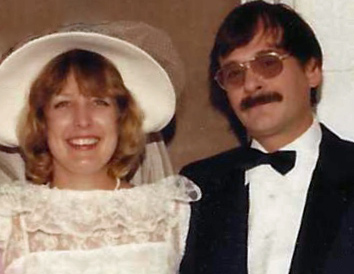
Forty years ago today, I married my best friend.

We met at work, where I plotted to make sure my cute new colleague’s desk was placed next to mine. The scheme worked. Before long, we were doing lunch together, then hanging out after work, then introducing each other to our respective families. Besides being handsome, he was charming and witty. I was smitten.

When we vowed to take each other for better or worse, for richer or poorer, in sickness and in health, we embarked on a journey. And what an amazing journey it’s been!

Pete and I have been lucky to experience lots of the “better” over the years – good times with wonderful friends, successful careers, a beautiful home, amazing vacations. We’ve also weathered our share of the “worse” – workplace drama, health problems, the loss of loved ones – and survived stronger than ever.

In our early days we were “poorer than church mice,” as the saying goes. Since we both worked several years for small faith-based not-for-profit organizations before retiring, we were fond of joking, “Actually, we are church mice!” But while we were never filthy rich, we’ve always had enough.

Like a gazillion other couples before us, Pete and I chose 1 Corinthians 13 as a reading for our wedding. And the more anniversaries we’ve celebrated, the more I’ve come to appreciate the standards this Biblical passage sets for the kind of love that makes a marriage last.

Love is patient. Pete’s taste in clothes and home decor is strictly “plain vanilla,” while mine tends toward “hot fudge sundae with a cherry on top.” I love carrots and beets, but detest peas and green beans. Pete thinks peas and green beans are at least okay, but would eat beets only if truly starving. And has anyone ever noticed how compulsive neatniks inevitably wind up with people whose standard of neatness is decidedly more … um … casual? At some point, we figured out these differences were not about right or wrong, but were simply preferences. The way to work out differing preferences was through compromise. And compromise, as we’ve learned over the years, takes considerable patience.

Love is kind. I first fell in love with the man who would go considerably out of his way to give me a ride to work when my car broke down. (I was driving a real lemon in those days, so it was always breaking down.) Little kindnesses have continued to be part of his charm. I still adore the man who serenades me with his dulcimer or harmonica when I’m doing morning meditation in front of the fireplace.

Love does not envy. Pete and I do have a bit of a competitive streak. We’ve been known to laugh as we sing to each other, “Anything you can do, I can do better!” And I’ve always suspected he was secretly charmed by the fact that I wasn’t the kind of girl to let the boys win at checkers. But underneath the friendly competition, we have always supported each other’s career choices. We take genuine pride in each other’s accomplishments.

Love does not boast. If there is one thing our marriage journey has taught us, it’s humility. Part of humility means that sometimes we must give up our insistence that our own way is the only right way to resolve a contentious issue. In fact, there have been times we needed to s-t-r-e-t-c-h our thinking enough to acknowledge that the other person might have a point.

Love does not dishonor others. From the time my sibs and I were old enough to date, our mother warned us to watch how a prospective partner treats other people besides us. Why? Because that’s how this person is going to treat us once the newness wears off the romance. Fortunately, one of the things that impressed me most about my sweetie was how much of a gentleman he was. He has always been unfailingly polite, diplomatic and respectful in his interactions with others, no matter who they are.

Love does not insist on its own way. During a required prenuptial counseling session, the minister who officiated at our wedding said, “I always tell young people they’ll need to compromise more than they’re used to doing.” He turned to his wife of 60 years. “One of the things I learned to do early on was say, ‘yes, dear.’ Isn’t that right?” His wife promptly replied, “Yes, dear.” To this day, Pete and I chuckle at the memory, and have been known to say to each other quite often, “Yes, dear.”

Love is not easily angered. This can be a hard one at times, since we both have a bit of a temper. When I hear a couple claim they never fight, I suspect one of two things is true. Either someone is not being quite honest about their genuine needs, or they’ve been together long enough to work through most of their differences. Luckily, over many years, we’ve gotten pretty good at not pushing each other’s buttons – at least not too hard.

Love keeps no record of wrongs. If we must “have it out” occasionally, we try to avoid “kitchen sink fighting.” (A tactic where one brings up everything, including the kitchen sink, during an argument – as in, “Whose turn is it to do the dishes, anyway?”) And forgiveness is mandatory. Few things sink a relationship faster than holding a grudge. Ephesians 4:26 reminds us, “Don’t let the sun set on your anger.”

Love does not delight in evil, but rejoices in the truth. While we may disagree from time to time about politics, standards of neatness, or which vegetables are tasty and which ones are gross, we thankfully agree on the important things. We’ve shared similar values from the beginning on everything from moral issues to priorities in life to the importance of giving back to the community. And we both love cats.

Love always protects. One nice thing about being married to one’s best friend is that we can be relied on to have each other’s back. Pete likes to call me his therapy skunk, and he’s taken his turn playing that role for me as well. As the designated therapy skunk, our job is to accompany each other to doctor appointments, where we provide emotional support, ask the hard questions and insist that medical people take our needs seriously.

Love always trusts. I must admit, trust came a bit hard for both of us at first. We had each been hurt in prior romantic or family-of-origin relationships I can only call “challenging.” We each had to learn not to punish the other for someone else’s failings. I was not the overly demanding parent, and Pete was not the ex with the roving eye.

Love always hopes. Over the past three years, Pete and I have both faced life-threatening health conditions. Pete has survived Stage 4 cancer treatment – chemotherapy, radical surgery, immunotherapy and multiple hospitalizations. I’ve survived a heart attack and two heart surgeries. While we’ve gotten amazing support from family, friends and our spiritual community, possibly the one biggest thing we’ve needed is hope. For hope to happen, we’ve had to lean on a health care team we can trust, and more importantly, we’ve had to lean on and trust God to get us through.

Love always perseveres. It’s fairly easy to make a marriage work when we’re experiencing the “better” and the “richer” and the “in health” part of our wedding vows. It’s when we experience the “worse” – the terrifying diagnoses, the loss of loved ones, the COVID pandemic with all its stressors – that the rubber hits the road in a relationship. If the challenges of the past few years have done nothing else, they’ve convinced us of this: We’re an unbeatable team.

Love never fails. One can often hear couples say they love each other more after decades of marriage than they did when they first got together. That’s certainly true for me. After having been through both the “better” and the “worse” together, my love for this amazing man just gets stronger every day. I don’t think I truly understood real love when I was a starry-eyed twenty-something. Of course, I remember with fondness the heady infatuation I felt in the early days of our courtship. But real love? For me, anyway, that’s come with age and maturity. The initial idealization has become a deep connection built on trust, understanding, and a long history of shared experiences. Or, as Pete and I like to say, we had an office romance that grew up.

I do have a bit of a confession to make. If anyone reading this is thinking, “Haven’t I read this blog post before?” – it’s because I posted an earlier version of it two years ago in honor of our 38th anniversary. At that time, our medical issues were so precarious and scary, I wasn’t entirely sure we would both make it to our 40th. And I wanted to make sure I got the chance to let both Pete and others know how much I appreciated him and our relationship while I still could.

But God is good! Pete’s condition is now “stable” and there has been no sign of cancer on his CT scans for almost two years now. After a couple years of cardiac rehab, I’m actually healthier than I was before. So we’re both still here, and right now, I consider myself one of the luckiest women alive.

After 40 years of marriage, Pete is still at the very top of my gratitude list. He’s kind, generous, decent and caring, my best friend, the wind beneath my wings, proof positive that there are good men, and the best thing that ever happened to me. I love that man to the moon and back, and I truly consider him to be a gift from a kind and loving God.

And I pray every day for God to please watch over us and take care of us, because I want us to have many more years together!

Update: Some good news

Over the past year and a half, several of you who follow my blog have been generously keeping my husband Pete and me in your prayers. So, on this very blessed Easter Sunday, I’d like to take this opportunity to offer an update.

Pete was diagnosed with bladder cancer in October of 2022, and in December of the same year, I had a heart attack. I got the easier part of the bargain – two stents for Christmas, followed by cardiac rehab therapy, a healthier eating plan and more exercise. Pete’s journey has been far more grueling – chemotherapy, followed by major surgery to remove his bladder, then several hospitalizations due to infections and other complications, and finally, immunotherapy treatments.

There were bright spots, like the major milestone moment when Pete “rang the bell” upon finishing chemo last spring.

But much of 2023 was a chaotic roller coaster ride of repeated hospital stays, juggling medical appointments (sometimes as many as 15 in one week between the two of us) and frustrating efforts to navigate the health care system – not to mention an abundance of anxiety and uncertainty about the future.

So it’s with much relief, joy and thanksgiving that we’re finally able to report some good news. In mid-March, Pete went for a complete follow-up CT scan of his lungs, abdomen and pelvis. Nothing scary was growing and several previous “areas of concern” had either shrunk or disappeared entirely. Last week, Pete’s oncologist confirmed that his current regimen of immunotherapy seems to be keeping his “bad-boy cells” under control.

Because it’s Stage 4, there is no cure at this point. But the oncologist assures us the cancer continues to be treatable, and so far (knock wood!) the side effects from the immunotherapy have been minimal. These days, a LOT can be done – even some advanced cancers are now being treated like a chronic illness rather than an automatic death sentence. As Pete said a few days ago in his Facebook update about the CT scan results: “This stuff never goes away, and doctors deal with probabilities, not certainties. But I’m taking this as very good news indeed!”

Meanwhile, my heart attack was definitely a wake-up call. My heart – quite literally – was telling me I really, really needed to establish better eating habits and address my mostly sedentary lifestyle. My cardiac rehab program offered nutritional advice, a personalized exercise plan and educational classes on how to live with a heart condition. So we’ve established a healthy eating plan and have added yoga and walking to our routine.

This, of course, has me singing: “Hallelujah! Hallelujah! Hallelujah, hallelujah, hal-le-e-lu-jah!” (Picture a choir singing the “Hallelujah Chorus” from The Messiah.) And I do have much to be thankful for.

I have been impressed and humbled by my dear husband’s strength, courage and persistence as he has plowed through his endless treatments.

I’ve taken to calling Champie our furry little comforter. Our sweet kitty kept Pete company and rubbed noses with him as Pete was recuperating from surgery and other complications. Our fur baby cuddled up with me on those lonely nights when Pete was in the hospital and I had to sleep alone at home. Even at the ripe old age of 18, he continues to be his sweet, ornery, adorable self.

We are both beyond grateful for the mountain of get-well wishes, the delicious meals sent to our house by special angels when we didn’t feel like cooking, the offers to assist with transportation and other needs, the cat photos and baby goat videos and bad puns posted to our Facebook pages to cheer us up, and the many other things our wonderful family members and friends have done to help us feel supported and loved as we’ve traveled through this uncharted and often frightening and frustrating territory.

Everyone’s continued prayers have been especially appreciated!! Our church congregation has kept us on their prayer list for well over a year now, and friends and family members have put us on the prayer lists at their own churches. The Dominican Sisters in our community have enveloped us in prayer and provided us with spiritual direction. Several dear readers who follow this blog have assured us that we’re in your prayers as well. The steady stream of prayers, cards and visits have helped more than people know!

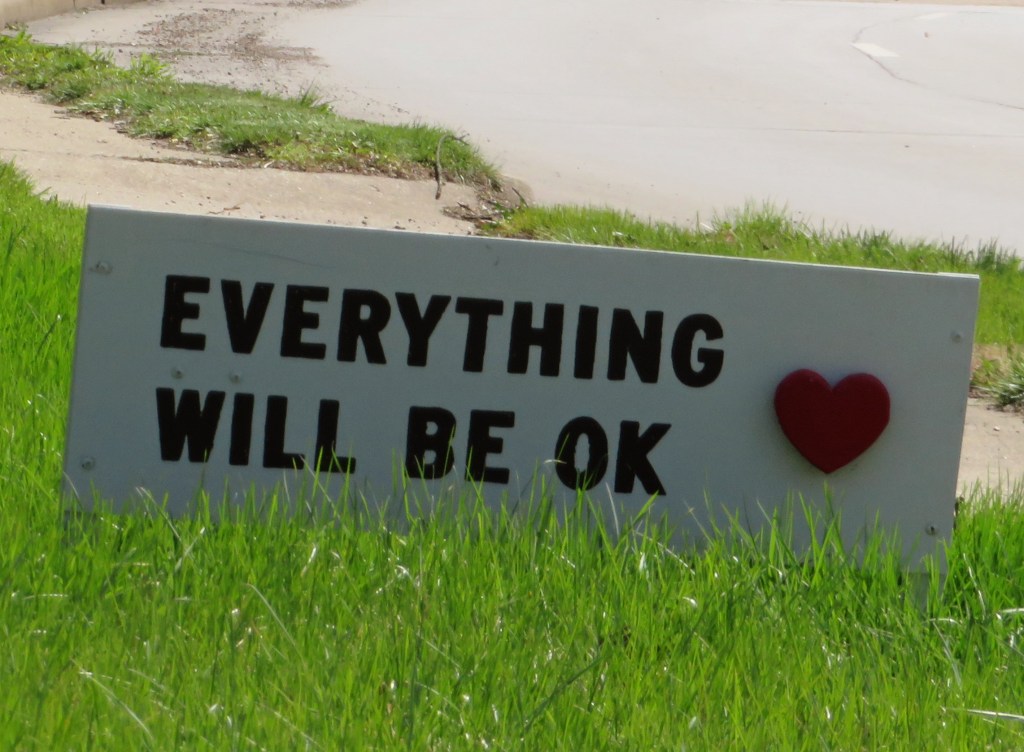
We’ve even gotten support from complete strangers who probably have no idea how much of an impact their small actions are having. When we’re out and about, especially when we’re on our way to doctor’s appointments, we make a point of driving by the house on MacArthur Boulevard with this sign in their yard.

While we’ve gotten amazing support from family, friends and our spiritual community, possibly the one biggest thing we’ve needed is hope. For hope to happen, we’ve had to lean on a health care team we can trust.

Over the past year, we’ve assembled a good medical team that is helping both of us get the ongoing physical care we need. As exasperating as our health care system can be to navigate, we’ve been blessed with competent and dedicated health care professionals, from Pete’s oncologist and my heart specialists to the overnight nursing staff who helped keep Pete and me comfortable during hospital stays.

We mustn’t forget to mention the amazing staff at the Simmons Cancer Institute’s infusion center, the interventional radiology team at St. John’s Hospital, the folks at the Prairie Heart Institute’s cardiac rehab center, and the home health team who came to our house throughout the late winter, spring and early summer of 2023.

More importantly, we’ve had to lean on and trust God to get us through. The “Prayer of Good Courage” was written in 1941 by Anglican priest Eric Milner-White, and is a favorite at Holden Village, a Christian retreat center in Washington state. It has become a favorite for Pete and me as well, especially during times when we’ve found it hard to trust where God might be leading us next.

So … Pete and I finally seem to be turning a corner. I hope!! For those who have been keeping us in your prayers and offering a million other kinds of generous support — thank you, thank you, thank you!!

Happy Easter, everyone! Christ is risen indeed.

Love never fails

Thirty-eight years ago today, I married my best friend.

We met at work, where I plotted to make sure my cute new colleague’s desk was placed next to mine. The scheme worked. Before long, we were doing lunch together, then hanging out after work, then introducing each other to our respective families. Besides being handsome, he was charming and witty. I was smitten.

When we vowed to take each other for better or worse, for richer or poorer, in sickness and in health, we embarked on a journey. And what an amazing journey it’s been!

Pete and I have been lucky to experience lots of the “better” over the years – good times with wonderful friends, successful careers, a beautiful home, amazing vacations. We’ve also weathered our share of the “worse” – workplace drama, health problems, the loss of loved ones – and survived stronger than ever.

In our early days we were “poorer than church mice,” as the saying goes. Since we both worked for small faith-based not-for-profit organizations, we were fond of joking, “Actually, we are church mice!” But while we were never filthy rich, we’ve always had enough.

Like a gazillion other couples before us, Pete and I chose 1 Corinthians 13 as a reading for our wedding. And the more anniversaries we’ve celebrated, the more I’ve come to appreciate the standards this Biblical passage sets for the kind of love that makes a marriage last.

Love is patient. Pete’s taste in clothes and home decor is strictly “plain vanilla,” while mine tends toward “hot fudge sundae with a cherry on top.” I love carrots and beets, but detest peas and green beans. Pete thinks peas and green beans are at least okay, but would eat beets only if truly starving. And has anyone ever noticed how compulsive neatniks inevitably wind up with people whose standard of neatness is decidedly more … um … casual? At some point, we figured out these differences were not about right or wrong, but were simply preferences. The way to work out differing preferences was through compromise. And compromise, as we’ve learned over the years, takes considerable patience.

Love is kind. I first fell in love with the man who would go considerably out of his way to give me a ride to work when my car broke down. (I was driving a real lemon in those days, so it was always breaking down.) Little kindnesses have continued to be part of his charm. I still adore the man who serenades me with his dulcimer or harmonica when I’m doing morning meditation in front of the fireplace.

Love does not envy. Pete and I do have a bit of a competitive streak. We’ve been known to laugh as we sing to each other, “Anything you can do, I can do better!” And I’ve always suspected he was secretly charmed by the fact that I wasn’t the kind of girl to let the boys win at checkers. But underneath the friendly competition, we have always supported each other’s career choices. We take genuine pride in each other’s accomplishments.

Love does not boast. If there is one thing our marriage journey has taught us, it’s humility. Part of humility means that sometimes we must give up our insistence that our own way is the only right way to resolve a contentious issue. In fact, there have been times we needed to s-t-r-e-t-c-h our thinking enough to acknowledge that the other person might have a point.

Love does not dishonor others. From the time my sibs and I were old enough to date, our mother warned us to watch how a prospective partner treats other people besides us. Why? Because that’s how this person is going to treat us once the newness wears off the romance. Fortunately, one of the things that impressed me most about my sweetie was how much of a gentleman he was. He has always been unfailingly polite, diplomatic and respectful in his interactions with others, no matter who they are.

Love does not insist on its own way. During a required prenuptial counseling session, the minister who officiated at our wedding said, “I always tell young people they’ll need to compromise more than they’re used to doing.” He turned to his wife of 60 years. “One of the things I learned to do early on was say, ‘yes, dear.’ Isn’t that right?” His wife promptly replied, “Yes, dear.” To this day, Pete and I chuckle at the memory, and have been known to say to each other quite often, “Yes, dear.”

Love is not easily angered. This can be a hard one at times, since we both have a bit of a temper. When I hear a couple claim they never fight, I suspect one of two things is true. Either someone is not being quite honest about their genuine needs, or they’ve been together long enough to work through most of their differences. Luckily, over many years, we’ve gotten pretty good at not pushing each other’s buttons – at least not too hard.

Love keeps no record of wrongs. If we must “have it out” occasionally, we try to avoid “kitchen sink fighting.” (A tactic where one brings up everything, including the kitchen sink, during an argument – as in, “Whose turn is it to do the dishes, anyway?”) And forgiveness is mandatory. Few things sink a relationship faster than holding a grudge. Ephesians 4:26 reminds us, “Don’t let the sun set on your anger.”

Love does not delight in evil, but rejoices in the truth. While we may disagree from time to time about politics, standards of neatness, or which vegetables are tasty and which ones are gross, we thankfully agree on the important things. We’ve shared similar values from the beginning on everything from moral issues to priorities in life to the importance of giving back to the community.

Love always protects. One nice thing about being married to one’s best friend is that we can be relied on to have each other’s back. Pete likes to call me his therapy skunk, and he’s taken his turn playing that role for me as well. As the designated therapy skunk, our job is to accompany each other to doctor appointments, where we provide emotional support, ask the hard questions and insist that medical people take our needs seriously.

Love always trusts. I must admit, trust came a bit hard for both of us at first. We had each been hurt in prior romantic or family-of-origin relationships I can only call “challenging.” We each had to learn not to punish the other for someone else’s failings. I was not the overly demanding parent, and Pete was not the ex with the roving eye.

Love always hopes. Over the past year, Pete and I have both faced life-threatening health conditions. While we’ve gotten amazing support from family, friends and our spiritual community, possibly the one biggest thing we’ve needed is hope. For hope to happen, we’ve had to lean on a health care team we can trust, and more importantly, we’ve had to lean on and trust God to get us through.

Love always perseveres. It’s fairly easy to make a marriage work when we’re experiencing the “better” and the “richer” and the “in health” part of our wedding vows. It’s when we experience the “worse” – the sickness, the loss of loved ones, the COVID pandemic with all its stressors –that the rubber hits the road in a relationship. If the challenges of the past few years have done nothing else, they’ve convinced us of this: We’re an unbeatable team.

Love never fails. One can often hear couples say they love each other more after decades of marriage than they did when they first got together. That’s certainly true for me. After having been through both the “better” and the “worse” together, my love for this amazing man just gets stronger every day. I don’t think I truly understood real love when I was a starry-eyed twenty-something. Of course, I remember with fondness the heady infatuation I felt in the early days of our courtship. But real love? For me, anyway, that’s come with age and maturity. The initial idealization has become a deep connection built on trust, understanding, and a long history of shared experiences. Or, as Pete and I like to say, we had an office romance that grew up.

After 38 years of marriage, Pete is still at the very top of my gratitude list. He’s kind, generous, decent and caring, my best friend, the wind beneath my wings, proof positive that there are good men, and the best thing that ever happened to me. I love that man to the moon and back, and I truly consider him to be a gift from a kind and loving God.

And I pray every day for God to please watch over us and take care of us, because I want us to have many more years together!
Grateful for an amazing program

Today, I’m celebrating a major milestone: 30 years of continuous sobriety.

I was what many would call a “functioning” alcoholic/addict. I was married to a wonderful man. I had a nice home. I had a successful career as an award-winning journalist. I never got a DUI. But my life was nevertheless full of the needless complications that came from denying a problem I desperately needed to get real about.

I’ll spare readers the “drunk-a-log” one occasionally hears in 12-Step meetings. Suffice it to say the recreational drug use my friends and I engaged in may have been considered normal at that time among many people of my generation, but it certainly was not healthy. I referred to the endless round of political fund-raisers, Chamber of Commerce cocktail parties and Happy Hour gatherings with colleagues as “networking” and convinced myself these alcohol-soaked events were essential to my job … until I wound up in detox.

When I embarked on my recovery journey in 1992, I immersed myself in the 12-Step movement – one of the best decisions I’ve ever made. Recovery from alcoholism/addiction has brought with it many gifts, both simple and profound, but perhaps one of the greatest gifts was the 12-Step program itself.

Rigorous honesty was a hallmark of “the program,” and the first thing that appealed to me was a refreshing level of openness of a kind I hadn’t seen before. People “around the tables” talked frankly about their private problems in ways we usually don’t do in a society that encourages us to paste on a smiley face and edit the details of our lives for public consumption. My own issues didn’t make me as unique as I thought they did.

The program turned out to be an amazing training course in basic life skills. By sharing our stories of experience, strength and hope with others in the group, we taught each other how to acknowledge problems rather than sweeping them under the rug, look for our own part in these problems rather than blaming everyone around us, promptly admit when we were wrong and make amends, and reach out for help when we needed it.

Meetings gave me the chance to practice relating to all kinds of people without a drink in my hand. My fellow travelers often observed at meetings, “We are people who ordinarily would not mix.” And the diversity was amazing – young and old, male and female, janitors and CEOs, every race and ethnic group, every conceivable religion and none.

Some of the positive changes in my life showed up almost immediately.

Mornings were much more pleasant. In fact, when I first got sober, I was amazed to discover I was actually a morning person. Instead of waking up with a hangover, I started the day sitting in my favorite recliner with a cat in my lap and a cup of freshly-brewed coffee at my side while I journaled about everything from spiritual questions to daily priorities. This meditation ritual remains a vital part of my prayer life to this day.

Our house stayed cleaner. I can’t say it stayed perfectly clean 100 percent of the time (we’re talking progress rather than perfection here), but it was at least presentable. That, and my housekeeping standards got a bit more realistic. 

Our financial situation improved even before I started getting better jobs and pay raises. I was surprised to find out how much more money we had left over at the end of each month. I could actually pay all the bills, in full, and even put something into savings.

Instead of sleepwalking through most of my waking hours as I crossed one item after another off my endless to-do lists, I began to take notice of beautiful sunsets, the first crocuses of spring, wildflowers along road banks, fall leaves, and the birds, squirrels and other wildlife in our backyard.

Some changes came more gradually.

I began to have more real relationships, as opposed to the merely transactional ones that were so much a part of my professional life. My marriage improved. (I’m still married to the same wonderful man, who I truly believe is a gift from a kind and loving God.) I visited my family more often. I got better at holding up my end of friendships.

I was increasingly in a position to give back to others.  I became active at church, where I sang in the choir, and did volunteer work in the community. I was able to contribute time and money to organizations that help others less fortunate than I was. (And I learned how to stay off the pity pot long enough to realize there were people less fortunate than I was.)

I got a master’s degree and transitioned from journalism and public relations to a career in human services, where I worked with people experiencing disability issues, addiction, mental health issues, domestic violence, homelessness, human trafficking and involvement in the criminal justice system.

Every so often in those early years of recovery, I’d have little epiphanies.

One morning after I’d been sober a couple of years, I woke up feeling nauseous and achy all over. The first thought that came to mind was, “Should I call in sick to work or will I feel fine by noon and be embarrassed?” Then I burst out laughing as it dawned on me that having symptoms like that now meant I really was sick. There had once been a time when I woke up with flu-like symptoms day after day and considered this normal. How lovely that I didn’t have to live like that anymore!

Another such epiphany came when I suddenly noticed the absence of something – constant fear. I no longer worried about who I might run into at the grocery store, or what they might see in my cart. I no longer risked embarrassing myself in public by announcing to a friend in front of 50 people that her new outfit made her look fat. I no longer panicked when I saw a squad car behind me in traffic because I no longer risked the prospect of shelling out thousands of dollars to pay for lawyers, fines and other expenses associated with a DUI or drug possession charge. I no longer lived in dread that I might do something truly awful – like killing somebody while driving impaired. Or worse, a whole carload of somebodies. Nor did I l have to live with the nagging suspicion that I was doing irreversible damage to my own body.

I know some Christians express concern about certain aspects of 12-Step programs, especially when participants use them as a substitute for church. The 12-Step movement in all its incarnations (A.A., N.A., Al Anon, CODA) does label itself “spiritual but not religious.” The people I met “around the tables” came from a wide variety of spiritual/religious backgrounds with wildly diverse understandings about God. For me, however, the program was what brought me back to God, and eventually back to church.

I was able to deconstruct and reconstruct both my faith and my life in ways I probably wouldn’t have done otherwise. (One might say 12-Steppers were “deconstructing” before deconstruction was cool.) Among other things, my 12-Step friends encouraged me to fire the perpetually angry God of my childhood understanding and get in touch with the real one. On issues of spirituality, folks at the meetings advised me, “Take what you need and leave the rest.”

At this point in my life, I do consider my church congregation to be my spiritual community. And in a way, I think that is one of the things a good 12-Step group can do – it can bring people back into a spiritual or even religious community who wanted nothing to do with any of it prior to their recovery journey.

I certainly don’t mean to imply my life has been perfect since I got into recovery all those years ago. Pete and I have experienced the loss of both sets of parents and several beloved friends. Right now, as I write this, we are living through chemotherapy (for Pete) and cardiac rehab following a heart attack (for me). And, of course, there’s been all the disruption and craziness brought on by the pandemic.

But the program has taught me how to face these crises one day at a time. “The Promises” beloved by the 12-Step community assured us that we would begin to “intuitively know how to handle situations that used to baffle us.” And, “we will suddenly realize that God is doing for us what we could not do for ourselves.” Both of these promises have largely come true.

Perhaps most importantly, I’ve learned that help from supportive people – and from God – is always available in times of trouble. There is no problem so big I have to drink over it, and I never have to face any problem alone.

When Martha Stewart becomes a verb

During a recent church service, I heard the familiar story of Mary and Martha from Luke 10:38-42. The two sisters open their home to Jesus as he travels with his disciples. While Martha busies herself with preparations, Mary sits at the feet of Jesus and listens to his teaching. Martha complains to Jesus, “Lord, do you not care that my sister has left me to serve alone? Tell her to help me!” Jesus answers, “Martha, you are anxious and troubled about many things, but only one thing is needed. Mary has chosen what is better, and it will not be taken away from her.”

Now, I don’t need to take any of those Are-You-Mary-Or-Martha quizzes on Facebook to figure out which sister I am. As someone who struggles constantly with perfectionism in areas ranging from my diet and my housekeeping to my writing and my spiritual life, I seriously relate to Martha. 

In fact, the Mary-versus-Martha story reminds me of a visualization exercise my spiritual director recommended shortly after we began working together. She instructed me to imagine myself in my ideal spiritual state. As I did this exercise, I realized I’d been imagining my “idealized state” (not to be confused with “ideal spiritual state”) for most of my life. I have daydreams that would rival Walter Mitty’s about an amazing woman I facetiously call Super Me. This marvelous creature is a slightly older version of myself, and she has her life TOTALLY UNDER CONTROL. 

Not only can Super Me leap tall buildings in a single bound, she has a meticulously ordered household, with a place for everything and everything in its place – even in the garage and the basement. She frequently invites family and friends to splendid gatherings, where she serves up a banquet better than anything Martha Stewart could produce. She has managed to achieve a svelte figure by adhering to an eating plan that is not only healthy, but painless, because she has re-educated her palate to prefer vegetables over chocolate-covered peanut butter cookie bars and she never misses her Stay Fit exercise class even during an ice storm. She volunteers for various organizations that work to make the world a better place, and she even serves on the board of directors for a couple of them, but she never gets burned out because she’s learned how to set appropriate boundaries without people getting mad at her. Her recently published book sits atop the New York Times bestseller list. And she never loses sleep at 3 a.m. wondering who God is and what God wants from her, because she has finally discerned ALL the answers to life’s “ultimate” questions.

The Super Me fantasy is particularly potent when I’m working on New Year’s resolutions, or engaging in my annual birthday tradition of evaluating my priorities and setting goals for the coming year. Coupled with the Super Me fantasy is what I’d call the Ultimate Rejection fantasy, in which people wrinkle their noses in utter disgust when they find out what my house really looks like if I’m not expecting company. I wouldn’t have been surprised if Luke had told us that Martha harbored both of these fantasies from time to time.

I’m relieved whenever I discover I’m not alone in having “Martha” tendencies. I laughed out loud when Alicia, author of the blog For His Purpose, used “Martha Stewart” as a verb. “I like to say I can just Martha Stewart everything,” Alicia confessed in one of her posts (link HERE), as she expressed her fear that the exchange student coming to live with her family would decide that her whole household was nuts and run screaming back to Russia in response to the chaos. In my own case, I feel compelled to warn houseguests not to venture into my basement or garage lest I find it necessary to file a missing persons report and organize a search party to rescue them.

“As an overachieving Martha myself, I am trying to understand Mary doing the better thing first,” said Elizabeth, author of Saved By Words (link HERE), in response to my birthday blog post, in which I outlined my priorities for the coming year (link HERE). “Not that Martha is doing anything wrong. Just that at the time sitting at Jesus’ feet was more important.” In the ensuing discussion, she and I agreed we both might possess some Martha-like traits.

The dilemma is real. 

I struggle with the advice Jesus gave Martha. I agree that we need to keep what’s really important at the forefront. This was brought home to me rather painfully over the summer. With my beloved mother in hospice, the past few months represented my last chance to “visit with her more often.”

On the other hand, doesn’t Galatians 5:22-23 remind us that one of the fruits of the Spirit is self-control? In my mind, self-control equals the self-discipline to maintain healthy eating habits, family obligations, a clean house and active participation in church and community, among other things. 

And then, of course, we women have the Proverbs 31 Woman often held up by fellow believers as an example to emulate. If the Proverbs 31 Woman were transported to the 21st Century, I can imagine her having Ruth Bader Ginsberg’s career, Christie Brinkley’s looks and Martha Stewart’s homemaking and entertaining skills. For starters.

Besides, I’ve found that several of the priorities I identified in my birthday post are really no longer optional for me. For example, with my newly-diagnosed diabetes, healthy eating is no longer simply a worthy goal, but a medical necessity.

While perhaps less crucial, crossing backlog tasks off my to-do list actually makes my life easier in the long run. Certain things really do need to get done, like it or not. Keeping the fridge and pantry in order reduces food waste – better for both our budget and the environment. When the clutter around the house gets out of control, my whole life feels out of control. It’s stressful to have deadlines hanging over my head all the time.

And I have one priority that hasn’t changed since I was 10: Write a book! The fact that I’m retired means I have never been in a better position to achieve this dream, and the time to do it is now, not some future date when everything will have settled down and fallen into place so I can start living my life in earnest.

All of this requires some level of the self-control spelled out in Galations 5:23 as a “fruit of the spirit.”

The good news is, my life does not feel nearly as out of control as it did prior to my retirement, when I was juggling the 24/7 demands of running a social service organization. And I do like to think my current priorities are a vast improvement over the ones I had in high school, when being popular was my number one goal, or even in my 40s and 50s, when my top priority (judging by my behavior) was chasing after brass rings and fancy job titles. 

Before I retired, it seemed as if my life had been reduced to crossing items off endless To-Do lists: my To-Do List for work, my To-Do List for household chores, my To-Do List of personal self-care routines, my To-Do List of urgent matters, even a Master List to keep track of all the To-Do Lists. This elaborate system of lists was suggested by the day-planner I carried around constantly and jokingly called “my conscience.” I constantly juggled so many balls in the air, I was convinced I had to keep these multiple To-Do Lists or I wouldn’t remember to do simple things like brush my teeth. Despite all the To-Do lists designed to help me hold myself accountable for how I spent my time, I couldn’t seem to keep up with all the demands.

Even now, however, repeated efforts to get my life under better control often leave me feeling more frustrated than ever. I’m reminded of the Apostle Paul, when he says in Romans 7: “I don’t understand myself, for I want to do what is right, but I don’t do it. … I want to do what is good, but I don’t. I don’t want to do what is wrong, but I do it anyway.” 

So yes, I do need to practice some reasonable self-discipline. But at the same time, I also want the next chapter of my life to amount to more than eating, sleeping, dodging other people’s dramas and crossing items off To-Do lists. In other words, I’d like for my life to include a few more “Mary” moments.

It’s nice to be able to find things when I need them without sorting through mounds of clutter. But I probably need to face the fact that our home will always look like real people (and pets) live here, no matter how much time I spend cleaning. There will never be a time when my house is in perfect order inside and out, including the closets, the garage and the basement. The perfectly clean house exists only in Better Homes and Gardens – and then only for the hour or so needed to photograph it. Unless you’re Martha Stewart, who probably not only has a full-time housekeeper, but a full-time housekeeping staff. (Speaking of Martha Stewart, is she the ultimate “Martha” in the Mary and Martha story?)

 “Baby steps,” my spiritual director often advises when I complain of my life feeling out of control. “That’s what matters.” The baby-steps advice does seem to work when I heed it. In the past month, I’ve finished cleaning the fridge (one shelf at a time), the freezer in the basement (one shelf at a time) and the pantry (one shelf at a time), as well as sorting through several weeks’ accumulation of junk mail. I’m finding ways to make the food preparation required for healthy eating easier – batch cooking, for example. 

Meanwhile, I try to muster the self-discipline to include morning meditation in my daily routine as often as possible. This reminds me to keep my relationship with God “in the #1 slot,” as the folks around the tables in 12-Step groups would say.

Of course, when it comes to Super Me, I’m in no danger of achieving that exalted state anytime soon. One thing coping with multiple medical issues over the past few months has done for me is, I’ve stopped trying to Martha-Stewart anything. At least for now, while I’m healing. And maybe, as Martha Stewart herself would say, “That’s a good thing.”

As I write this, it occurs to me that if I really did manage to achieve the level of perfection I fantasize about in my Super Me daydreams, people might not necessarily like me. After all, I personally find other people intimidating when their lives seem too perfect.

Fortunately, I’ve learned that God loves me the way I am – not because I’m perfect, but because God is perfect. Good news, indeed, even if I have to remind myself of this from time to time.

There’s a secret part of me, however, that still hopes Mary helped Martha wash the dishes after Jesus left. After all, food preparation and clean-up don’t happen by themselves.

An abundantly extravagant greeting

When people read John 10:10, we may be tempted to think of abundance in terms of wealth or possessions. But I sense that Jesus had something entirely different in mind.

This past Sunday evening represented the tail end of a bruising week that began with my spending the night in a hospital emergency room and ended with my mother’s funeral.

Needless to say, the week had left me feeling both emotionally and physically exhausted.

In a show of support, some longtime friends of ours invited my husband and I to join them at an all-you-can-eat buffet for a feast of serious comfort food.

As I stepped out of the car and walked through the restaurant’s parking lot, God greeted me with a stunning display of abundantly extravagant beauty. The photo below doesn’t begin to do it justice.

But it does offer evidence that the “abundance” Jesus talks about in John 10:10 has to do with much more than money or material goods.

A blessed day

On my birthday, I resolved to begin each new day of the coming year by reminding myself, “This is the day that the Lord has made. Let us rejoice and be glad in it!”

I must admit the past couple of days posed a challenge to this resolution. 

I got a message from one of my sisters telling me that Mom – who had been in hospice care since May – might not make it through the night.

“How can I possibly rejoice in a day that may include the loss of a person I love dearly?” I asked God as Pete and I drove the two-and-a-half hours up to the farm where Mom lives, and where my sisters and I grew up.

I prayed and hoped against hope that we would make it there in time for me to hug Mom and talk to her at least once more.

Thankfully that prayer was answered. Mom did survive long enough for me to get there and hug her good-bye.

My last words to her were, “I love you!”

Her last words to me were, “I love you too!” 

“We need to regard each day we still have her as a blessing,” my husband had said repeatedly over the past few weeks.

I was indeed blessed to have that last day with her. Thanks be to God!

I know she is now with God and happily reunited with Dad, whom she has missed terribly over the past six years.

One of my sisters snapped this photo of the sun rising on our family farm. I think it makes the perfect background for Psalm 118:24.

Baby steps

I began the Lenten season with our church’s Ash Wednesday service and a pledge to:

  • Give something up: Participate in the 40 Bags in 40 Days Decluttering Challenge, which involves decluttering one area of our home each day and letting go of “stuff.”
  • Add a positive habit: Include 3-5 daily servings of fruits/veggies in my diet.
  • Resume my Morning Meditation routine, which I had allowed to lapse over the winter.

How am I doing so far? Well, let’s just say my husband and I also began our Lenten discipline with “His” and “Hers” prescriptions for Tamiflu. Ugh! This has been the capstone of a L-O-N-G winter, which has included three separate bouts of illness for both of us. I’m still sniffling, in fact.

But I haven’t given up on my Lenten pledge.

I had embarked on the 40 Bags Challenge with an ambitious list: Clean the refrigerator on Day 1, the freezer on Day 2, the pantry on Day 3, and so on. I had also planned to try a batch of new veggie recipes.

Instead, the notorious fatigue that accompanies flu, coupled with a bit of nausea, meant I managed to finish one shelf of the refrigerator each day and I ended up drinking my fruits and veggies for several days running. (The good news is, an 8-ounce glass of V-8 juice equals two servings of vegetables and orange juice contains all kinds of Vitamin C.)

“Baby steps,” my spiritual director said, when I explained my modified plans. “That’s what matters.”

The baby steps seem to be working. After two weeks, I’ve finished cleaning the fridge (one shelf at a time), sorted through several weeks’ accumulation of junk mail, gotten caught up with a month’s backlog of ironing and am now halfway through the freezer (one shelf at a time).

Meanwhile, when I ventured outside to feed the birds – and squirrels – a few mornings ago, I spied a patch of snowdrops in our backyard. YES!!!!! Those little flowers make me so happy. Their appearance signals this L-O-N-G winter is finally coming to an end and spring is on its way … a baby step at a time.

Lent: Borrowing a tradition

Even though I grew up Protestant, from early childhood on, I’ve usually participated in the annual tradition of giving up something for Lent.

My Aunt Marie – Sunday School teacher extraordinaire and a great Christian role model – believed that while Protestants didn’t require people to make a Lenten sacrifice, there was no reason why we couldn’t borrow this idea from the Catholics. “It’s good discipline,” she explained.

One year, as my sisters and I sat around the kitchen table discussing what we would give up – cake, ice cream, chocolate – my father added his two cents to the conversation.

“I’ve never really believed in the idea of sacrifice just for the sake of sacrifice,” he said. “Not when life gives us so many opportunities to make real sacrifices. If you’re going to give up something for Lent, I think you should make a sacrifice that actually means something.”

We all looked at him quizzically.

Dad grinned from ear to ear. “Instead of cake and ice cream, why don’t you kids give up fighting for Lent?”

“That sounds wonderful,” Mom chimed in. “No fighting for six whole weeks!”

I think my sisters and I may have actually accomplished this feat for a week or two.

In recent years, some of my Christian friends – including Catholics – have added a new tradition to their Lenten discipline. Instead of (or in addition to) giving something up, they approach Lent as a time to “take something on” and acquire a new positive habit. This could include anything from healthy eating and exercise to daily prayer and meditation or a new charitable commitment.

Since Ephesians 4:22-24 tells us to put off the “old self” and put on a “new self,” I’m thinking it would make sense to include both a sacrifice and an “add-on” this year.

In Dad’s honor, I’ve decided to make a sacrifice that would really mean something – letting go of a significant portion of the “stuff” that clutters every nook and cranny of our house. Toward that end, I’ve decided to accept the 40 Bags in 40 Days Decluttering Challenge.

The 40 Bags in 40 Days Challenge coincides with the 40 days of Lent, and involves decluttering one area of our home each day. The Challenge was started in 2011 by Ann Marie Heasley, author of the blog White House Black Shutters. It has become an annual event and the blog’s companion Facebook group now boasts 67,000 members. The 2018 Challenge starts February 14 and goes until March 31. (Click HERE to read more about The Challenge.)

For the “add-on” part, I’d like to acquire the habit of eating 3-5 servings of fruits and vegetables per day as recommended by nutrition experts. I’m lucky if I get in one or two servings on most days – some might say my eating habits resemble those of a rebellious 10-year-old – so this will be a challenge! Fortunately, psychologists say it takes 30 days for a new behavior to become a habit, so Lent would give me a bonus of 10 extra days to make this new habit my own.

Meanwhile, I also plan to get back in the habit of morning meditation. My meditation ritual, which I’ve practiced for several years, involves starting my day in front of the fireplace with a cup of coffee at my side and a cat in my lap while I journal about everything from the meaning of life to my plans for the day. Some days my husband joins me and serenades me with folk tunes played on his dulcimer.

Alas, looking through my journal entries this morning, I realized I haven’t partaken of this lovely ritual for several weeks. I’ve allowed a combination of illness and other people’s drama to crowd out a habit that helps me feel centered – no wonder I’ve been a tad bit crabby lately. I definitely want my morning meditation ritual to be a keeper!